


Saffron harvest in Karzan began as Ilam province’s planted area reached about 20 hectares. The report followed one Karzan grower whose small family plot had been producing for four years, then placed that experience within the wider expansion of saffron in Sirvan, Chardavol and Badreh.
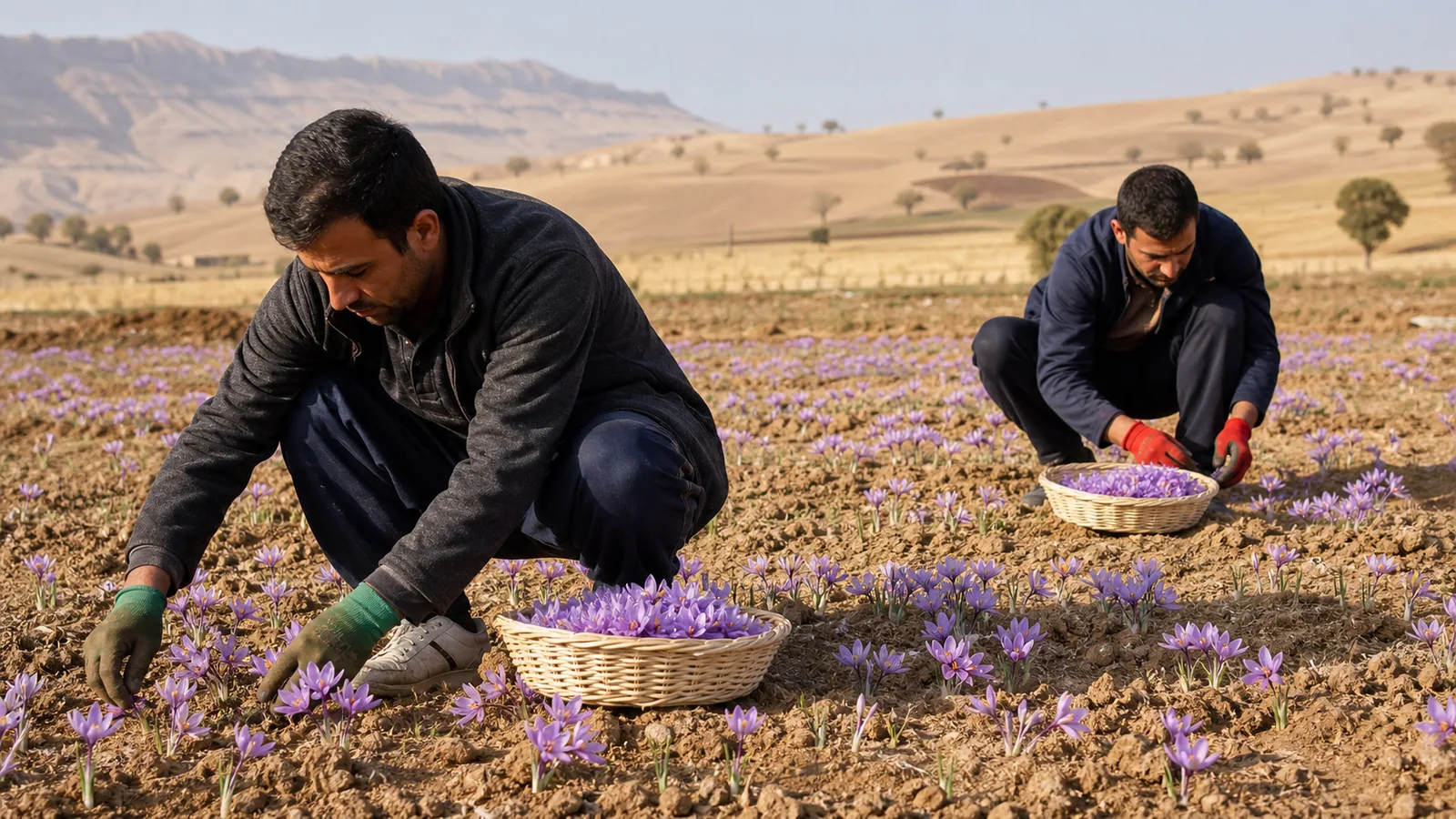
A small Karzan field with four seasons behind it
The farmer, identified as Karaminejad, had devoted 7,000 square metres of family farmland and orchard ground to saffron corms. That is seven-tenths of a hectare. The account said the field had been in saffron for four years and was producing about one kilogram of dried saffron annually.
Those details matter because they describe an established plot, not a new field being judged after its first flowering. Saffron is perennial: corms remain in the soil and produce replacement corms, so the age and condition of a stand can affect flowering. The report did not provide a year-by-year yield record, corm density or field measurements, however. Its one-kilogram figure should be read as the grower’s reported average, not a guaranteed result for another farm.
The original English text also referred awkwardly to using a “basement” to grow saffron corms. That appears to be a translation problem. It does not provide enough information to determine whether the reference was to a lower part of the orchard, a storage space or something else, so it should not be turned into cultivation advice.
What the 20-hectare forecast said
Across Ilam province, the report placed about 20 hectares under saffron in Sirvan, Chardavol and Badreh counties. The forecast was for 22 kilograms of dried stigmas during that harvest.
Dividing the forecast by the stated area gives an implied average of 1.1 kilograms per hectare. This is useful for checking the scale of the figures, but it is still forecast arithmetic. It does not show that every hectare was mature, productive or harvested at the same rate, and the source did not publish a final province-wide total.
Karaminejad’s own reported figures are broadly consistent with that scale: one kilogram from 0.7 hectare works out to about 1.43 kilograms per hectare. It would be misleading to call that a controlled yield comparison. The numerator was an annual average from one holding, while the 22-kilogram provincial figure was a forecast spread across fields of unknown age.
Why field age changes the numbers
A nearby example from the same period shows why acreage cannot be read on its own. An official Ilam agriculture report on Badreh recorded six hectares and a 12-kilogram forecast. It also said the previous harvest had been only six kilograms because many plots were in their first or second year.
That separate report does not replace Karzan’s figures or prove its final yield. It does show that young fields were part of Ilam’s developing saffron area and that output was expected to change as they matured. Weather, corm health, soil and water management, harvest timing and drying practice can introduce further differences.
This is why neither the 1.1-kilogram provincial calculation nor the grower’s 1.43-kilogram calculation should be promoted as a standard for Ilam. They are snapshots from a particular stage of local cultivation.
Karzan was part of a broader crop shift
The importance of the story was not that Ilam had displaced Khorasan as a saffron centre. Twenty hectares remained a modest footprint. What it recorded was successful flowering outside the region most closely associated with Iranian saffron, including a Karzan holding that had stayed in production for several seasons.
Ilam’s agricultural base is much wider than saffron. A later official overview of agriculture in Ilam reported 336,000 hectares of agricultural land and described field crops, horticulture and animal production at provincial scale. Against that background, saffron was a small diversification crop rather than the dominant use of farmland.
For an individual family, though, a plot of 7,000 square metres can still be meaningful. Saffron concentrates its harvest into a short flowering period and turns a small quantity of dried stigmas into the saleable crop. The trade-off is close attention at the busiest moment: flowers need prompt collection, separation and clean handling.
What the beginning of harvest actually involved
The purple flowers marked the start of the most time-sensitive part of the season. Picking is normally done while flowers are fresh, followed by separating the red stigmas and drying them carefully. A field’s planted area therefore tells only part of the story. Labour availability and handling after picking influence how much of the crop reaches a usable condition.
The original report celebrated the flower as the return on a farmer’s work, but it did not document harvest methods, drying temperatures, quality tests or sale prices. None of those details should be inferred from the 20-hectare and 22-kilogram figures.
Likewise, the report’s observation that saffron had adapted despite perceived climatic differences between Ilam and Khorasan was based on local flowering and harvest experience. It was not a province-wide agronomic trial. A successful plot supports further evaluation; it does not remove the need to assess soil, drainage, water quality, local temperature patterns and market access before planting.
Reading the Karzan harvest record accurately
The durable facts are modest but useful: a Karzan grower had maintained 7,000 square metres of saffron for four years and reported roughly one kilogram a year; Ilam’s saffron area in Sirvan, Chardavol and Badreh was put at 20 hectares; and the season opened with a 22-kilogram forecast.
The forecast was not a final harvest result. The implied yields were not controlled comparisons, and the unclear “basement” wording is not a cultivation instruction. Read within those limits, the account captures an early stage in saffron’s development in Karzan and elsewhere in Ilam: small fields, cautious production estimates and farmers learning how the crop behaved under local conditions.

![Exporting Saffron to Turkey + Price Guide [Complete 0 to 100]](https://img.rowhanisaffron.com/20260827003933/saffron-export-turkey-quality-inspection.webp)



