


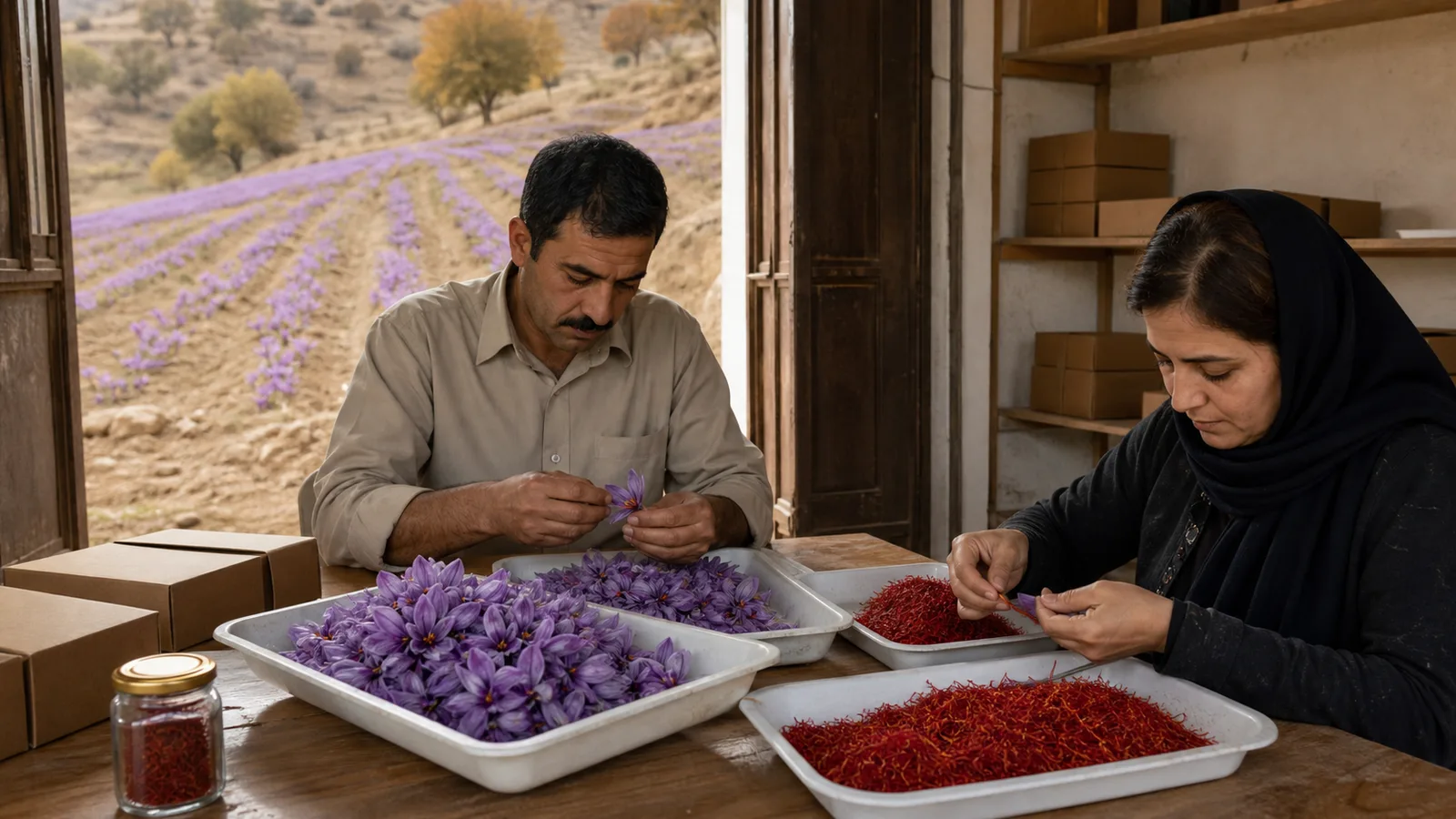
A historical report put saffron production in Lorestan at 1,400 kilograms from 420 hectares. An earlier provincial account recorded 728 kilograms from 218 hectares. Read together, the two snapshots show cultivated area and output growing at almost the same rate while average output remained close to 3.3 kilograms per hectare.
The articles do not identify a precise current crop year, so these figures are not a 2026 production statement. They document how Lorestan’s saffron sector was developing and which marketing and processing gaps officials saw at the time.
From 728 kg to 1,400 kg of saffron
Esfandiar Hassani Moghaddam, a provincial agricultural official, reported 728 kilograms of annual saffron from 218 hectares in the earlier account. Khorramabad was identified as the leading city within Lorestan.
The later report gave 420 hectares and up to 1,400 kilograms annually. Simple division produces an average of about 3.34 kilograms per hectare in the first snapshot and 3.33 in the second. That does not prove every farm held a steady yield: new fields, mature fields and local conditions may differ. It only shows that the reported aggregate area and output expanded proportionally.
Moghaddam said Lorestan had little recorded saffron production about a decade earlier and that provincial development work began around Iranian year 1390. By the later report, several local brands existed, although the official said the sector still needed strengthening.
How the wider agricultural infrastructure matters
The destination article was part of a broader discussion of Lorestan agriculture. It described high output of walnuts, figs, pomegranates, apples and grains alongside a shortage of conversion, processing, packaging and cold-storage capacity.
Not every part of that infrastructure applies to saffron. Dried saffron does not need the same cold chain as fresh fruit, but the underlying issue is relevant: products sold outside the province in bulk retain less local value than traceable, tested and properly packed lots.
The official said private investors could apply for licences in processing and packaging. For saffron, useful capacity would include hygienic stigma separation, controlled drying, moisture-safe storage, lot segregation, testing and packaging that protects the product without obscuring its origin.
The quality claim needs lot evidence
The earlier source claimed Lorestan saffron was superior to saffron from other parts of Iran in quality and taste. It did not identify a laboratory, sample set, test method or competing lots. That statement is therefore retained as an official regional claim, not an established national ranking.
Quality can vary within one province and even within one farm. Buyers should examine thread composition, aroma, moisture, cleanliness, traceability and agreed laboratory results for the lot being offered. ISO 3632-1:2025 covers dried saffron in filament, cut-filament and powder forms and provides a common specification framework.
Historical and health claims in the archive
The source described saffron cultivation as roughly 3,000 years old. This is a broad history-of-use statement, not evidence that Lorestan itself has an unbroken 3,000-year production record.
It also claimed saffron would reduce depression and aggression if widely consumed. No clinical evidence, dose, population or safety context was supplied, so that directive medical claim is not repeated. A regional production article should not turn a crop-promotion interview into treatment advice.
Interpreting the global figures
Moghaddam’s interview gave approximately 110,000 hectares under saffron worldwide, 107,000 of them in Iran, and said Iran produced about 87 percent of global saffron while holding about 3 percent of its trade. These are dated, attributed figures and the source does not define “share of trade” by value, volume, brand ownership or another measure.
The same account called Lorestan’s 218 hectares and 728 kilograms about 2 percent of Iran’s cultivated area and production. That percentage is incompatible with its own 107,000-hectare national figure: 218 hectares is far below 2 percent of 107,000. The statements should not be used together as a precise market-share calculation.
For current trade analysis, UN Comtrade can be filtered by saffron product classification, reporting country, partner and period. Production area requires a current agricultural source using the same crop-year and geography definitions.
What sustainable growth would require
The reported doubling of area and output gave Lorestan a larger base, but more hectares alone do not guarantee more value. The sector also needs:
- healthy, identifiable corms and field records;
- training for harvest and stigma separation;
- controlled drying and moisture-safe storage;
- lot-specific testing and traceability;
- packaging suited to the customer and sales channel;
- market access that does not erase Lorestan origin.
For comparison with other historical Iranian regions, see this regional saffron production overview. The same rule applies in every province: keep forecast, final output, cultivated area and tested quality separate.
References: ISO 3632-1:2025 saffron specification; UN Comtrade trade-data explorer. Lorestan production and market-share figures are retained as dated, attributed evidence from the two archived posts consolidated here.

![Exporting Saffron to Turkey + Price Guide [Complete 0 to 100]](https://img.rowhanisaffron.com/20260827003933/saffron-export-turkey-quality-inspection.webp)



