


The beginning of harvesting 2,500 kg of saffron in the city of Natanz was announced on 27 October 2020. Saeed Zamani, then director of Natanz Agricultural Jihad, said 332 hectares had entered harvest and the season would create about 16,000 person-days of work.
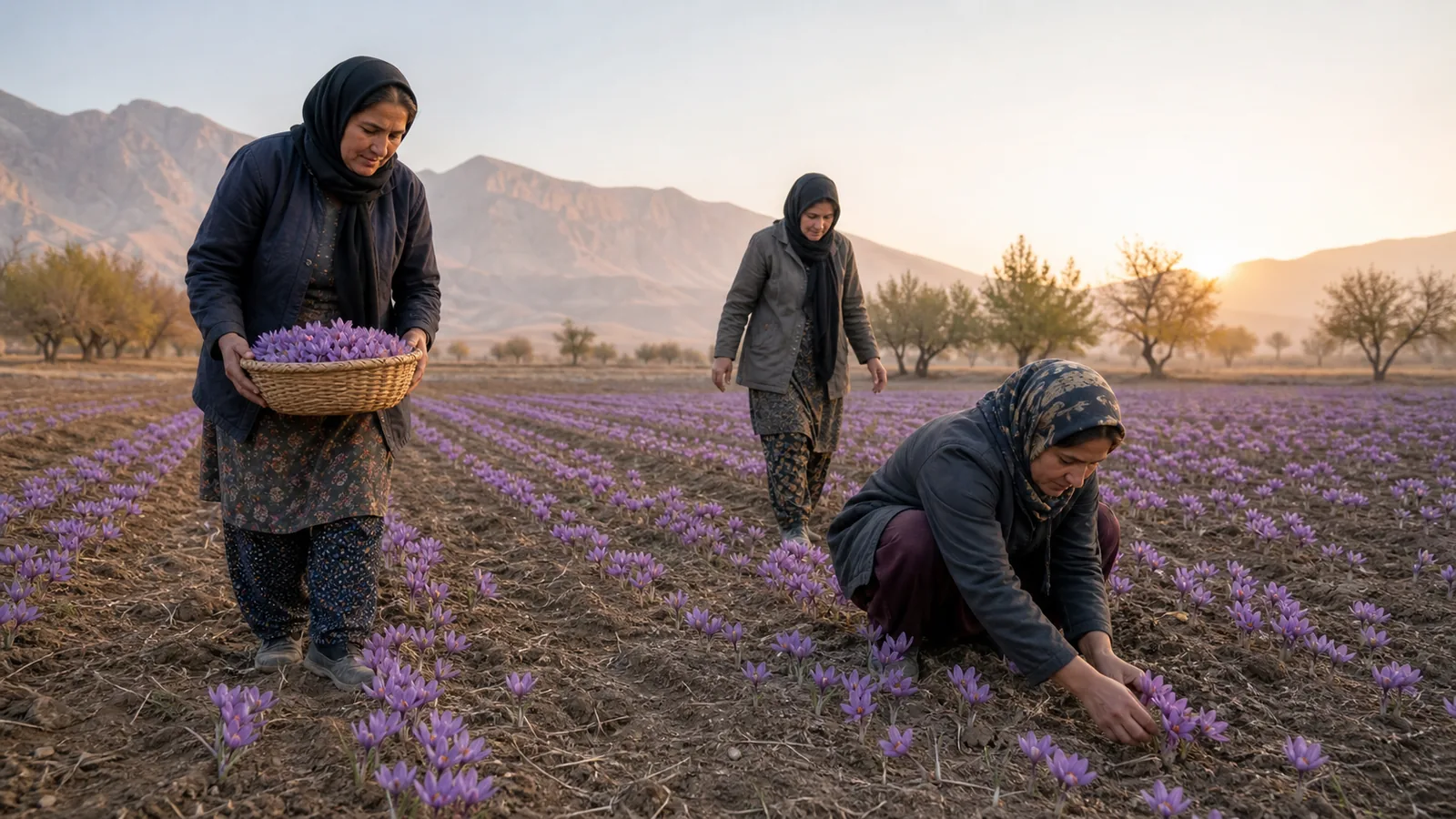
The 2,500-kilogram figure was a harvest forecast
Zamani expected the 332 hectares of saffron farms to produce 2,500 kilograms of dried stigmas. That was a forecast made as picking began, not a final measured total.
Dividing the forecast by the planted area gives an implied average of about 7.5 kilograms of dried saffron per hectare. This is a derived planning figure, not a claim that every field produced the same yield. Farm age, corm size, planting density, irrigation, soil, temperature and field care can create large differences within one county.
The original report called Natanz first in Isfahan Province for both saffron production and cultivated area at that time. It did not claim the county ranked first nationally.
Harvest ran across several Natanz climates
The old English post says work would continue “until the end of December.” The official Persian report says until the end of Azar, the ninth Iranian month, which ends around 21 December. That is a meaningful correction: Azar is not identical to the Gregorian month of December.
Zamani said the harvest lasted about two and a half months because saffron farms were spread across cold, temperate, and hot and dry parts of Natanz and Badroud. Flowers do not emerge everywhere on the same morning when elevation and local climate differ.
The staggered season can distribute labour over a longer period, but each individual field still has a short peak. Flowers need to be collected promptly, and the stigmas must be separated and dried with care.
What the official Natanz report recorded
The Iranian Agriculture News Agency’s dated account provides the missing context behind the archived translation. Its Natanz saffron harvest report names Zamani, gives the 332-hectare area and 2,500-kilogram forecast, and dates the announcement to 6 Aban 1399.
It also explains that the 16,000 employment figure was measured in person-days over the flower harvest and stigma-separation period. The English version incorrectly turned this into 16,000 people employed at one time.
A person-day means one person working for one day. The same seasonal worker may account for several person-days, so the figure cannot be converted into a headcount without attendance records.
Rural women carried much of the seasonal work
Zamani said the roughly 16,000 person-days of seasonal work were performed mainly by rural women. Their labour covered flower picking and the careful separation of stigmas during a period of about two and a half months.
This work is central to the value of the finished spice. Picking too late, crushing flowers in deep containers, leaving them warm for too long or drying the stigmas unevenly can reduce quality. A production forecast tells only part of the story; the handling between field and dry saffron determines what can actually be sold.
Seasonal employment also needs to be described honestly. It brings concentrated income during harvest but does not necessarily provide year-round work. The person-day unit is the most accurate way to preserve Zamani’s claim.
Why saffron cultivation expanded in Natanz
Zamani connected the larger cultivated area with several local conditions: smaller landholdings, saffron’s relatively low water requirement, work that farmers could fit around other activities, and interest among growers in Badroud and its surrounding villages.
The old English version also refers to a better purchase price and easier cultivation than other products. Those advantages are not automatic. Establishing a saffron field requires healthy corms, suitable soil preparation and capital; harvesting and separation remain labour-intensive. The economic comparison depends on yield, labour cost and the price available in that season.
“Low water” should not become “no water.” Saffron needs timely irrigation and adequate soil moisture at key stages. FAO’s account of Iran’s qanat-based saffron farming system describes the crop as suitable for a water-scarce region while still placing it inside a managed irrigation system.
Mountain cultivation and the move toward Badroud
Zamani said saffron had a long history in Natanz’s mountainous areas. The crop was also receiving a positive response in the more desert-like Badroud section because of its relatively modest water demand.
Expansion into a different local climate should not be based on drought tolerance alone. Soil drainage, salinity, irrigation-water quality, winter chilling, summer heat, corm health, labour and market access all matter. A field that survives is not necessarily a field that produces a profitable dry-stigma yield.
The range of climates within the county helps explain the extended harvest calendar, but it also means one set of irrigation or planting advice may not suit every Natanz farm.
Credit and support were part of the development plan
The director said authorities had tried to provide facilities and support to active farmers so saffron cultivation could develop further. The report does not state the loan amount, interest rate, eligibility rules, uptake or repayment outcome.
That missing detail matters. Credit is useful when it helps a grower improve corm quality, irrigation, field management, hygienic drying or storage. It can become a burden if production or selling prices fall. The historical statement records an intention to support development, not proof that every applicant received suitable finance.
What the Natanz harvest figures mean today
The 332 hectares, 2,500-kilogram forecast, provincial first-place statement and 16,000 person-days belong to the 2020 harvest announcement. A later year may have a different area, yield, labour requirement and ranking.
Read in its own period, the report gives a useful picture of Natanz saffron: production spread from mountain settlements toward Badroud, a harvest stretched across several climates, substantial seasonal work led mainly by rural women, and a crop chosen partly because water was constrained.
The headline’s “2,500 kg” should therefore remain what Zamani intended—a forecast at the beginning of one harvest. The lasting lesson is how much timing, labour and local adaptation sit behind that compact number.

![Exporting Saffron to Turkey + Price Guide [Complete 0 to 100]](https://img.rowhanisaffron.com/20260827003933/saffron-export-turkey-quality-inspection.webp)



