


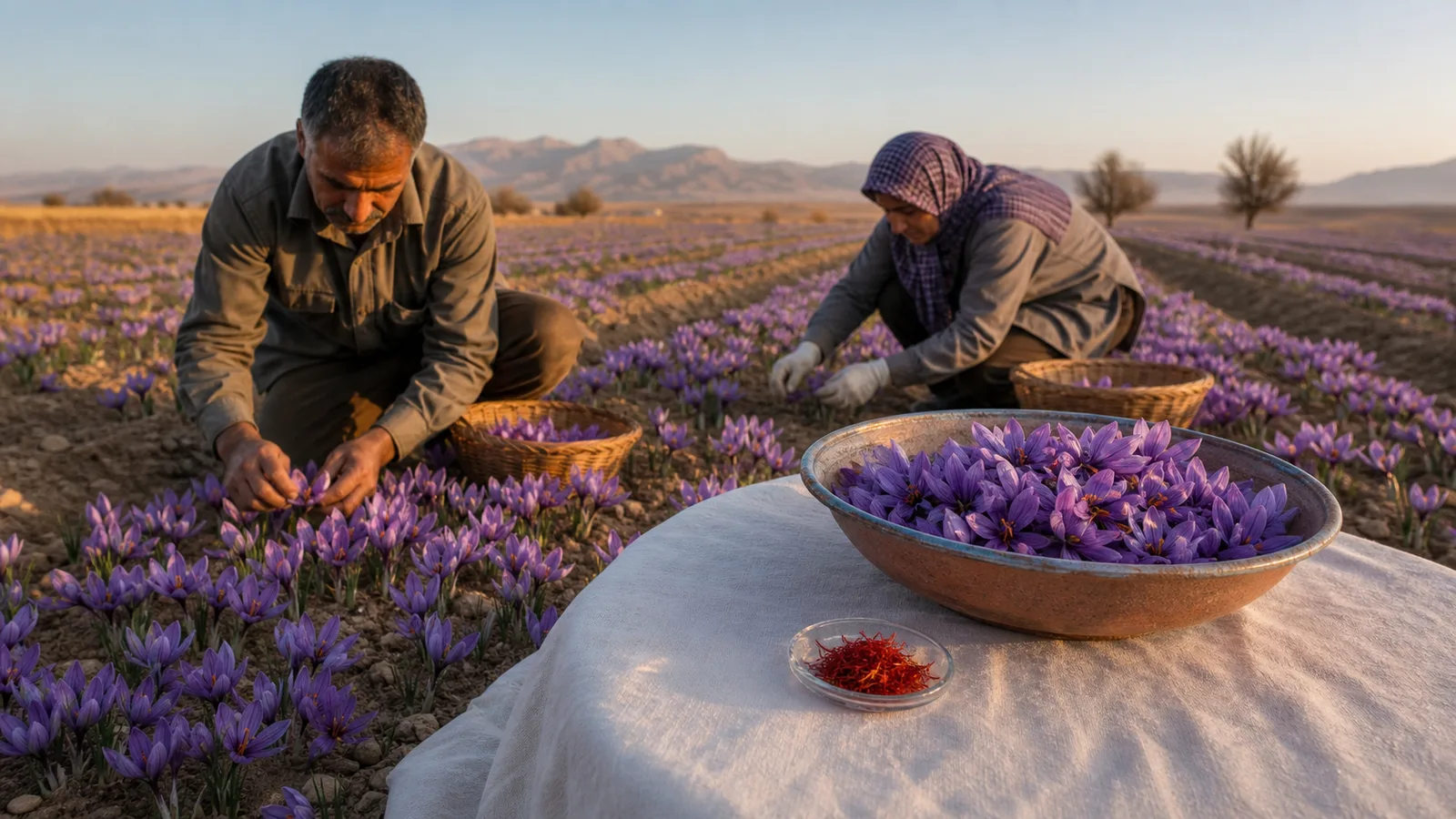
Saffron production in Iran extends beyond the best-known fields of Khorasan. Historical agricultural reports from Hamadan and Markazi show how smaller producing provinces were expanding cultivation, while a Khorasan Razavi report provides the scale of the country’s established production centre.
The figures below belong to specific crop years reported between 2014 and 2016. They are useful regional snapshots, not current national statistics. Production area, yield and exports should always be compared within the same geography and crop year.
Hamadan’s 172-kilogram production forecast
The original Hamadan report forecast 172 kilograms of dried saffron for the coming crop year from 53 hectares. It said the previous year had produced 162 kilograms from 48 hectares. The awkward word “massacre” in the old English title was a translation error; the article concerned a harvest forecast.
Rahim Bayat, then identified as a provincial horticulture official, said saffron was being grown across Hamadan and mentioned development in Nahavand and Tuyserkan. The report referred to a planned cultivation area of about 20 hectares in one local project, but its wording does not establish a province-wide expansion total.
The article also described saffron as a multi-year crop whose useful field life depends on corm health and management. Planting can require substantial investment in corms during the first year, while flower picking and stigma separation create a concentrated demand for labour during harvest.
What the Hamadan account says about cultivation
The archived report placed Hamadan’s harvest during October and described a crop cycle that is active through the cooler part of the year. Exact timing varies with altitude, temperature and the season, so a historical provincial date should not be treated as a universal calendar.
It also mentioned soil, irrigation, rodents, fungal disease and post-harvest drying as yield and quality concerns. The original machine translation included pesticide and fungicide directions without naming a product, dose or current approval. Those directions are not repeated. Growers should use current local agronomic and pesticide guidance for their field and jurisdiction.
The report compared rapid controlled drying with a much slower traditional process. Its exact 30–60-minute and 8–12-day figures were not tied to temperature, humidity, load size or a documented method, so they cannot serve as operating instructions. The safe principle is to use a validated process that dries separated stigmas hygienically without burning them or leaving excess moisture.
Several numbers in the old translation conflict internally. It reported only 60 tonnes for national production in the same discussion that assigned much larger regional shares, and it mixed acres and hectares in its corm and yield figures. Those values are not presented as reliable statistics here.
Markazi province: a smaller growing region
Two assigned source posts are near-duplicates of the same interview with Ali Asghar Zarei of the Markazi Province agricultural organisation. They are consolidated once rather than repeated.
Zarei reported 85 hectares under saffron and expected another eight hectares to be added. The previous harvest was given as 255 kilograms, or an average near three kilograms per hectare. Khomein had the largest reported area at 21 hectares, followed by Delijan with 15 and Mahallat with 11.
The translated report described planting from 10 September to 10 October and a roughly 20-day harvest beginning in November. These dates reproduce the archived English account; local calendar conversion and yearly weather can shift the practical schedule.
Some planting corms were produced within Markazi, while others came from South Khorasan and Khorasan Razavi. Zarei promoted saffron as an option for areas facing water scarcity and said local quality could compete with Khorasan. Lower water demand than some alternative crops does not mean water-free production, and a regional quality claim still needs lot-specific sensory, physical and laboratory evidence.
Khorasan Razavi’s 2013–14 crop-year snapshot
The Khorasan source covers the Iranian 1392–93 crop year, corresponding broadly to 2013–14. A provincial horticulture official reported more than 263 tonnes of dried saffron, an increase of more than 30 percent from the previous crop year.
Reported cultivation area rose from about 61,000 to more than 65,000 hectares. Approximately 70 tonnes were said to have been exported through Mashhad. The official attributed part of the increase to technical cultivation practices and timely access to inputs.
At that time, the report assigned more than 70 percent of national production to Khorasan Razavi and named Zaveh, Torbat Heydarieh and Roshtkhar among its leading production areas. These are historical administrative figures; they should not be used as a current market-share statement without a newer official dataset.
How the three regional accounts fit together
The numbers differ in scale, but the provinces were not being measured for the same purpose. Khorasan Razavi was reporting a mature production base measured in tens of thousands of hectares and hundreds of tonnes. Markazi was documenting an emerging 85-hectare sector. Hamadan was forecasting 172 kilograms from 53 hectares.
That contrast explains why one national total cannot simply be reconstructed by adding the articles. They come from different crop years, some values are forecasts, and the original translations sometimes confused hectares, acres, tomans and dollars.
For a sound regional comparison, record:
- the exact province or county and crop year;
- planted area versus area actually harvested;
- fresh flower weight versus dried stigma output;
- forecast production versus final measured production;
- yield per hectare and the method used to calculate it;
- volume exported, consumed locally, stored or carried forward.
History, origin and regional identity
The Hamadan source linked local saffron history to the Median period and to place names in the province. It provided no archaeological or linguistic evidence for that claim, so it is retained only as local historical commentary.
The same post called Iran and China the plant’s original home. Current Kew taxonomy instead treats Crocus sativus as an accepted cultivated species, a tuberous geophyte whose native range is recorded as a cultigen from Greece, with Iran listed among its introduced areas. That botanical record does not diminish Iran’s long cultivation history, but it does mean the old origin sentence should not be stated as settled fact.
Quality after the harvest
Regional reputation alone does not define a lot. Picking time, separation of stigmas, drying, moisture control, storage and protection from adulteration all influence the finished spice. The current ISO 3632-1 specification covers dried saffron in filament, cut-filament and powder forms and gives buyers and producers a shared basis for product requirements.
A buyer comparing Iranian regions should therefore ask for the crop year, actual origin, lot traceability and agreed test evidence. The historical provincial numbers explain where production was developing; the supplied lot determines what the buyer receives.
References: Kew Plants of the World Online: Crocus sativus; ISO 3632-1:2025 saffron specification. Regional figures are retained as dated, attributed evidence from the four archived posts consolidated here.

![Exporting Saffron to Turkey + Price Guide [Complete 0 to 100]](https://img.rowhanisaffron.com/20260827003933/saffron-export-turkey-quality-inspection.webp)



