


Iran was described as the world’s largest saffron consumer in an archived National Saffron Council interview, while some African markets—Ghana was the example—were said to have little awareness of the spice. The contrast is useful, but the figures were industry estimates from a particular period. They should not be read as a current league table of national consumption.
Ali Hosseini, identified in the source as a council member, put annual world saffron consumption near 300 tonnes. He said Iran’s population was about 75 million and domestic use roughly 40 tonnes a year. On those assumptions, consumption works out to just over half a gram per person, which is why he called Iran the largest per-capita consumer.
The interview also attributed about 50 tonnes of annual consumption to the United States and named 40–50 countries as meaningful markets. These claims are preserved because they explain the original article, not because they have been independently validated for the present day.
What “largest consumer” meant in the source
There are two different ways to describe a large market: total national volume and consumption per person. A populous country can buy more in total while using less per resident. The archived statement appears to make a per-capita claim for Iran, based on the 40-tonne and 75-million-person estimates.
The calculation is plausible as arithmetic: 40 million grams divided by 75 million people is about 0.53 grams per person per year. It is not proof that every household buys saffron or that consumption is evenly distributed. Restaurant use, food manufacturing, gifts, household traditions and income can concentrate demand.
The US figure raises another distinction. A country can import saffron for domestic sale, industrial use, stock or re-export. Import quantity does not automatically equal final consumption. Reliable market analysis keeps customs movement, business inventory and consumer use separate.
The markets named in the historical interview
Hosseini listed Italy, Spain, France, Germany, Canada and Australia among established saffron-consuming countries. In Asia and the Middle East, he named Saudi Arabia, the United Arab Emirates, Bahrain, Kuwait, Jordan and Oman.
The report said Iranian saffron had often reached the United States through Spain and Italy during years when sanctions constrained direct access. It also noted limited saffron production in India and Greece. These were historical observations about trade routes and supply; they do not establish the origin of every pack sold in those markets today.
Origin can be obscured when bulk saffron is repacked abroad. A packer’s country is not necessarily the harvest country. Buyers who care about Iranian origin need lot-level traceability, harvest and processing records, and documents that follow the same goods through packing.
Why Ghana was described as an unfamiliar market
The original headline’s difficult phrase “African unidentified red gold” came from the claim that people in countries such as Ghana did not know saffron. That is too broad if treated as a fact about an entire population. A more careful reading is that the council saw low product awareness and little established saffron trade in the market channels it knew.
A market can be small for several reasons. The spice may not have a familiar role in local cooking. Retail distribution may be limited, the price may be high relative to customary ingredients, or consumers may not trust an unfamiliar product. A lack of measured imports can also reflect incomplete classification or informal trade rather than complete absence.
It would be a mistake to treat “Africa” as one market. Ghana, Egypt and the many other countries on the continent have different cuisines, incomes, food rules, retail systems and trade links. The source itself said Egypt had a small share, which already shows that its broad wording did not describe every African country in the same way.
How to verify saffron demand by country
National consumption is rarely available as one clean official number. A practical study starts with several types of evidence:
- official import and export quantities for the relevant product classification;
- domestic production where it exists;
- stock changes and re-exports, if those data are available;
- retail pack availability, price and distribution;
- food-service and manufacturing use; and
- interviews or surveys that distinguish awareness from actual purchase.
The United Nations’ UN Comtrade platform provides official merchandise-trade records reported by countries. It can help compare recorded flows over time, but it does not directly measure what households consumed. The product code, reporter, partner, period and unit must all be documented before two markets are compared.
Very small quantities require extra care. One large commercial shipment can make a yearly series look like a surge, and a missing record does not prove that no saffron was sold. Weight and trade value should be reviewed together, with obvious anomalies checked against the reporting notes.
Market awareness is not created by a slogan
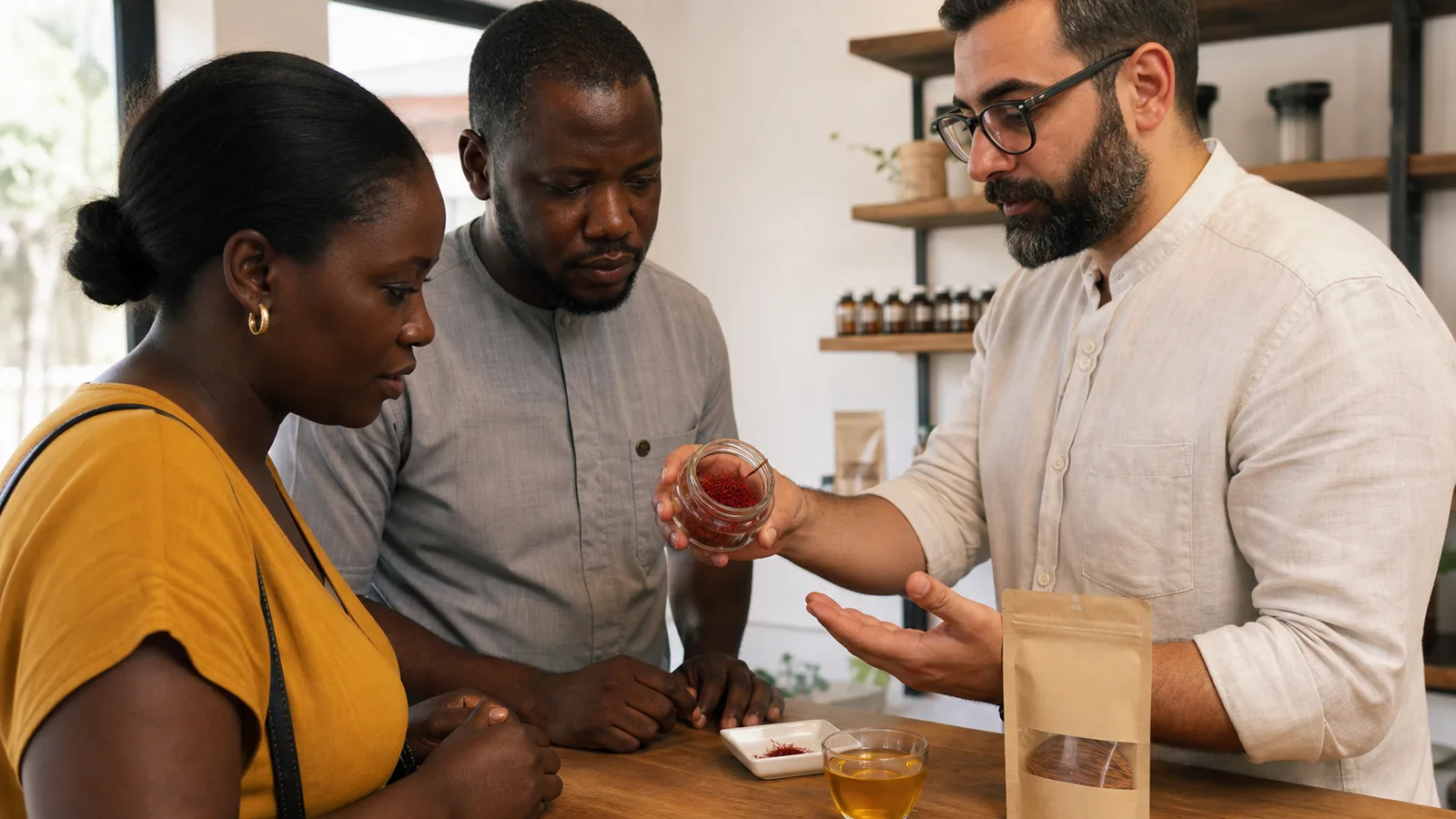
Calling saffron “red gold” may be familiar within the trade, but it does not tell a new customer what to do with it. In a less familiar market, the useful introduction is practical: what genuine threads look and smell like, how little is needed, how to bloom them, and which local dishes or drinks can accommodate their flavour without pretending they have always belonged there.
Education should also set boundaries. Saffron has culinary and cultural importance, but it should not be promoted with promises to treat disease. “Organic” should appear only when the product and supply chain meet the applicable certified standard. These details matter more in a new market, where one misleading claim can damage trust in the category.
Pack size can reduce the first-purchase barrier. A small, well-protected pack lets a customer try a real recipe without paying for more than they need. The price per gram may be higher than a bulk pack, but the cash cost and waste risk are lower.
A responsible market-entry test
An exporter considering Ghana or another less-established destination should begin with a bounded test rather than a countrywide assumption. Choose a specific customer group—perhaps independent restaurants, specialist grocers or home cooks already buying premium spices—and learn how they currently shop and cook.
Use one traceable lot and a small number of pack sizes. Provide clear English labelling where appropriate, accurate preparation guidance and a way to report questions. Record repeat purchases, not just samples distributed or social-media interest. A second order is stronger evidence of demand than curiosity at a tasting.
The local importer should confirm food-registration, labelling, customs and tax requirements before goods are shipped. Commercial terms need a named delivery point, responsibilities for clearance and a plan for products that are delayed or rejected. No historical list of consuming countries can replace that work.
What established markets can still teach
Iran’s domestic familiarity with saffron supports frequent culinary use, but it cannot simply be copied elsewhere. Spain, Italy and Gulf markets likewise have their own recipes, trade structures and customer expectations. Their value lies in showing how usage knowledge, trusted retail channels and consistent supply reinforce each other.
For a seller, the durable objective is not to make every country consume half a gram per person. It is to find a real use, present a verified product and build repeat demand at a scale the supply chain can serve. Our guide to working with a saffron exporter explains the documentation and lot questions that protect both sides of that relationship.
The archived interview captured a meaningful contrast: saffron was woven into everyday food culture in Iran yet remained unfamiliar in some potential markets. Its numerical ranking is uncertain and dated. The better lesson is to measure demand carefully, avoid continental generalisations and earn awareness through useful cooking knowledge, traceability and honest claims.

![Exporting Saffron to Turkey + Price Guide [Complete 0 to 100]](https://img.rowhanisaffron.com/20260827003933/saffron-export-turkey-quality-inspection.webp)



