


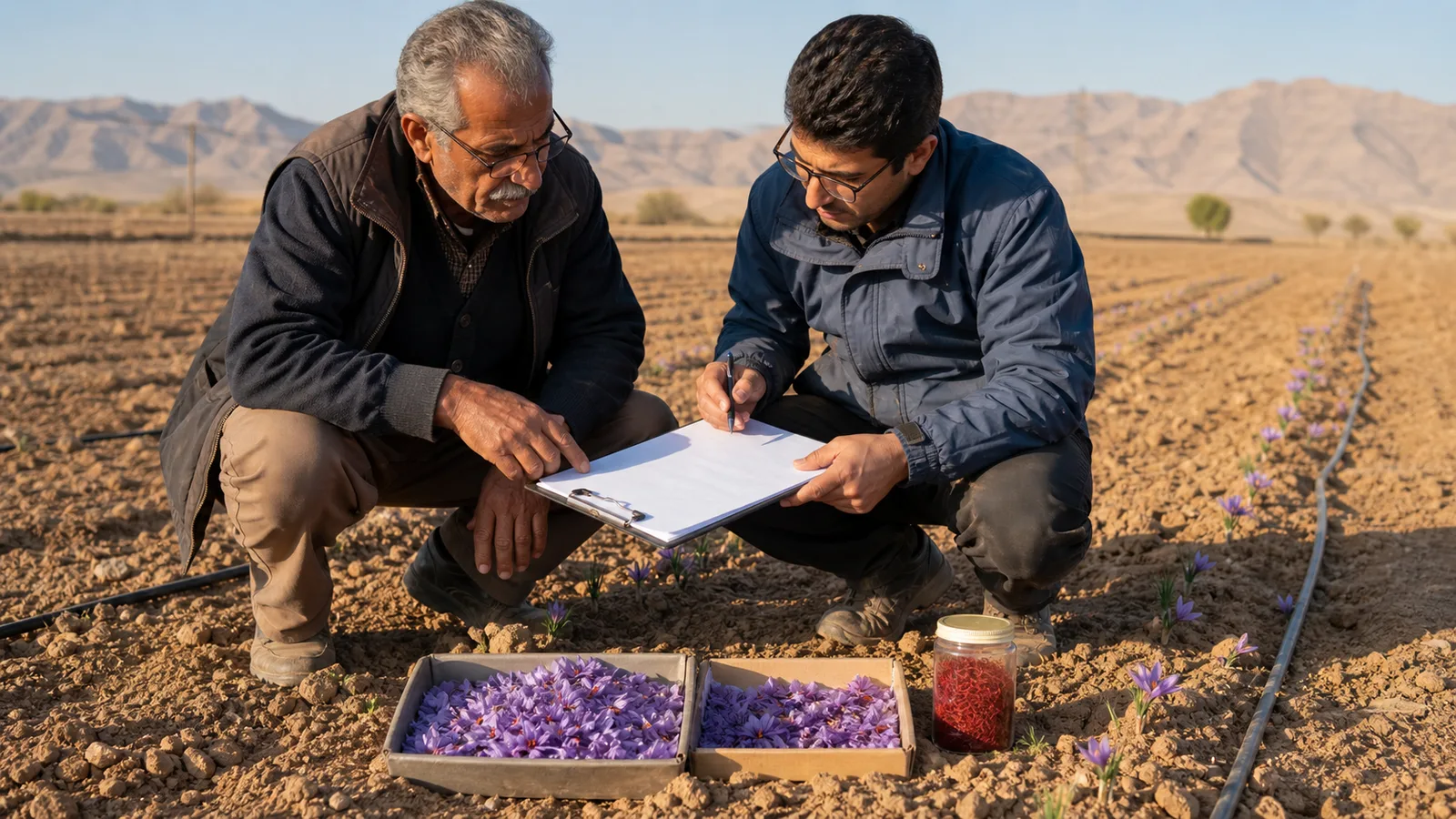
“The world needs 300 tons of Iranian saffron” was a market estimate, not a measured annual requirement. In the archived interview, National Saffron Council member Ali Hosseini used the 300-tonne figure to argue that new planting had to follow real demand. His concern was simple: expanding fields without developing customers could leave growers producing more than the market would absorb at a sustainable price.
Hosseini said saffron cultivation had spread into Kerman, Yazd and Fars as farmer interest grew. Razavi Khorasan and South Khorasan remained the two largest producing provinces, with more than 80,000 hectares between them. Because saffron needs relatively little water compared with many crops, it was being considered in water-constrained areas.
The figures belong to the period of the report. They should not be treated as current acreage, production or demand.
How the 300-tonne argument was constructed
The source combined three claims. First, it placed world saffron demand at about 300 tonnes. Second, it forecast Iranian output at roughly 300 tonnes for that year. Third, it described average Iranian field yield as 3.5–4 kilograms per hectare.
Hosseini then used a yield scenario for the two Khorasan provinces. If more than 80,000 hectares produced an average of 5 kilograms per hectare, their output alone would reach about 400 tonnes. The arithmetic explains why he called for marketing and market development before cultivation expanded further.
None of those numbers proves a fixed global ceiling. Demand changes with price, inventory, food manufacturing, restaurant activity, household use and the amount carried over from previous harvests. A round forecast from an industry interview is best read as a planning warning.
Why average yield needs context
An average of 3.5–4 kilograms per hectare can hide enormous variation. The report said some Iranian farmers achieved 10 kilograms and exceptional growers even reported 40 kilograms per hectare. Those high figures should not become general promises.
Field age, corm health and density, soil, drainage, irrigation timing, autumn temperature, flower-picking speed and stigma drying all affect the measured result. The denominator matters too: a demonstration plot, a fully established field and a whole farm can produce very different “per hectare” figures.
A grower considering a 5-kilogram target should start with records from comparable local fields. The useful baseline is several seasons of saleable dried saffron, not a single best plot or the wet weight of flowers.
Low water does not mean no water planning
Saffron’s seasonal pattern makes it attractive in dry regions, but “needs very little water” is too simple. Establishment and flower initiation still depend on suitable soil moisture and irrigation timing. Water quality, drainage and the field’s other uses matter as much as annual volume.
A crop can also be poorly suited to a site for reasons unrelated to water. Heavy or poorly drained soil raises corm-disease risk. A shortage of labour during the short flowering window can leave flowers unpicked. Inadequate separation and drying capacity can reduce quality after a good field harvest.
Expansion therefore needs a whole-system budget: corms, land preparation, water, labour, drying, testing, packaging, storage, finance and a realistic sales route.
What market development should measure
“Marketing” in this context should not mean more promotional language. Before planting, a producer group needs evidence about:
- which saffron form and grade a buyer uses;
- annual and seasonal purchase quantities;
- test, traceability and packaging requirements;
- delivery terms, payment timing and rejection risk;
- the buyer’s alternative origins and substitute products; and
- what portion of the forecast volume is covered by credible orders.
An exhibition enquiry or sample request is not contracted demand. A prudent plan separates confirmed orders, repeat buyers, qualified prospects and speculative market size.
Trade data does not equal world consumption
Official customs data can show recorded imports and exports under a product classification. The UN Comtrade platform is one source for country-reported merchandise trade. It cannot, by itself, reveal exact global consumption.
Some saffron is re-exported after packing, some remains in inventory and some is produced and consumed domestically. Reporting practices and revisions also differ. Adding every country’s imports can double-count the same lot as it moves through a trading hub.
A better estimate combines trade flows with production, re-export, inventory and market-channel evidence, and keeps the year attached to every figure.
When additional hectares make commercial sense
New cultivation is easier to defend when the field is agronomically suitable, corm material is healthy, labour and drying capacity are available, and the expected saleable crop has a buyer or a conservative route to market. It should also survive a lower-yield and lower-price scenario.
At a cooperative level, expansion can be staged. A small first area tests field performance and post-harvest handling. The next stage follows only after buyers accept the product and payment arrives as agreed. That approach is slower than planting toward a headline demand number, but it gives growers evidence they can use.
Existing fields may offer the first opportunity. Better flower collection, separation hygiene, controlled drying and lot segregation can increase saleable quality without adding hectares. A buyer may pay more for consistency and documentation than for an undifferentiated increase in volume.
The 300-tonne figure as a warning, not a target
The historical estimate placed Iranian supply and world need at the same round number. If both were literally correct, a rapid move toward 400 tonnes would create obvious pressure unless demand, inventory or market share changed. That is the logic behind Hosseini’s call for precise cultivation planning.
It does not follow that Iran should never produce more than 300 tonnes, or that every additional hectare is harmful. Nor does it prove that global demand is still 300 tonnes. The useful conclusion is that production forecasts and sales evidence must be reviewed together.
Our guide to saffron cultivation in Iran places acreage and output figures alongside their dates. For an individual farm, the decision remains local: establish a credible yield range, cost the entire harvest chain, identify the specification a real buyer wants, and expand only when the downside remains manageable.

![Exporting Saffron to Turkey + Price Guide [Complete 0 to 100]](https://img.rowhanisaffron.com/20260827003933/saffron-export-turkey-quality-inspection.webp)



