


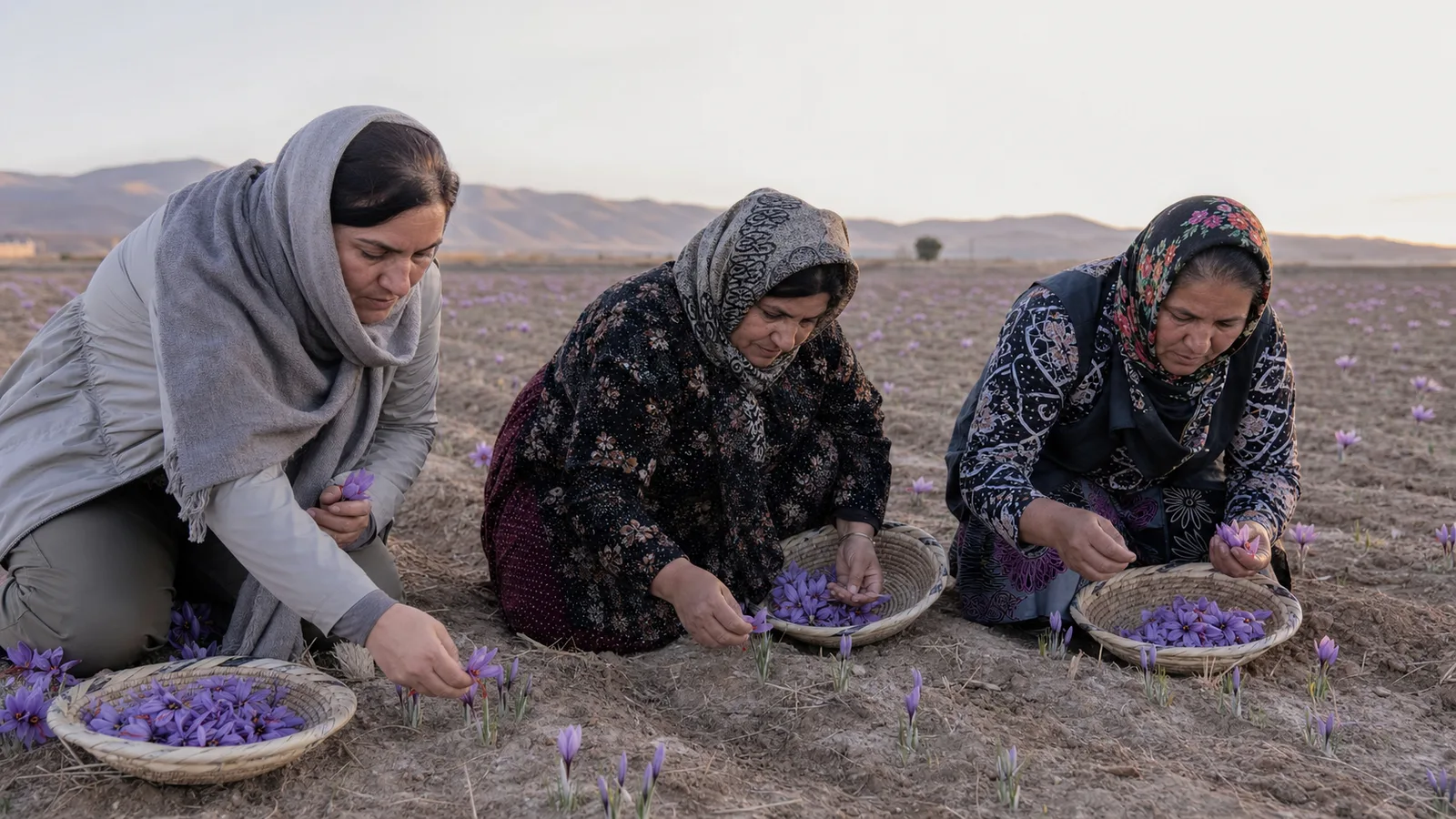
Norwegian ambassador Aud Lise Norheim joined saffron farmers in Ark village, Khusf County, during a visit to South Khorasan in November 2015. She entered the field during the harvest, picked flowers alongside rural women and shared a saffron breakfast with villagers. The occasion offered a close view of work that is usually reduced to one line on a package.
The original machine translation rendered her name as “Odyssey morning Nvrhym” and the village as “arches.” The Persian report identifies Aud Lise Norheim and Ark village in Khusf. Keeping those corrections matters because this is a record of real people and a real place, not a generic ambassadorial visit.
A morning with the saffron farmers of Khorasan
Saffron flowers are normally collected early, before stronger sun and handling reduce their condition. The pace is set by the crop: flowers emerge over a short autumn period and need to move quickly from field to separation.
For the women who hosted the ambassador, picking was only the visible first step. Each flower contains three red stigmas. These are separated by hand, dried under controlled conditions and protected from moisture, light and contamination. Delays between picking and separation can make the work harder and affect the finished lot.
A visitor carrying a small basket experiences the concentration the task requires, but not the whole economic burden. Families organise labour before dawn, manage repeated picking rounds and continue processing after the field work ends.
Ark village and Khusf
Ark lies in Khusf County, west of Birjand in South Khorasan. The region’s dry climate and sharp temperature changes form part of the setting in which saffron became an important rural crop.
The historical report presented the visit as the start of Norheim’s trip to Khusf. Sharing breakfast in the village placed local hospitality beside production. That detail is more than decoration: food, farming knowledge and community identity meet in the saffron harvest.
Diplomatic visits do not prove a trade agreement or create export demand by themselves. Their value is in attention and exchange. A serious follow-up would connect farmers, processors and buyers around traceability, quality evidence, working conditions and a viable price.
How much saffron the report attributed to Iran
The article said Iran produced about 300 tonnes and supplied 92% of the world’s saffron. Those were period estimates. They should not be used as current production or market-share figures without a dated source and a clear method.
It also said Iranian saffron cultivation went back more than 3,000 years. Saffron has a deep cultural history across Iran and the wider region, but a precise single starting date is difficult to establish from this news item. The safer conclusion is that cultivation and use are longstanding, not that this report proves an exact age.
What is well supported is Khorasan’s continuing importance. The UN Food and Agriculture Organization recognises the qanat-based saffron farming system in Gonabad as a Globally Important Agricultural Heritage System. Its description links saffron, limited water, livelihoods, biodiversity and long-established irrigation knowledge.
The famous 170,000-flower figure
The source said roughly 170,000 flowers were needed for one kilogram of dried saffron and associated the work with about 40 labour hours. The flower count is a useful illustration, not a universal conversion.
Flower size, stigma length, moisture at weighing, separation style and finished-product specification all change the ratio. Labour time also depends on field density, travel, picking method, worker experience and whether separation and drying are included.
For a real lot, the processor should record flower weight, fresh stigma weight, dried weight, labour time and losses. Those measurements are more useful for costing than repeating a global average.
Why women’s work should remain visible
The original report specifically placed the ambassador alongside rural women. That contribution should not disappear behind a general phrase such as “farm labour.” In many saffron communities, women take part in picking, stigma separation, drying preparation and household-level quality decisions.
Visibility is not the same as fair value. A responsible supply chain asks who performs each task, how time is recorded, how workers are paid, and whether equipment and workspace protect health and product hygiene. A photograph of harvest participation can open that conversation; it cannot answer it.
What a field visit should examine
A useful visit goes beyond posing among flowers. Visitors can ask to follow one identifiable lot through the day:
- when and where the flowers were picked;
- how baskets are kept clean and protected;
- how quickly flowers reach the separation room;
- who separates the stigmas and under what conditions;
- how temperature, time and final dryness are controlled; and
- how the dried saffron receives a lot number and storage record.
That sequence turns a memorable harvest scene into evidence about quality and provenance. It also lets a buyer see which improvements would genuinely help rather than imposing equipment or packaging that does not fit the village workflow.
Saffron’s value is built after the flower is picked
The original post called saffron “red gold” and one of the world’s most expensive agricultural products. Its price reflects scarcity and labour, but high value is not automatic. Threads can lose aroma, absorb moisture or become mixed if handling is poor.
Flavour, aroma and colour make saffron useful in food. Historical medicinal use should not be turned into a treatment promise, and the vague reference to chemical applications does not establish a safe use. Product purpose and destination rules must be clear.
Norheim’s morning in Ark remains valuable because it brought international attention to the people behind Khorasan saffron. The complete story is not that an ambassador picked a few flowers. It is that a short-lived crop depends on coordinated human work—from the first pre-dawn basket to a dry, traceable lot that carries the village’s effort without hiding it.

![Exporting Saffron to Turkey + Price Guide [Complete 0 to 100]](https://img.rowhanisaffron.com/20260827003933/saffron-export-turkey-quality-inspection.webp)



