


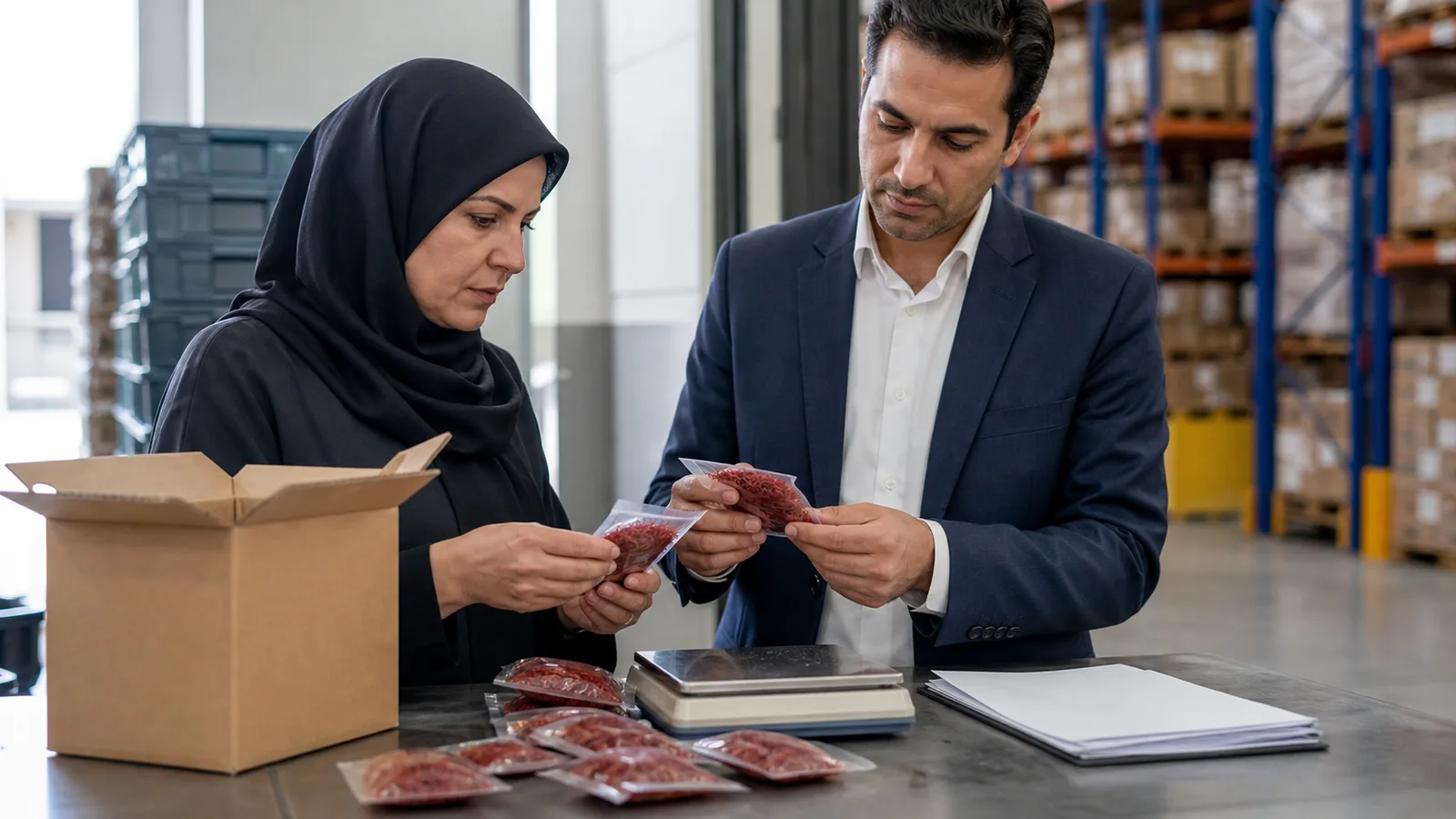
A historical customs report placed exports through Razavi Khorasan at more than one billion dollars in the first eight months of the year, with packaged saffron among the province’s principal export goods. The headline connected the total to Mashhad and said saffron held the highest share, but the body did not publish a saffron-only weight or value. The billion-dollar figure therefore describes the wider provincial export basket, not saffron alone.
The original machine translation damaged the official’s name and several totals. What survives clearly is the structure of the report: customs merchandise, border-market “suitcase trade,” imports, a positive trade balance and a list of leading products. Every number below is kept as a dated reported figure rather than a current statistic.
What the eight-month report said
The article attributed merchandise exports of about $1.026 billion to Razavi Khorasan customs during the eight-month period. It separately cited approximately $27.497 million in passenger or suitcase trade through the Bajgiran and Dogharun border markets.
Imports through the province’s customs and border markets were reported at 280,000 tonnes worth $232 million. The customs official put the resulting positive foreign-trade balance at roughly $819 million.
Those figures do not reconcile perfectly if the rounded export amounts are simply added and the import value subtracted. That may reflect translation damage, different coverage or rounding in the original report. It would be unsafe to “fix” the historical balance without the underlying customs table.
Where saffron appeared in the export basket
The source named handwoven or non-velvet floor coverings, saffron in packs of 10–30 grams and tomato paste among the principal exports. It also referred to a year-on-year change of 134% by weight and 12% by value, but the broken sentence does not make clear whether that comparison applied to one product or the full basket.
This is an important limit. A list of main products does not establish each product’s percentage. To claim that Mashhad saffron represented the largest share, an analyst would need the customs value and net weight for the relevant saffron tariff lines, period and customs offices.
The observed search terms for this page—“Mashhad saffron” and “saffron export”—remain central because Mashhad is a major processing and trade centre for Khorasan production. The article’s actual evidence, however, is a provincial customs snapshot.
Why 10–30 gram packs matter
Pack size helps distinguish a retail-ready or specialist-food product from anonymous bulk trade. A 10–30 gram saffron package may be intended for restaurants, food service, a distributor or subdivision into smaller consumer units. It carries more handling and packaging cost per kilogram than a large bulk container.
For export statistics, the description must match the customs classification used at that time. Traders should not infer a current code from an old news translation. The invoice, packing list, net weight, product form and classification should agree before a declaration is filed.
Commercially, a smaller pack adds value only if it protects the saffron and fits the buyer. A decorative box is not a substitute for traceability, test results, moisture protection or accurate labelling.
How to read Mashhad saffron export data
A defensible analysis records five dimensions before comparing numbers:
- the exact start and end date;
- the customs office or geographic coverage;
- the product code and description;
- net weight, declared value and currency basis; and
- whether border-market, passenger and ordinary merchandise flows are combined.
Mixing a province-wide total with a Mashhad-only product line can produce a convincing but false percentage. The same problem arises when one report uses eight Iranian-calendar months and another uses a calendar year.
The official UN Comtrade platform can provide country-reported international merchandise data for cross-country comparison. A provincial customs release may contain more local detail, so the two sources should be treated as complementary rather than expected to match row for row.
Trade balance is not exporter profit
A positive $819-million provincial trade balance means the reported value of exports exceeded imports under the report’s coverage. It does not mean exporters collectively earned $819 million in profit.
Export value is gross transaction value. Producers and exporters still carry the cost of crops, processing, tests, packaging, finance, freight, insurance, rejected lots and marketing. Import value can also include production inputs that support later exports.
For a saffron business, margin has to be calculated from its own lot and contract. Provincial totals are useful for context and infrastructure planning, not for deciding what one kilogram should earn.
What a current saffron export report should show
A useful current report would separate threads, powder and pack-size categories; show weight and value together; identify destinations; record revisions; and state whether the origin is harvest, customs exit or exporter address. It should also distinguish saffron from the province’s other goods.
Unit value—declared value divided by net weight—can reveal broad changes, but it is not a market quotation. Grade, pack size, contract terms and exchange treatment can move it sharply. A low unit value may reflect bulk product rather than poor quality; a high one may reflect small packs rather than an extraordinary margin.
Businesses planning to work with a saffron exporter need the shipment-level specification behind the total: lot identity, analysis, packaging, delivery basis, payment and destination requirements.
What remains reliable in the old headline
The customs story supports three conclusions. Razavi Khorasan recorded more than a billion dollars across its export basket in the reported period. Saffron in 10–30 gram packs was one of the important goods moving through the province. Exports exceeded imports by a wide margin.
It does not prove that saffron alone produced a billion dollars or quantify its “highest percent.” Preserving that distinction makes the article more useful: Mashhad saffron was commercially important, but the saffron export share must come from a product-level customs table, not from the wording of a broad provincial headline.

![Exporting Saffron to Turkey + Price Guide [Complete 0 to 100]](https://img.rowhanisaffron.com/20260827003933/saffron-export-turkey-quality-inspection.webp)



