


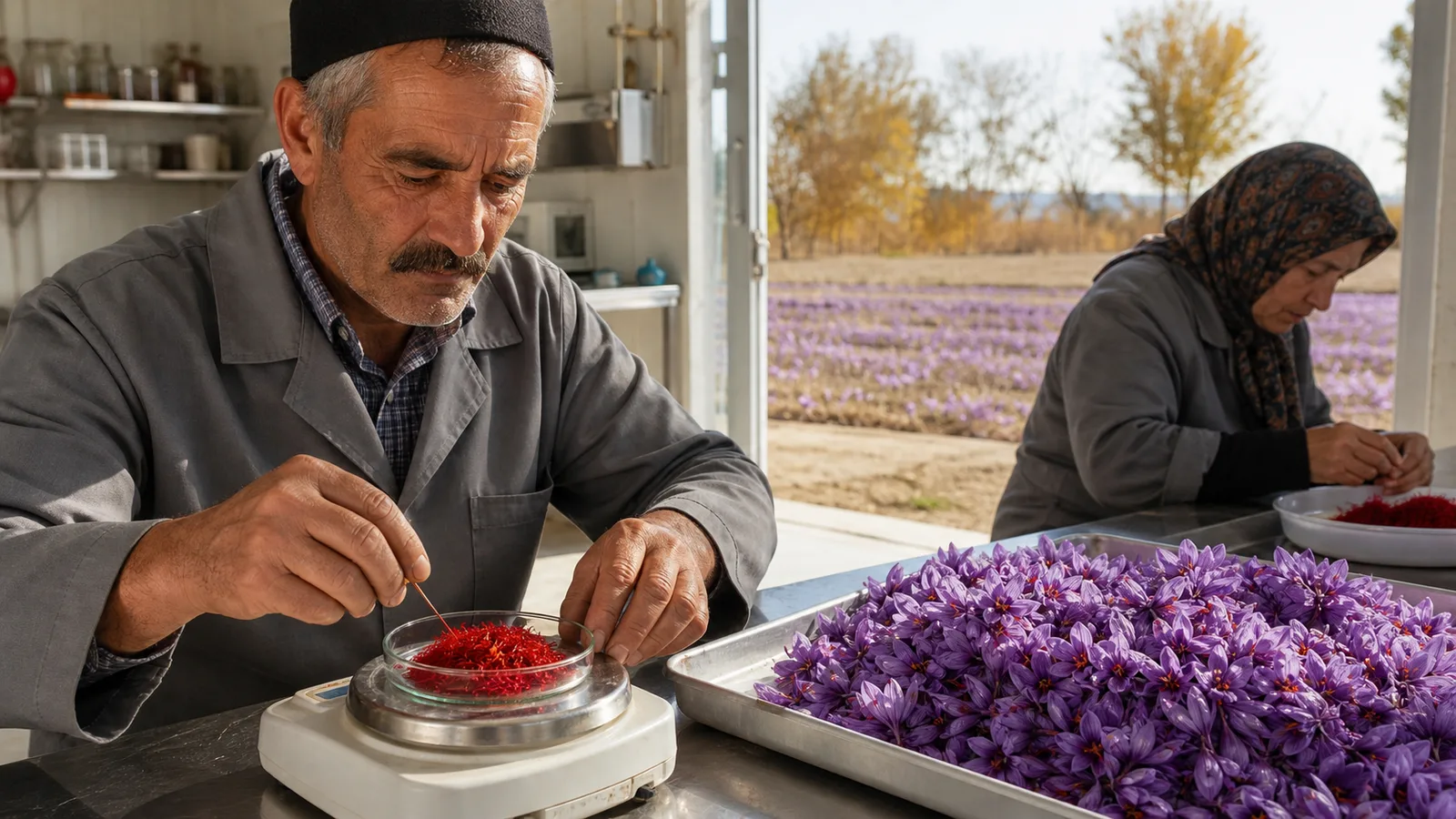
Iran is the world’s largest saffron producer, and saffron is often called the most expensive spice in the world. The 300-tonne figure in this article’s title came from an older Iranian production discussion, while the body reported about 250 tonnes from roughly 90,000 hectares. Those figures describe different estimates or moments; neither is a live crop total.
Mitra Majdzadeh, then a deputy director in Iran’s Ministry of Agriculture office covering greenhouses, medicinal plants and mushrooms, described saffron as one of the country’s most valuable historical non-oil agricultural exports after pistachios. She also warned that Iran was not retaining the full value added along the chain.
The useful question is therefore broader than “who produces the most?” It is why saffron is expensive, how producer rankings should be measured and how a large crop becomes a consistent, traceable product rather than anonymous volume.
Why saffron is the most expensive spice by weight
Saffron is made from the dried stigmas of Crocus sativus. Each flower provides only three red stigmas. Flowers are picked during a short autumn period, then separated and dried quickly enough to protect aroma, colour and condition.
That combination creates a high labour requirement for a very small dried yield. Corm establishment, field care, picking, stigma separation, drying, testing, storage and loss all sit behind the price. Small consumer packs add packaging and distribution cost per gram.
“Most expensive” still needs a basis. A retail gram in a premium jar cannot be compared directly with a bulk kilogram at origin. Grade, thread form, testing, pack size, delivery terms, tax, date and currency all affect the visible number.
Is saffron expensive in Iran?
Saffron may cost less near the producing region than in a distant retail market, but it remains a high-value product for Iranian households too. The answer depends on the harvest, grade, pack size, seller, exchange rate and whether the comparison is made in local income or converted currency.
A low local nominal price does not mean production is cheap. Growers pay for corms, land, water, seasonal labour and processing, often before knowing the final yield or sale price. Inflation and currency conversion can make an old rial or toman figure meaningless in a current comparison.
A buyer should ask for a dated quote that states net weight, thread or powder form, lot, grade or test results, packaging and delivery basis. Without those details, “saffron price in Iran” is not one comparable number.
What the 250- and 300-tonne figures mean
The source text placed annual Iranian production near 250 tonnes and cultivated area around 90,000 hectares. The title used 300 tonnes. This difference should remain visible rather than being forced into one value.
Production estimates can change before and after harvest. Acreage may include young, mature and declining fields with different yields. Some reports refer to dried saffron, while poor translations can blur flowers, stigmas and finished product.
For current analysis, every total needs a crop year, publishing body, geographic coverage and method. A forecast made before flowering is not the same as the final saleable crop or customs export volume.
Why Iran is the biggest producer of saffron
Iran’s position rests on scale, concentrated knowledge and a production system developed across generations. The Khorasan provinces are the main centre, with suitable dry conditions, established corm supply, harvest labour, traders and processing capacity.
The UN Food and Agriculture Organization’s description of the qanat-based saffron system in Gonabad identifies Iran as the largest producer and places more than 90% of production in the country in that documented context. The page also explains how saffron fits water scarcity, livelihoods and inherited irrigation knowledge.
Iran is the largest producer of saffron in that cited FAO context. The share should always be kept with its source date because other countries cultivate saffron and production changes. “Largest producer” does not mean that every Iranian lot is superior or that all saffron sold under another country’s brand was grown there.
Afghanistan’s growth in the archived statement
The old translation says Afghan saffron had become significant after production was only about 300 kilograms five years earlier. The sentence is too damaged to establish the later quantity or ranking, so those details are not invented here.
Afghanistan’s Ministry of Agriculture has published a national saffron development programme describing saffron as a newer commercial crop and documenting its labour, processing and market-development needs. Its numbers belong to that programme’s date and should not be mixed with the older Iranian interview.
Competition does not erase Iran’s advantages. It does mean origin, quality and buyer service must be demonstrated. A country name by itself is not a specification.
Where value can be lost after production
Majdzadeh’s value-chain concern remains relevant. A country can dominate farm output while downstream businesses elsewhere perform testing, branding, small-pack distribution and retail. Some of that work is necessary; some reflects commercial power and buyer access.
Iranian producers can retain more value where they can deliver:
- clean, consistently separated threads;
- controlled drying and protected storage;
- lot-specific identity, purity and quality evidence;
- traceability from field or collector to finished pack;
- packaging that meets the buyer’s real channel; and
- stable specifications, quotations and delivery records.
Not every shipment needs consumer packaging. A well-specified bulk contract can be efficient. The loss occurs when the product is anonymous and the seller has little evidence with which to defend its identity or price.
How to compare saffron producers fairly
Country rankings usually use dried production weight, but commercial decisions need more. Compare the share of output that meets the required specification, year-to-year consistency, traceability, test capacity, logistics and the ability to repeat a lot.
Do not infer quality from volume alone. A 300-tonne crop can contain many grades and processing conditions. Conversely, a small producer may supply an excellent specialist lot without affecting the global ranking.
For a buyer, samples should come from the offered lot and be tested under the same method. For a grower or exporter, the most useful benchmark is saleable yield and accepted repeat orders, not a national headline.
Reading the title accurately
The original title compresses three ideas into one awkward sentence. A clearer interpretation is: Iran was reported to produce around 250–300 tonnes of saffron, making it the world’s largest producer of a spice renowned for its high price by weight.
That does not mean Iran itself is “the most expensive spice,” nor does it prove a current 300-tonne crop. It also does not answer which lot is the world’s most expensive saffron. Those questions require product and date-specific evidence.
The durable conclusion is strong without exaggeration. Iran built saffron production at a scale no other origin matched in the cited context. Preserving that lead—and receiving more of the value—depends on the quality, identity and commercial record of each lot after the flowers leave the field.

![Exporting Saffron to Turkey + Price Guide [Complete 0 to 100]](https://img.rowhanisaffron.com/20260827003933/saffron-export-turkey-quality-inspection.webp)



