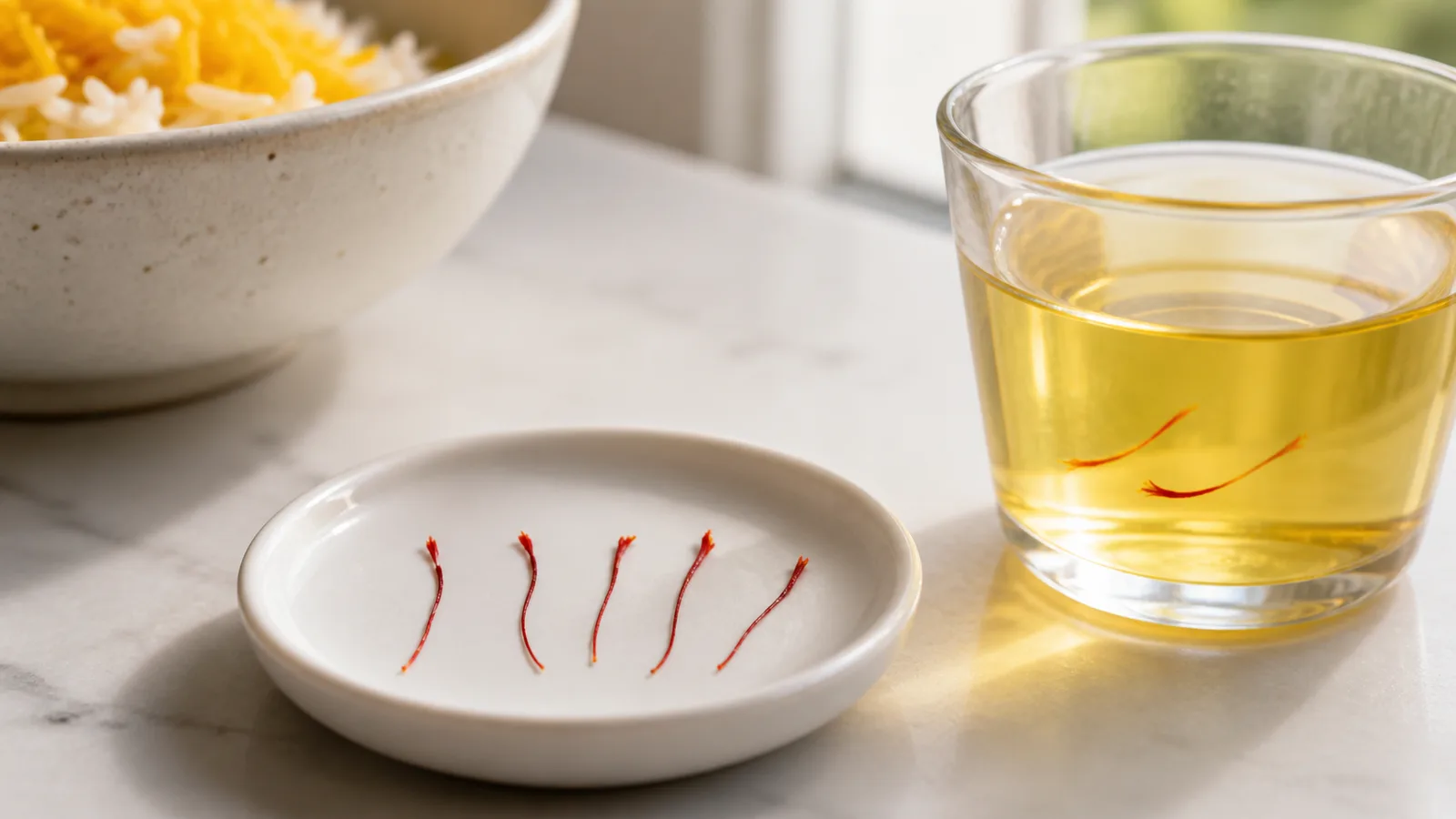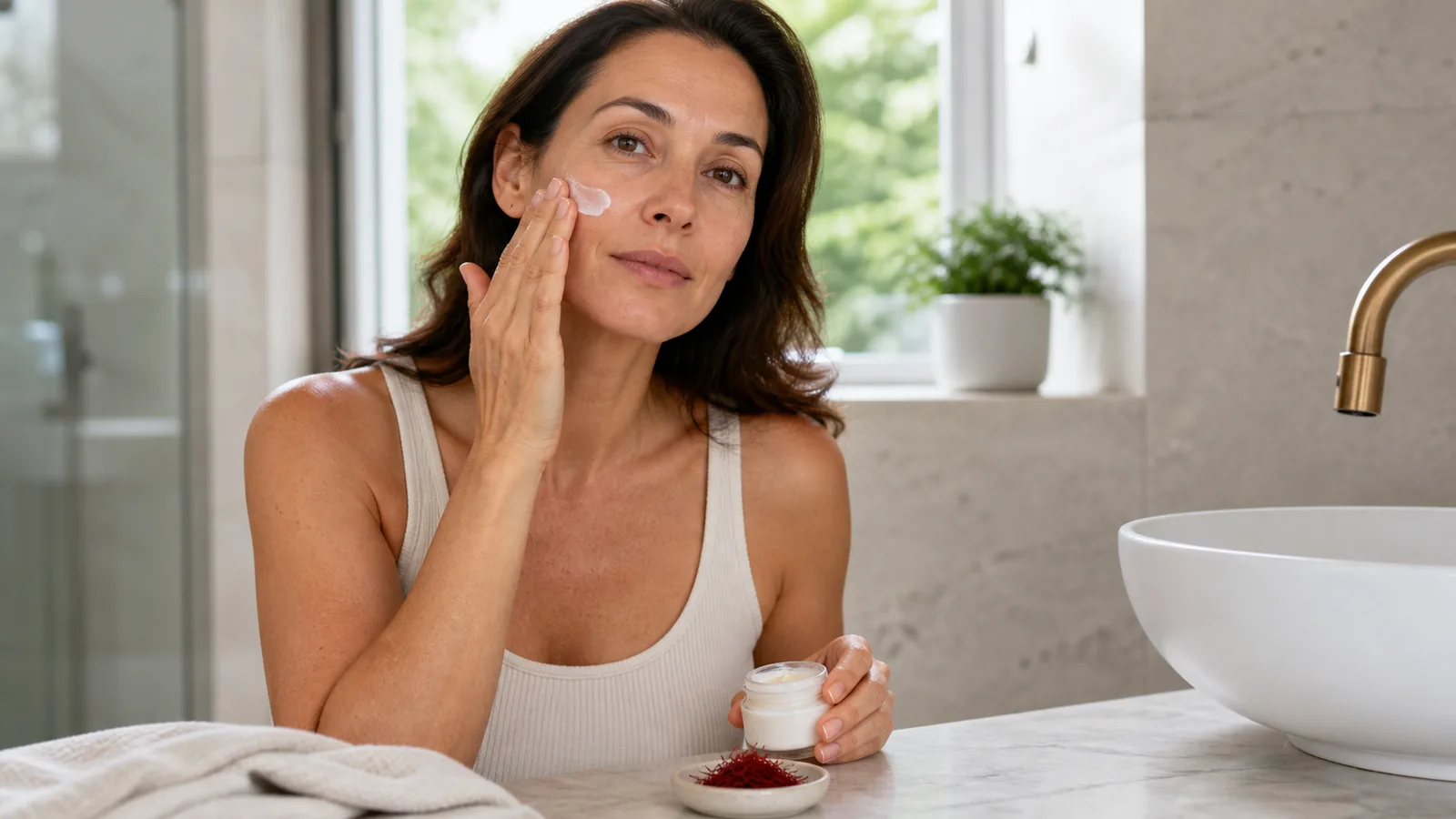
Saffron has not been shown to make a person look younger. A small study of one cream and several laboratory experiments give researchers reasons to keep studying saffron-derived compounds, but they do not prove that eating saffron, rubbing kitchen threads on the face or buying any product labelled “saffron” will reduce wrinkles.
The phrase saffron for youthful skin is best treated as a cosmetic possibility with limited evidence. For visible ageing, daily sun protection and a suitable moisturizer have a much firmer place than a homemade mask.
Why is saffron linked with youthful skin?
Saffron contains crocin, crocetin, picrocrocin and safranal. Crocin in particular has shown antioxidant and anti-inflammatory activity in laboratory systems. These findings are often translated into claims about neutralising free radicals, soothing redness, boosting circulation or restoring a youthful glow.
The familiar anti-aging claims usually fall into three groups: saffron’s antioxidant properties will soften fine lines; skin-brightening will promote skin glow; or anti-inflammatory effects will calm puffiness and irritation. Each idea has a plausible-sounding mechanism, but none is established as a dependable result from culinary saffron.
That translation moves too quickly. An antioxidant result in a test tube does not tell us whether a finished product penetrates human skin, remains stable, reaches an effective concentration or changes how someone looks. “Antioxidant” is a property measured under particular conditions, not a promise of fewer wrinkles.
What does the human anti-wrinkle study show?
A 2020 study of an experimental saffron-extract and avocado-oil cream followed 20 healthy volunteers who applied the formulation daily for 12 weeks. At 12 weeks, 45% had at least a one-grade improvement on the investigators’ aesthetic scale, and some measured wrinkle and elasticity outcomes changed. Participants were moderately satisfied, and no allergic reactions were reported.
Those results are interesting but preliminary. The sample was tiny, and the cream contained both saffron extract and avocado oil in a formulated base. The abstract does not describe a placebo or comparison cream, so the study cannot tell us how much change came from saffron, the oil, the moisturizer base, normal variation or expectations. It certainly cannot show that loose threads mixed at home produce the same result.
What crocin research can—and cannot—tell us
A laboratory study of crocin and skin ageing used human keratinocytes and fibroblasts grown in vitro. It found antioxidant and anti-inflammatory responses and changes in gene activity under those laboratory conditions. This is mechanistic evidence, not a clinical test of appearance.
Cells in a dish do not have the skin barrier, sun exposure, product ingredients or everyday routines of a human face. The work supports further formulation research; it does not establish that saffron reduces fine lines, puffiness, blemishes or redness in ordinary use.
Does saffron brighten skin or improve circulation?
Saffron’s colour can temporarily tint a mixture and may leave a warm cast on skin. That is not the same as treating pigmentation or creating healthier “glow.” Reliable evidence that topical saffron evens skin tone by improving blood circulation is lacking.
Uneven pigmentation has many causes, including sun exposure, irritation, acne and melasma. Treating it with an untested kitchen mixture can make matters worse if the skin becomes inflamed. Persistent or changing pigmentation is a better question for a dermatologist than for a spice jar.
Are saffron face masks safe?
The familiar recipe—mix saffron strands with milk or honey, apply for 10 to 15 minutes and expect hydration or fewer blemishes—has not been validated as an anti-ageing treatment. Milk, honey and culinary saffron do not form a stable, preserved cosmetic. A homemade mixture can irritate the skin, trigger contact symptoms or become contaminated if it is stored.
If you still choose a rinse-off mixture, use clean equipment, make only what you will use immediately, keep it away from the eyes and broken skin, and stop if it stings, burns, itches or swells. Do not use a DIY mask before an important event: irritation can be more visible than the concern it was meant to improve.
How to evaluate a saffron skincare product
A professionally formulated product is not automatically effective, but it is more informative than counting threads. Look for a complete ingredient list, directions, batch or manufacturer details, a suitable container and claims that describe modest cosmetic effects rather than treatment or reversal of ageing.
The origin of the spice does not settle the question. Iranian saffron may be excellent for cooking, yet country of origin alone says nothing about extract concentration, skin delivery, stability or clinical testing in a cream.
Patch-test a new product before broad use. The American Academy of Dermatology’s wrinkle-care guidance recommends testing a small amount on the inner forearm twice daily for four to five days, even when a label says “hypoallergenic.” Follow the product directions and stop if a reaction develops.
What has better evidence for younger-looking skin?
Start with the unglamorous essentials. The American Academy of Dermatology identifies sunscreen and moisturizer as the two most effective anti-ageing products to begin with. It recommends a broad-spectrum, water-resistant sunscreen rated SPF 30 or higher and warns that cosmetic products produce modest results, not a facelift.
- Protect exposed skin from the sun every day and reapply sunscreen as directed.
- Use a moisturizer formulated for your skin type.
- Add one targeted product at a time so irritation is easier to identify.
- Ask a dermatologist about persistent pigmentation, significant sun damage or a retinoid if appropriate.
- Support skin health with sleep, a balanced diet and avoiding tobacco rather than expecting one ingredient to reverse ageing.
The realistic answer
Does saffron make you look younger? Not on the evidence available. One small mixed-ingredient cream study and laboratory findings around crocin are not enough to promise wrinkle reduction, brightening or rejuvenation from saffron itself. A well-formulated product might feel pleasant and may eventually earn stronger evidence. Until then, keep expectations modest and let sunscreen, moisturizer and individualized dermatology care do the dependable work.