


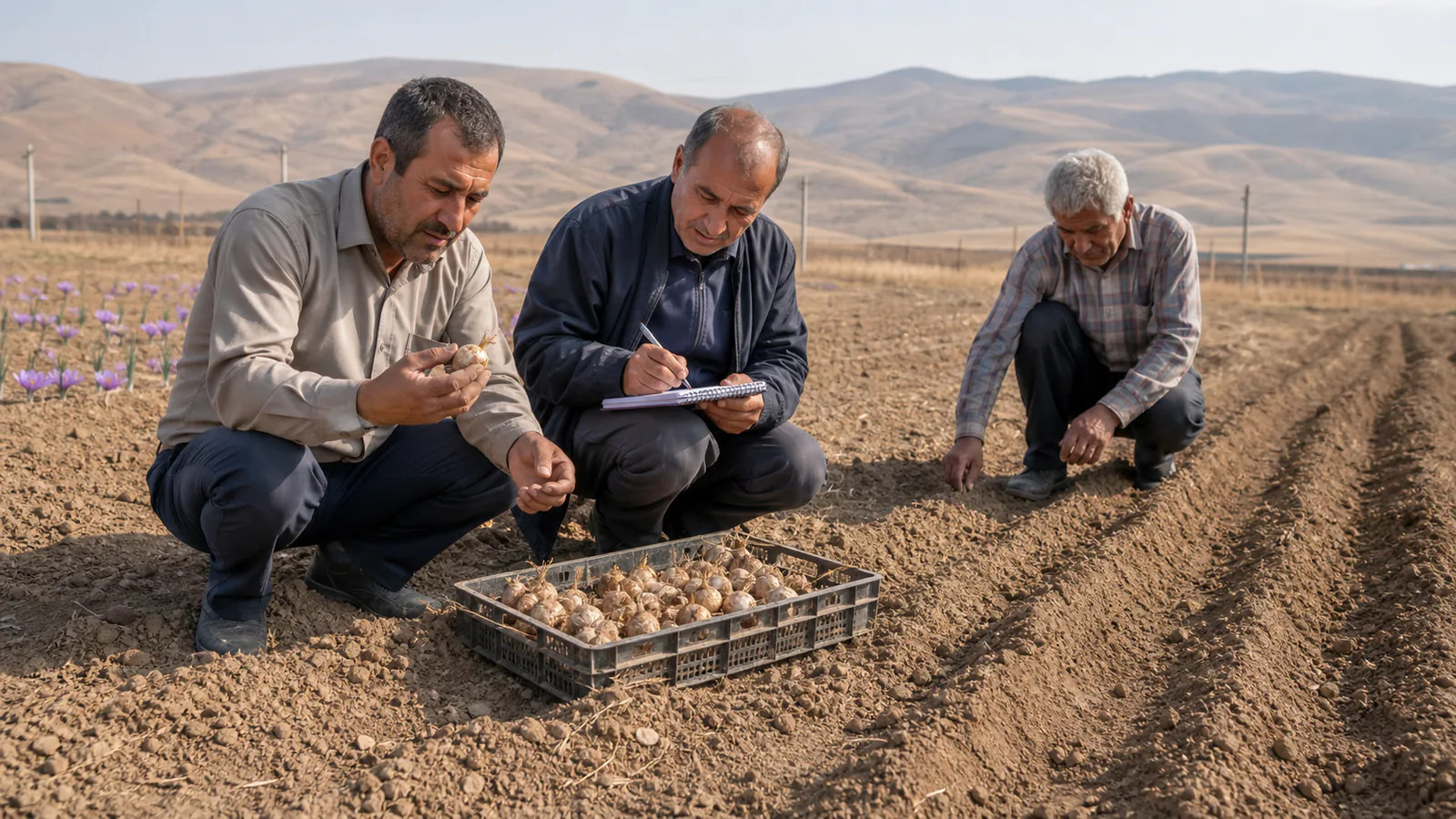
Ahar saffron cultivation grew from a five-hectare base to a reported 12 hectares, then 13 hectares in a later update. The earliest account also recorded six hectares planted in the 1399 Iranian crop year (2020–21). These figures describe a modest local programme, not a production centre on the scale of Khorasan. They are still useful because they show how an emerging area can separate planted land, bearing land, average yield and exceptional farm results.
The reports use “saffron onions,” a literal translation commonly found in older English coverage. Saffron is planted from corms, not culinary onions or seed. That distinction matters when a grower is choosing healthy planting material, estimating establishment costs or asking the local agricultural office for advice.
Ahar planted six hectares in the 1399 crop year
Mohammad Asadi, then director of Ahar’s Agricultural Jihad office, described six hectares of saffron planted during crop year 1399. His remarks came during a visit to farms around Naqareh Koob village. The growers reportedly established those plots without subsidised planting-material credit or free facilities.
The same report placed the citywide saffron area at 12 hectares. Six newly planted hectares and a 12-hectare total can coexist if the first number refers to one season’s additions and the second includes older fields. The account does not provide a parcel register, however, so it would be unsafe to reconstruct an exact year-by-year total from those two numbers alone.
The later area update was 13 hectares
A later statement from Asadi said that Ahar had previously cultivated saffron on only five hectares and had reached 13 hectares, with further expansion under consideration. That is an eight-hectare increase, or 160%, from the stated five-hectare baseline. It is also one hectare above the earlier 12-hectare report.
The sequence is best read as a historical progression rather than a current acreage claim. Neither report supplies a field list, measurement date for every parcel, abandonment figure or the share old enough to flower. A future update should retain the 12- and 13-hectare milestones separately unless a newer official dataset reconciles them.
Why Ahar promoted saffron and rosemary
Local advisers presented saffron and rosemary as alternatives within a changing cultivation pattern. Their stated aims included productive employment, improved farm income, fewer incentives for rural migration, non-oil exports and a better fit with limited water. Those were programme objectives. The reports did not measure jobs created, household income, migration or water saved, so none should be described as a proven outcome.
Saffron’s irrigation needs are seasonal, but “lower water demand” is not the same as no water requirement. Establishment, soil, timing and corm density interact with irrigation. A peer-reviewed semi-arid field study of saffron irrigation and corm intensity illustrates why a local plan needs actual water scheduling rather than a broad low-water label.
Ahar reported a four-kilogram average yield
The first Ahar account reported an average dry-saffron yield of four kilograms per hectare, while some leading farms were said to reach ten kilograms per hectare. The ten-kilogram figure is an upper-end observation, not the city average and not a promise to a new grower.
If all 12 hectares had been bearing and had matched the reported average, the arithmetic would imply 48 kilograms. That is only an illustration. The report does not say how many hectares were mature, how yield was sampled, whether weights were independently verified or which season the average represents. A credible local production total requires measured dry stigma and a clearly defined bearing-area denominator.
Corm choice and local guidance come before expansion
Asadi encouraged farmers to contact Ahar’s agricultural management and service centres while the planting window was still open. The practical point remains sound: planting material should be identified correctly, checked for visible damage and disease, and matched to a suitable field before money is committed.
Crocus sativus is sterile and is propagated vegetatively through daughter corms, as described in a peer-reviewed botanical review of saffron. Our guide to saffron corms explains the terminology and handling in more detail. Neither corm size by itself nor a high-yield report from another farm guarantees establishment, health or harvest on a new plot.
The wider Ahar report was mainly about wheat
The source that supplied the 13-hectare update also described Ahar’s much larger wheat programme. It reported roughly 28,000 hectares planted and about 16,000 tonnes purchased from local farmers. Officials discussed higher fertiliser costs, evaluation of alternative fertilisers, and a change to Azar-2 seed on 30% of wheat land alongside tighter purchasing rules for unspecified seed.
That context helps explain why saffron formed only one small part of the local agricultural discussion. Wheat tonnage, seed policy and fertiliser decisions do not establish saffron performance, so they should not be folded into its yield or profitability claims.
Bardaskan offers a scale comparison, not an Ahar result
A separate report from Bardaskan in Khorasan Razavi forecast about seven tonnes of saffron from 2,172 hectares. Dividing the forecast by the reported area gives approximately 3.22 kilograms per hectare. This is a forecast average for Bardaskan, not a result that can validate or replace Ahar’s reported four-kilogram average.
The two areas were at very different scales: Bardaskan’s stated area was about 167 times Ahar’s later 13 hectares. Climate, field age, corm density, irrigation, labour and measurement methods may also differ. The comparison is valuable precisely because it warns against transferring a headline yield from one county to another.
What Bardaskan’s quality claim did and did not prove
Bardaskan Agricultural Jihad director Seyed Mohsen Fakhr-Kazemi attributed the county’s “excellent” saffron to the use of organic fertilisers, limited chemical fertiliser and very little herbicide. That is an attributed official assessment. It is not a batch test, an ISO grade or proof that all Bardaskan saffron was certified organic.
Production method is only part of quality. Crocin, picrocrocin, safranal, moisture, foreign matter and post-harvest handling all affect what reaches the buyer. Research on saffron compounds and commercial quality recommends prompt stigma separation after flower harvest and explains the importance of drying and storage. That evidence supports the Bardaskan instruction without turning the director’s broad quality judgement into a laboratory result.
Fast stigma separation was part of the Bardaskan advice
Farmers were asked to separate the red stigmas as soon as practical after picking the flowers. This is not a decorative finishing step. Flowers are perishable, and delayed or unhygienic handling can increase contamination risk and reduce the consistency of the dried spice.
The Bardaskan office also reported an “ideal saffron” project across 50 hectares, intended to raise production and reduce costs. No before-and-after yield, cost ledger, treatment protocol or final evaluation was included. It should therefore remain a reported pilot objective, not evidence that either outcome was achieved.
What a useful Ahar field record should show
The next reliable Ahar update needs more than a larger area number. For each season, it should distinguish:
- total planted area from mature bearing area;
- new and replacement corm plantings;
- measured fresh flowers and dry stigma;
- average yield from leading-farm yield;
- irrigation timing and volume;
- labour, corm, fertiliser, processing and packaging costs; and
- quality results from named test methods rather than general praise.
A modest trial that records those details can be more informative than rapid expansion with no denominator. Growers considering a new plot can also use our broader saffron growing-conditions guide to frame the questions they take to a local agronomist.
Ahar’s record is encouraging but still historical
The strongest conclusion is simple: Ahar’s saffron programme expanded from a reported five hectares to 12 and then 13 hectares, and officials recorded a four-kilogram average while directing growers toward local technical help. The reports also show why headline numbers need care. New planting is not automatically bearing area, a leading farm is not the city average, and an expansion plan is not an achieved harvest.
Bardaskan contributes a useful comparison on scale and post-harvest discipline, but it does not change Ahar’s story. Kept in their proper places, the two records offer a practical lesson: build the field carefully, separate forecasts from measurements, and protect quality from corm selection through drying.

![Exporting Saffron to Turkey + Price Guide [Complete 0 to 100]](https://img.rowhanisaffron.com/20260827003933/saffron-export-turkey-quality-inspection.webp)



