


An experiment in Yazd was described as planting saffron without water and soil, offering a hopeful idea for farmers living through prolonged drought. “Without soil” can be accurate for a controlled system; “without water” needs an important correction.
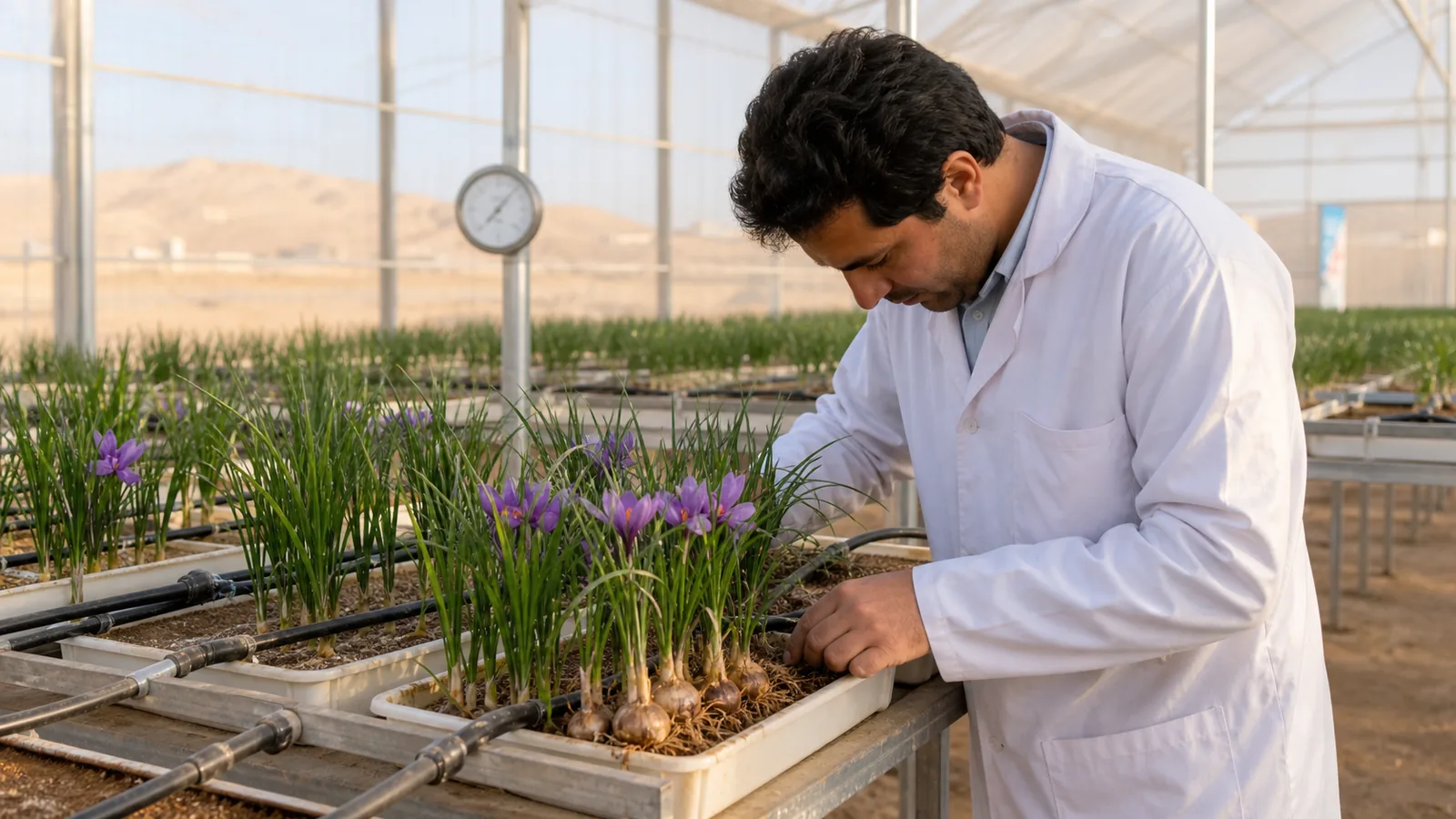
Saffron corms can flower for a short period using reserves stored inside them, which makes soil-free forcing possible. They still need controlled moisture and nutrition if the grower expects healthy roots, replacement corms and repeat production. The Yazd story is best understood as a report about protected, space-efficient cultivation rather than a crop that requires no water at all.
Why saffron interested drought-affected Yazd farmers
Years of water scarcity had pushed farmers in Yazd toward crops with lower irrigation demand. Saffron offered a high-value alternative whose active season does not coincide with the hottest part of summer. That does not make the plant water-free, but it can fit arid farming better than many thirsty annual crops when irrigation is timed well.
Khorasan remained Iran’s main saffron-growing region, while cultivation expanded in Yazd Province. The archived report says it began locally in Bahabad and later reached Bafq, Abarkuh, Mehriz and Yazd city. It described Yazd saffron as high quality because of the climate and placed the province seventh nationally at that time.
What the older Yazd figures show
The report attributed steady growth to the provincial agricultural authority and said about 50 hectares were being added to the cultivated area each year. Those are historical figures, not a current acreage estimate. A separate 2020 account from Yazd’s agricultural organisation reported 100 additional hectares allocated to saffron.
That later account listed roughly 400 hectares in Bahabad and six hectares in Yazd city, with a provincial average of about five kilograms of dried saffron per hectare. The difference between these figures and the earlier “50 hectares per year” statement is a reminder to attach a date and definition to every agricultural statistic.
What “without soil” means in practice
A soilless grower places selected saffron corms in trays or containers rather than planting them directly in a field. The rooting medium may be an inert substrate such as perlite or another porous material. In some forcing systems, dormant corms are held under managed temperature and humidity until flowers emerge.
The flower can appear because a mature corm already contains stored energy and a formed bud. This is why a photograph of corms flowering on a shelf may look as if nothing has been supplied. It shows one stage of the cycle, not the complete process needed to maintain planting stock.
Why “without water” is not literally correct
Soilless cultivation replaces field soil; it does not remove the plant’s biological need for water. Research on nutrient and irrigation management in soilless saffron measures how substrate, nutrient concentrations and irrigation affect cormlet production. Water is the carrier for those nutrients and has to be supplied in controlled amounts.
The useful distinction is between lower water demand and zero water. Too much moisture can encourage corm rot, while too little during root and leaf growth limits the plant’s ability to build daughter corms. A serious system therefore controls irrigation, drainage, humidity and airflow instead of claiming to eliminate water.
The Yazd grower’s small-space example
The archived article identified Hamedi Nasab, a retired cultural worker, as someone who had begun this type of production. Its translated account says that one kilogram of saffron “onion” was planted in a 100-square-metre space. Saffron is propagated by corms, not onions, and the sentence does not explain whether one kilogram was a test batch placed within a larger room or the intended planting density for the whole area.
That missing detail matters because flower output depends strongly on corm size, health and density. The reported ratio should not be copied as a cultivation prescription. A prospective grower needs a plan expressed as graded corms per tray or square metre, along with expected flowers, dry stigma yield and corm recovery.
Space can shrink, but facilities do not disappear
The original story suggested that this method did not need agricultural land, facilities or equipment. It is fair to say that a tray system may avoid owning a conventional field. Yet protected cultivation still needs clean shelving or benches, ventilation, temperature monitoring, suitable containers, a safe water supply and a place to separate and dry the stigmas.
Electricity, labour and disease prevention also affect the cost. A small room can lower the barrier to a trial, but scaling that trial changes the ventilation load, handling time and risk of losing closely packed corms to a shared problem. Space efficiency is useful only when plant health and product hygiene remain under control.
The corm cycle continues after flowering
Harvesting the purple flower is not the end of saffron cultivation. Leaves continue growing after bloom, and the plant uses photosynthesis to support daughter corms. Those corms become the planting material for the next cycle. Removing or neglecting the plants immediately after flowering can leave the grower without vigorous stock for another season.
Some forcing operations treat flowering and corm multiplication as separate stages, moving plants into different conditions after harvest. Others begin with new field-grown corms each time. The business model should say which approach it uses, because repeated purchases of large, healthy corms can change both cost and biosecurity risk.
Training should cover more than flower production
Hamedi Nasab said interested growers could attend courses associated with agricultural, technical and vocational organisations. Useful training should cover corm selection, sanitation, temperature and humidity, irrigation, flowering schedules, stigma separation, drying, storage and realistic yield calculations.
It should also explain how quality is checked before sale. An attractive indoor crop does not guarantee strong colour, aroma or taste, and a producer needs traceable batches if the saffron enters commercial channels. Claims about future provincial ranking should follow measured area, yield and quality rather than the number of experimental rooms.
A realistic lesson from the Yazd experiment
- Soilless saffron can reduce dependence on conventional farmland.
- Flower forcing may use the reserves of a mature corm, but a full production cycle still requires moisture and nutrients.
- Yazd’s dry climate makes low-water crops relevant, though local performance must be measured rather than assumed.
- One small demonstration does not establish a commercial planting density or export-scale yield.
- Clean handling, controlled drying and healthy replacement corms matter as much as the first flush of flowers.
Planting saffron without water and soil is therefore a memorable shorthand, not a literal agronomic description. The promising part is real: controlled cultivation can produce flowers in a compact area. The safer message for Yazd growers is to test it with sound training, record every input and yield, and plan for the corm’s entire cycle before investing at scale.

![Exporting Saffron to Turkey + Price Guide [Complete 0 to 100]](https://img.rowhanisaffron.com/20260827003933/saffron-export-turkey-quality-inspection.webp)



