


The plant used instead of saffron is safflower, Carthamus tinctorius, also known in parts of Iran as kajireh. Its coloured florets can be used as a food colourant, and its seeds yield cooking oil. It is a useful crop in its own right, but it is not saffron and must never be sold as though it were.
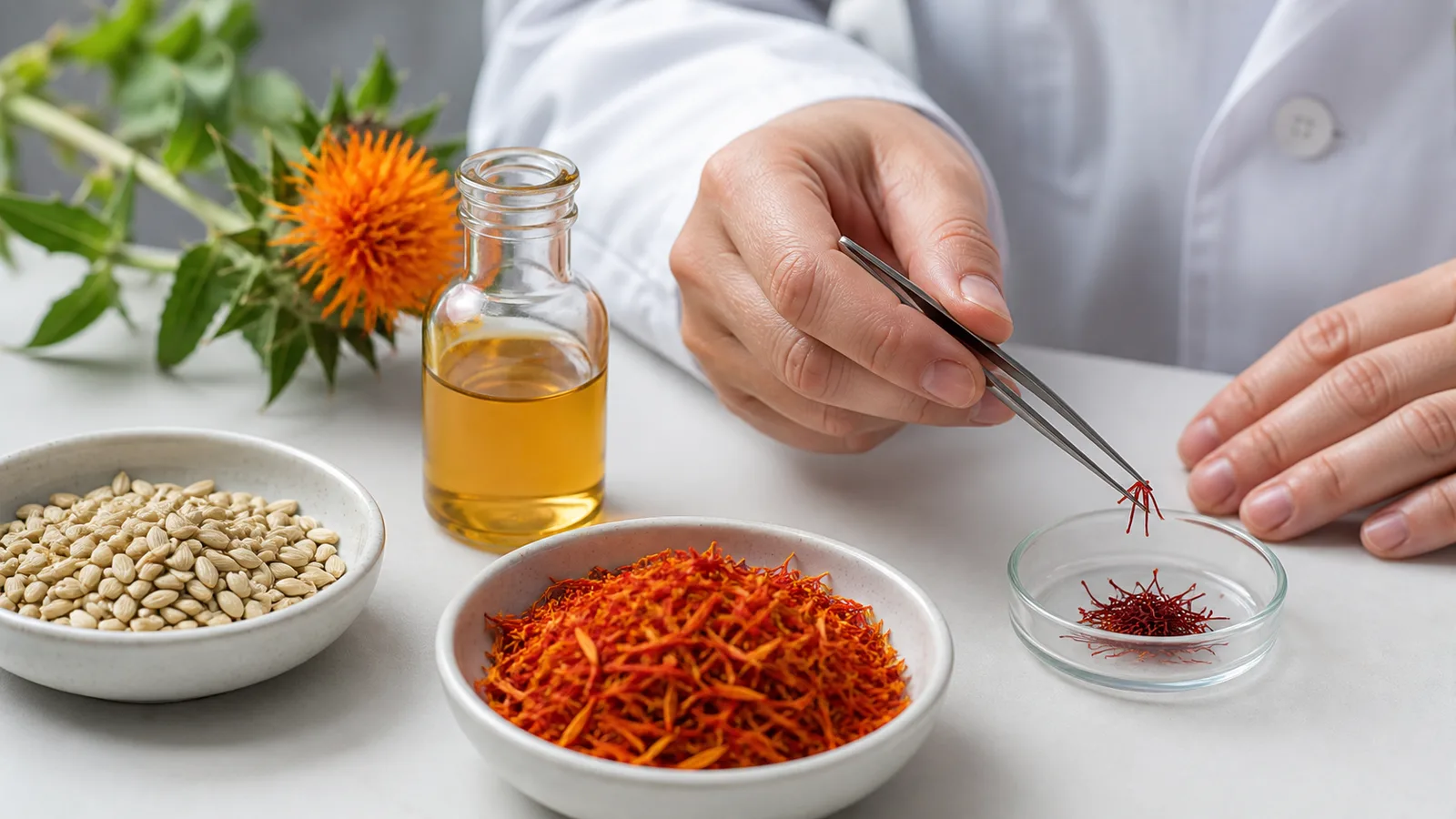
The distinction protects both cooks and growers. Using safflower instead of saffron can add colour, but it does not reproduce saffron’s characteristic aroma, flavour or chemistry. A recipe may intentionally call for safflower; adding it to a product labelled pure saffron is substitution or adulteration.
What is safflower?
Safflower is an annual, thistle-like member of the daisy family, Asteraceae. The previous translation called it a plant of the “enamel family” and printed the name as “hamCarthamus tinctorius”; both were errors. The cultivated species is Carthamus tinctorius.
Mehdi Ebrahimi, introduced in the archived report as director of a strategic-plant production and processing group at Jihad University of South Khorasan, named India, Kazakhstan, Mexico, the United States and Argentina as important producers. That list reflects the period of the report and should not be treated as a current global ranking without recent FAOSTAT data.
The crop has two commercial stories. Historically, people valued its red and yellow flower pigments. Today, seed oil is generally the larger use. The FAO’s natural-colourant reference describes safflower as “dyer’s saffron” and notes its adaptation to semi-arid conditions.
How safflower colour differs from saffron colour
Safflower florets contain the water-insoluble red pigment carthamin—not “cartamine”—and water-soluble safflower yellow pigments. Their proportions and extraction method determine the resulting colour. Saffron’s colour is driven mainly by crocins in the stigmas, while picrocrocin and safranal help define its bitterness and aroma.
This is why safflower can colour rice or another food without making it taste like saffron. It may be used deliberately where its own colour is wanted and where that use complies with local food rules. It should be identified as safflower rather than presented as a drop-in version of saffron.
When substitution becomes saffron fraud
Dried orange-red safflower florets can resemble saffron from a distance, especially in powder or a mixed sample. Modern authenticity research treats safflower as a common botanical adulterant. A 2023 analytical study developed chemical markers capable of detecting several plant adulterants, including safflower, at additions as low as 1% by weight under its test conditions.
Saffron consists of narrow red stigmas, often with a trumpet-shaped end. Safflower material is usually flatter, broader and more petal-like. Appearance can help a buyer notice a problem, but laboratory methods are more reliable for powder, dyed material or a sophisticated mixture.
- Buy saffron from a traceable supplier and keep the batch information.
- Prefer intact threads when visual inspection matters; powder hides plant structure.
- Expect a complex saffron aroma, not colour alone, but do not treat a home water test as proof of purity.
- Use an appropriate laboratory authenticity method when the commercial risk justifies it.
Safflower seed oil and its composition
Ebrahimi gave a seed-oil range of 23–36%, varying with cultivar and growing conditions. That kind of variation is plausible: seed genetics, climate, agronomy, maturity and extraction all influence oil yield.
Not all safflower oils have the same fatty-acid profile. Traditional high-linoleic types are rich in polyunsaturated linoleic acid; high-oleic cultivars contain more monounsaturated oleic acid and may behave differently during storage and heating. “Safflower oil” on its own does not tell a cook the cultivar, refinement or suitable temperature.
The old article described the oil as mild, similar in taste and colour to sunflower oil, stable at high temperatures and low temperatures, and free of a smoke smell during cooking. Mild flavour is common in refined oil, but smoke point depends on refinement and condition. Absence of an obvious smell is not a safety test; follow the product label and discard overheated or degraded oil.
Does safflower oil protect the heart?
The useful dietary principle is replacement. A network meta-analysis of 54 randomised trials found that several liquid plant oils, including safflower, lowered LDL cholesterol more than butter when exchanged isocalorically. That supports replacing a source of saturated fat with an unsaturated oil; it does not mean adding unlimited oil prevents heart disease.
The earlier claim that safflower oil is among the “least harmful” vegetable oils is too absolute. Cardiovascular effect depends on what it replaces, overall diet, quantity and the oil’s fatty-acid composition. Sunflower, corn and soybean oils are not automatically unhealthy alternatives, and an individual cooking oil should not be marketed as treatment for atherosclerosis, hyperlipidaemia or heart disease.
Weight, insulin resistance and metabolism
Small clinical studies have examined safflower oil in selected populations. One randomised crossover study enrolled 55 obese postmenopausal women with type 2 diabetes, with 35 completing both interventions; 8 g per day for 16 weeks improved several measured risk markers. A separate trial investigated adults with metabolic syndrome. These results are specific to their participants and protocols.
They do not establish safflower oil as a general weight-loss product or a cure for insulin resistance. Oil is energy-dense, and weight change depends on the wider diet and activity pattern. Anyone managing diabetes should not replace prescribed care with an oil supplement.
Vitamin E, skin and cosmetics
Safflower oil contains vitamin E compounds, but the amount varies with cultivar, processing and storage. The old claim that it always contains more vitamin E than olive oil is not a reliable product rule; values need to be compared for the actual oils and serving sizes.
The oil is used in some cosmetic formulations as an emollient. The statement that it causes no allergies in people is unsupportable. Any botanical or cosmetic formulation can cause irritation or an individual reaction, and safety also depends on purity, oxidation, fragrance and the other ingredients.
Traditional uses and stronger medical claims
The source described safflower flowers as stimulant, analgesic and laxative, consumed as a drink or soak, and said they speed blood circulation and help people with paralysis. It called the seed hot, dry and laxative. It also recorded traditional or oriental use of safflower oil for neuropathy, chickenpox wounds, numbness and tingling in the limbs.
These are traditional-use claims, not instructions supported by adequate clinical trials. Paralysis, new numbness or tingling can signal a medical emergency and should be assessed promptly. Safflower should not be used on a wound or taken as a laxative treatment without suitable product and safety guidance.
The article further credited safflower with building bone, preventing osteoporosis, protecting the liver, treating diabetes and obesity, improving metabolism, strengthening skin, and providing antioxidant and anticancer effects. Laboratory or animal mechanisms may justify research, but they do not prove prevention or treatment in people. None of these claims makes safflower oil a replacement for clinical care.
Safflower has value without pretending to be saffron
Safflower is a legitimate semi-arid oilseed and colourant crop. Its florets supply carthamin and yellow pigments, and its seed provides high-linoleic or high-oleic oil. Those uses deserve accurate naming and quality control.
Use safflower when safflower is intended. Use genuine saffron when a dish needs saffron’s aroma, flavour and stigma chemistry. The two plants can share a colour role, but they are not interchangeable products—and honest labelling is the line between a culinary choice and food fraud.

![Exporting Saffron to Turkey + Price Guide [Complete 0 to 100]](https://img.rowhanisaffron.com/20260827003933/saffron-export-turkey-quality-inspection.webp)



