


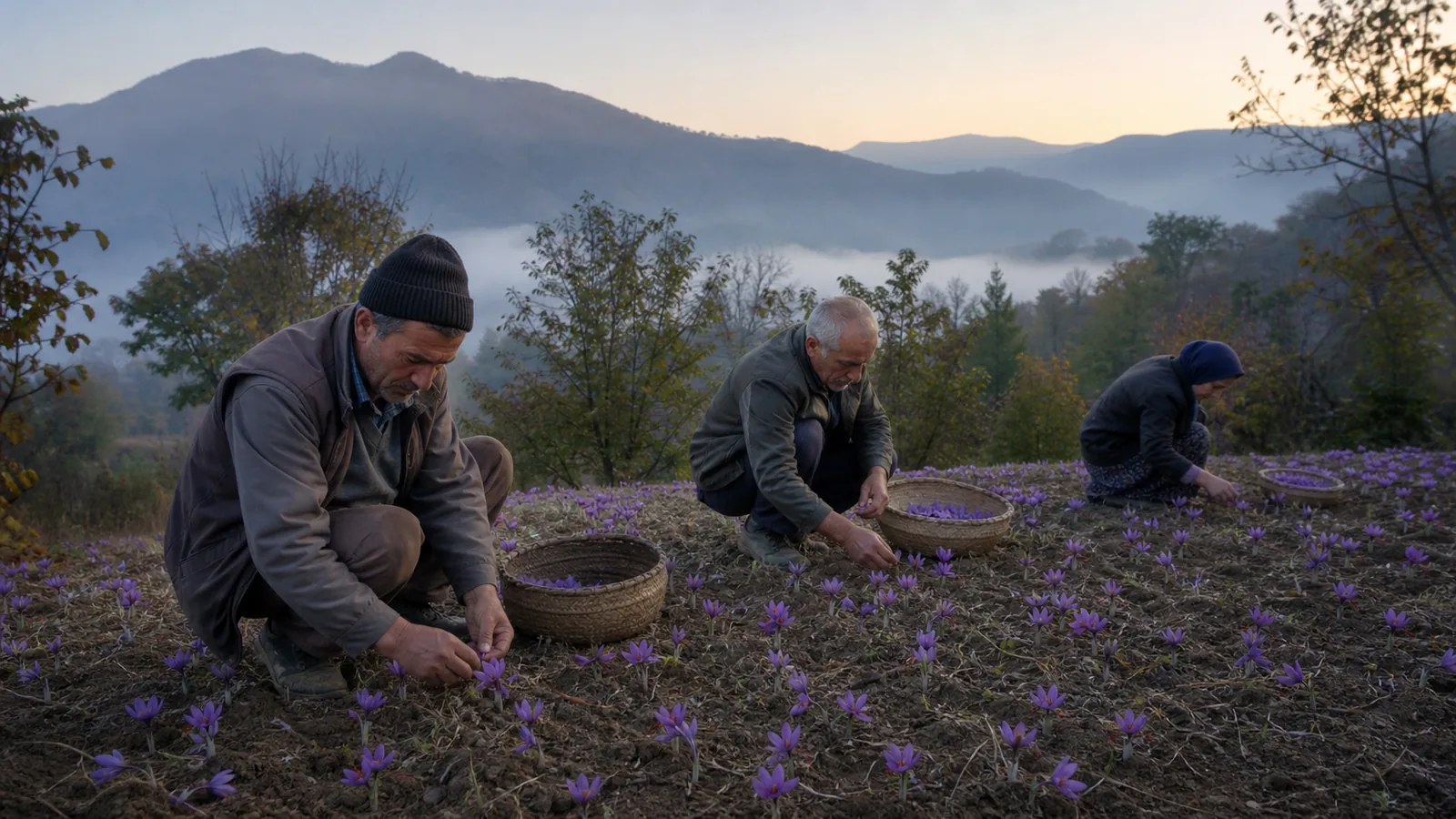
Behshahr saffron farmers were forecast to harvest about 40 kilograms of dried saffron from an early eight-hectare cluster, generating a reported 700 million rials in the reference season. A later account placed total saffron planting at 25 hectares and described the crop as part of a wider shift in the mountainous Yanehsar district.
The area, output and revenue values are historical. They show how the local crop developed; they are not current prices, yields or income promises.
The first eight hectares in Behshahr
Behshahr’s agricultural administration said growers had planted approximately eight hectares around the villages of Andrat, Pita No and Volo. Planning and farmer training formed part of the programme, which encouraged a move away from wheat and barley where those crops were no longer providing an adequate return.
Director Haghighi forecast roughly 40 kilograms of dried saffron from the eight hectares. If both numbers cover the same productive fields, that is an implied average near five kilograms per hectare. The report did not provide farm-level yields, moisture basis or laboratory grades, so the calculation is useful context rather than an audited productivity figure.
What the 700 million rial revenue meant
The same account put total grower revenue near 700 million rials. Spread across 40 kilograms, that would imply an average gross value of about 17.5 million rials per kilogram in that period. It does not tell us how much each farmer received or what remained after corms, labour, irrigation, drying and other costs.
Historical currency figures also become misleading when lifted into a present-day buying decision. Inflation, saffron grade, lot size and the sales channel can change the result. The report supports the conclusion that saffron produced meaningful local revenue; it does not prove that every new Behshahr field will earn the same amount.
Planting later expanded to 25 hectares
A later development report said saffron had been planted across 25 hectares of Behshahr’s upstream and mountainous agricultural land. This appears to represent expansion beyond the earlier eight-hectare cluster, rather than a conflict that should be resolved by choosing one number.
Officials described saffron as an alternative crop selected after considering the region’s risks. That wording matters. A change in cultivation pattern is not simply replacing one seed with another. Growers need suitable soil and water, healthy corms, labour for the short flowering period and a reliable route to process and sell the dried spice.
Harvesting in November and December
The local account placed harvest in November and December and recommended collecting flowers early in the morning, before strong sunlight and field heat. Pickers then need to separate the stigmas and move them into controlled drying without unnecessary delay.
Behshahr’s highland setting distinguishes these fields from the lower, more humid parts of Mazandaran. The saffron project was specifically associated with upstream and mountainous villages, where local conditions were considered more suitable.
Andrat’s first saffron festival
The development report connected the 25-hectare milestone with what it called Mazandaran’s first saffron festival, held in Andrat village in the Yanehsar district. It also promoted Andrat as the “saffron capital of Mazandaran.” That phrase is a local identity claim, not an official production ranking established by the article.
A festival can help growers show the crop, compare experience and bring customers into the area. Its longer-term value depends on what follows: repeat buyers, clear quality information, local drying and packing skill, and income that reaches the farms.
Saffron within a broader crop change
Saffron was one part of Behshahr’s alternative-crop strategy. The source also mentioned hazelnuts, medicinal plants and new orchard planting. One crop label in the English version appears as “black root trees,” but the species is not identifiable from that translation, so it should not be presented as a precise agricultural recommendation.
Diversification can reduce reliance on one weak crop, but it also spreads attention across products with different seasons, labour needs and markets. The best choice depends on each village and farm rather than a single citywide slogan.
What would show that the transition is working?
Behshahr’s early figures provide a baseline: eight hectares, a forecast 40-kilogram harvest and 700 million rials in gross revenue, followed by a reported expansion to 25 hectares. Future evaluation should separate planted from productive hectares and record dried yield, tested quality, farmer costs, sale price and repeat market access.
Those measures would show whether the crop is creating durable value rather than a one-season headline. Behshahr’s story is promising because it combines farmer training, a defined mountain cluster and local interest. Its real success rests on the quality and economics of each harvest.

![Exporting Saffron to Turkey + Price Guide [Complete 0 to 100]](https://img.rowhanisaffron.com/20260827003933/saffron-export-turkey-quality-inspection.webp)



