


West Azerbaijan’s saffron cultivation area grew from 48 to about 56 hectares in the season covered by this report. The eight-hectare addition equals 16.7%, which explains the rounded 17% growth in the headline.
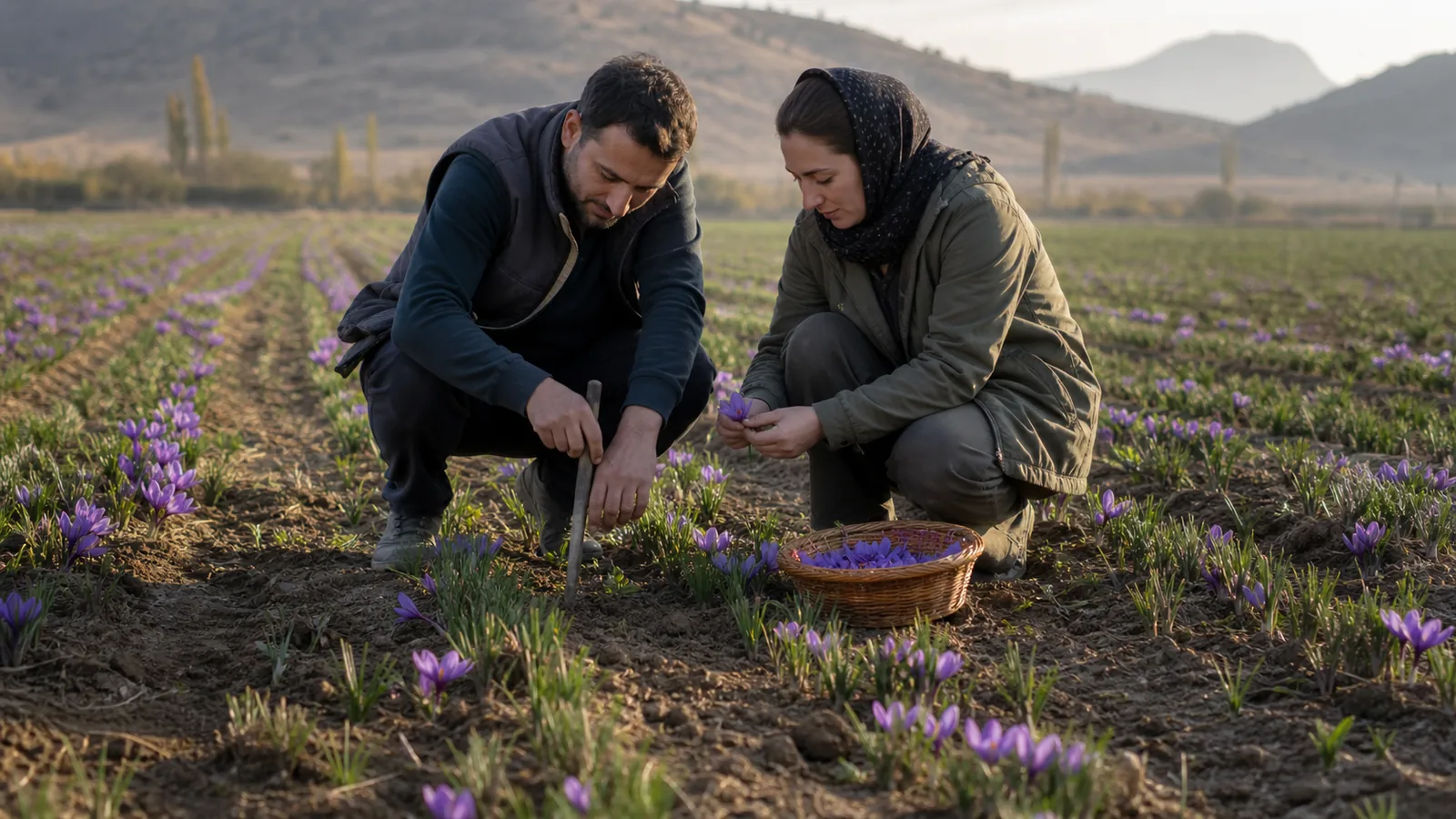
Rasoul Jalili, then head of the province’s Agricultural Jihad organisation, forecast a 72-kilogram harvest and presented saffron as a lower-water option for suitable parts of the province. The figures are a historical snapshot. Later reports show further change, so the old acreage and yield must keep their dates attached.
How the 17% cultivation growth was calculated
The previous area was reported as 48 hectares. Adding eight hectares brings the total to 56. Dividing eight by 48 gives 0.1667, or 16.7%. Rounded to a whole percentage point, the increase is 17%.
That is growth in planted area, not a 17% rise in harvest weight, farmer income or yield per hectare. Those measures can move differently because new fields may be young, only part of the planted land may flower, and weather and management affect the amount of dry saffron recovered.
The 70- and 72-kilogram harvest figures need care
The archived article says about 70 kilograms had been harvested in the preceding year and forecasts 72 kilograms for the new season. It also says average yield had increased by two kilograms per hectare. Taken literally, those statements do not form one consistent series.
Seventy kilograms from 48 hectares is about 1.46 kilograms per hectare. A 72-kilogram crop from 56 hectares would average about 1.29 kilograms per hectare. The “two kilograms” line may describe an improvement on selected farms, a target, or a mistranslated average rather than the province-wide calculation. Without the underlying field report, it should not be used to replace the arithmetic.
Where saffron was being grown in West Azerbaijan
Jalili named Urmia, Naqadeh, Miandoab, Showt, Piranshahr and Salmas as the province’s main saffron-growing counties at the time. The list identifies the places with the largest area in that report; it is not a ranking with hectare totals for each county.
Researchers at the provincial agricultural and natural-resources centre were said to identify locations where cultivation faced no technical objection. This qualification matters. A province-wide development policy does not make every plot suitable, and county names cannot substitute for checking soil, drainage, winter conditions and water quality on a particular farm.
Saffron among the crops grown in Miandoab
Searchers sometimes reach this page while looking for crops grown in Miandoab, West Azerbaijan, Iran. This report establishes that saffron was one of them and that Miandoab was among the leading saffron areas in the province at the time.
It is not a complete account of Miandoab agriculture. A later agricultural report describes grape production and more than 50 crop types in Miandoab. Saffron belongs within that diverse farming economy rather than defining it by itself.
Why saffron was considered for a water-short region
The report calls saffron a strategic response to water scarcity. Its reasoning is seasonal: active growth occurs through autumn, winter and spring, when rain and snow can meet part of the crop’s needs, while dormant corms generally do not require summer irrigation.
Lower demand is not the same as no demand. Root growth, flowering and daughter-corm formation still depend on well-timed moisture. Research into irrigation and nutrition in saffron cultivation shows that water and nutrient management influence corm development. Local rainfall cannot be assumed to cover every field or every season.
Profitability is also not automatic. Yield, corm cost, hand labour, drying quality and access to buyers all matter. Saffron can diversify a farm, but the decision should follow a plot-level budget rather than the price of a small premium retail jar.
The reported planting window
Jalili placed saffron planting from early September through the first ten days of October. That was local guidance in the archived report. Timing affects how well corms establish roots before cold weather and should be adjusted to the year’s conditions, corm state and advice from local agricultural specialists.
Only healthy, suitably sized corms should be planted. Damaged or infected material can introduce problems that persist for several seasons. Planting density and depth influence flower production as well as the size of the daughter corms that replace the original stock.
How growers obtained saffron corms
The article says private companies offered saffron corms during the planting period. Applicants planning larger areas were referred to South Khorasan Province to obtain stock. That preserved access to an established growing region, but origin alone did not guarantee corm health or suitability.
A grower needs traceable material, visual grading and guidance on sanitation and transport. Corms held in warm or damp conditions can deteriorate, while moving infected stock spreads risk into new fields. Quantity should be calculated from the intended density and usable field area, not purchased as an undefined bulk lot.
How the province changed after the 56-hectare snapshot
The growth did not stop at the figures in the headline. A West Azerbaijan Agricultural Jihad report dated November 2024 recorded 74 planted hectares and a 160-kilogram forecast. It said about 43 hectares were bearing and 90 principal growers were active.
Those numbers should not be spliced directly into the older 48-to-56-hectare calculation. They come from a later date and distinguish bearing area from total planted area. They do, however, show why the original 72-kilogram forecast is no longer an appropriate description of the province.
What the historic West Azerbaijan report establishes
- Planted area rose by eight hectares, from 48 to roughly 56 hectares, a rounded 17% increase.
- The article forecast 72 kilograms after reporting about 70 kilograms in the previous season.
- Urmia, Naqadeh, Miandoab, Showt, Piranshahr and Salmas were named as leading cultivation areas.
- Planting guidance ran from early September to the first ten days of October.
- Private suppliers provided corms, with larger applicants directed to South Khorasan.
- Later dated reporting shows a larger provincial area and harvest, so the headline remains historical.
The 17% figure is useful because its arithmetic is transparent. Its real significance is the early spread of saffron into several West Azerbaijan counties as farmers looked for a crop better aligned with seasonal precipitation. The safest way to build on that history is to keep area, bearing area, yield and forecast separate, then judge each field on measured conditions.

![Exporting Saffron to Turkey + Price Guide [Complete 0 to 100]](https://img.rowhanisaffron.com/20260827003933/saffron-export-turkey-quality-inspection.webp)



