


Kobra Alipouri was introduced as a pioneering saffron-growing woman in Kuhdasht, Lorestan, after she raised a small greenhouse crop and sold its “red gold” locally. Her story joins practical experimentation with the harder reality of farming where groundwater has fallen.
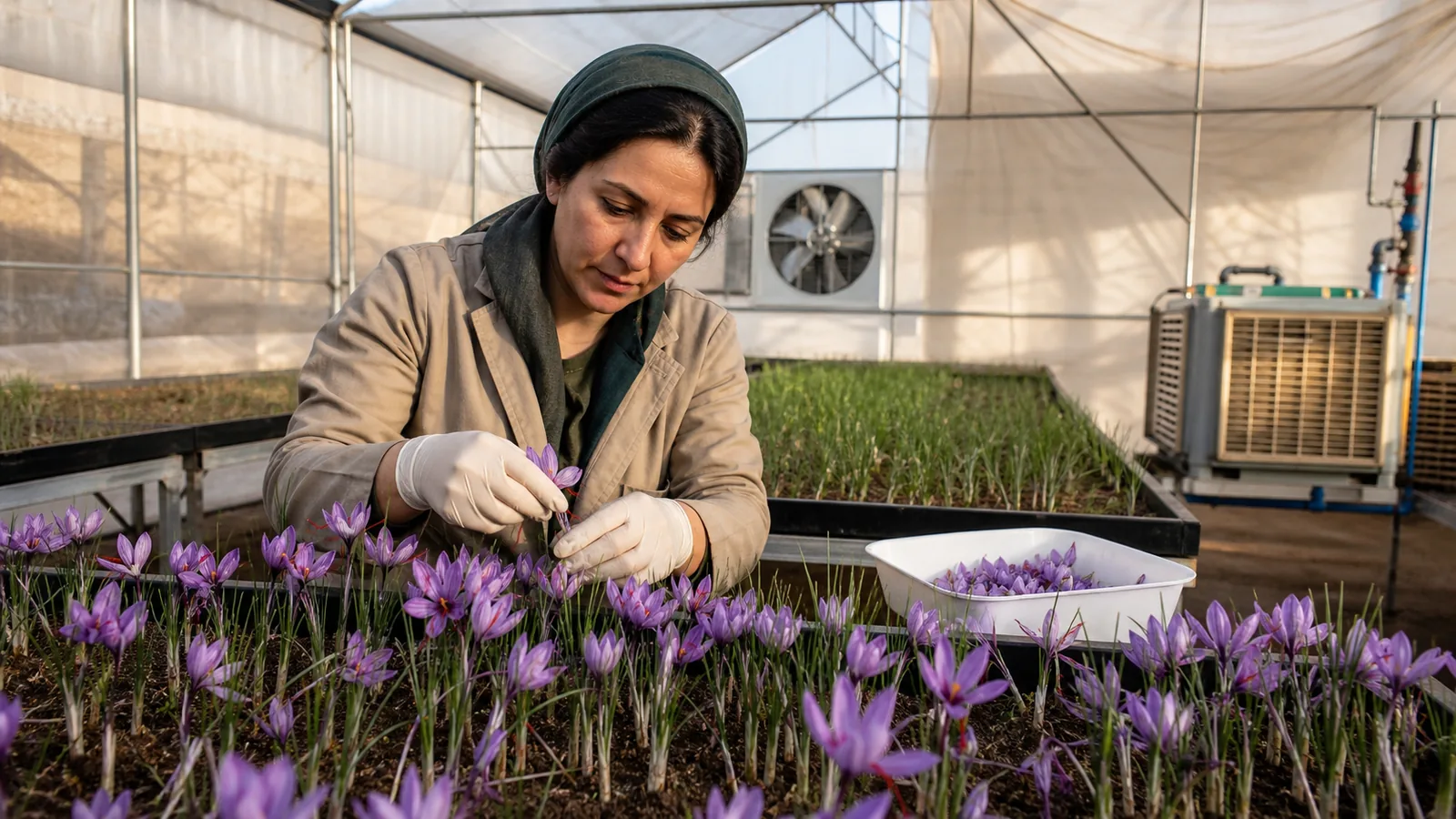
The archived report describes a modest first cycle: 97 saffron corms, a 24-square-metre room, about 15 grams harvested by November and five people given work. Those details are worth preserving, but they also need dates and definitions. They document a local trial, not a current business plan or guaranteed return.
Who was the Lorestan saffron grower?
The report names Kobra Alipouri as the first working saffron woman in Kuhdasht. She said a television programme introduced her to saffron cultivation, after which she took online training in medicinal plants. This was an unusual route into agriculture: curiosity came first, then training and a small controlled growing space.
Her name appears in English in several possible spellings, including Ali Poori and Alipour. The old translation also changes her pronouns from “she” to “he” halfway through the account. This article uses Alipouri and she consistently while retaining the facts attributed to her.
Why Kuhdasht farmers were looking for another crop
Morad Sepahvand, then associated with Lorestan’s agricultural research and education centre, connected the story to prolonged water scarcity. The report said groundwater around Kuhdasht had fallen by 22.5 metres over roughly 30 years and that pressure on aquifers had restricted some crop cultivation for five years.
It also referred to farming near the Seymareh and Kuhnani rivers and named Kuhdasht, Klein, Olad Ghobad, Dilavand, Cham Kooshak-e-Tolabi and Darb-e-Gonbad. Some of these names may be imperfect English transliterations, so they should be read as locations listed in the source rather than a definitive map of permitted farming zones.
Saffron attracted attention because its irrigation pattern can suit dry and semi-dry regions better than many summer crops. It is still a cultivated plant with water and nutrient needs. Changing crops may reduce demand, but it cannot by itself restore a depleted aquifer.
Lorestan’s plant diversity is part of the setting
The original text compresses several botanical figures into one sentence, saying the Zagros contains 20% of plant diversity, 8,000 plant species and 300 medicinal species. The 8,000 figure is commonly used for Iran’s national flora, not for Lorestan alone, so repeating the sentence literally would exaggerate the provincial count.
Lorestan does have rich plant knowledge. A peer-reviewed ethnobotanical survey of central Zagros and Lorestan documented 555 plants from 91 families used medicinally by local communities. That result supports the broader point about diversity without turning an unclear news quotation into a precise inventory.
How 97 saffron corms became a first crop
Alipouri reportedly obtained 97 saffron “onions” in July. Corm is the correct botanical term. She stored them for two months, moved them into her production system and saw flowers in November. The account does not give corm weight, size, temperature, humidity or the exact growing medium, all of which would help another grower understand the result.
A mature corm can hold a formed flower bud and enough reserves to support bloom under controlled conditions. That makes a compact first harvest possible. A complete system must also support roots, leaves and daughter corms after flowering if the planting material is expected to remain productive.
What the 24-square-metre room achieved
The reported production space measured 24 square metres, and the crop had yielded 15 grams by November. That works out to about 0.625 grams per square metre of room area, although usable tray area may have been smaller or arranged on several levels. Without a layout, the calculation is only a description of the report, not a performance benchmark.
The harvest was intended for the Kuhdasht market. A local sale avoids some of the documentation and logistics required for export, yet the product still needs clean flower handling, prompt stigma separation, careful drying and moisture-safe storage. Fifteen grams is enough to test those steps at a manageable scale.
The stated 12-million-toman setup cost needs a date
Alipouri estimated the greenhouse cost at 12 million tomans. The source does not say exactly what the amount purchased or in which year each expense was paid. It may have included shelving, trays, environmental controls, corms and room preparation, or only part of that list.
Inflation and equipment prices make the figure unsuitable as a current quote. Anyone evaluating the model now would need separate prices for space, healthy graded corms, ventilation, monitoring, irrigation, trays, electricity, labour, drying and packaging. Expected revenue should be based on saleable dry saffron, not the number of flowers or the headline value of premium retail packs.
What “employment for five people” may mean
The article says the greenhouse provided employment for five people. It does not specify whether those were full-time positions, seasonal harvest work, family labour or short assignments during setup and processing. With a 97-corm trial, permanent full-time employment would require explanation.
Small saffron projects do create concentrated tasks. Flowers need to be picked when open, stigmas separated quickly and the spice dried without delay. A group can share that work during bloom, while cultivation, sales and training continue outside the short harvest period. The most useful measure is hours of paid work across a full year, not a headcount on one harvest day.
Greenhouse saffron still needs controlled inputs
Moving corms indoors trades some field constraints for a different management job. Temperature and humidity influence flowering; close spacing can allow problems to spread; excessive moisture raises rot risk; and plants need light, water and nutrition to build replacement corms.
Current research on soilless saffron corm production measures the effects of substrate composition, irrigation and nutrient concentration. The lesson for a small greenhouse is straightforward: flowers can emerge in a compact room, but repeatable production depends on more than storing corms and waiting for bloom.
What this woman-led Lorestan project establishes
- A beginner used training and a small room to complete an initial saffron harvest in Kuhdasht.
- The account records 97 corms, two months of storage, November flowering, 24 square metres and 15 grams of saffron.
- The crop was planned for local sale rather than presented as an export shipment.
- The 12-million-toman cost and five-person employment claim are historical statements with missing definitions.
- The project shows a possible response to water stress, not a water-free solution for Kuhdasht agriculture.
Alipouri’s achievement is clearest at its real scale. She learned a new crop, tested it in a controlled space and brought a small harvest to market. That is a credible foundation for later growth. Future claims about income, jobs or water savings should follow the same practical spirit and be supported by dated costs, measured inputs, saleable yield and the health of the next generation of corms.

![Exporting Saffron to Turkey + Price Guide [Complete 0 to 100]](https://img.rowhanisaffron.com/20260827003933/saffron-export-turkey-quality-inspection.webp)



