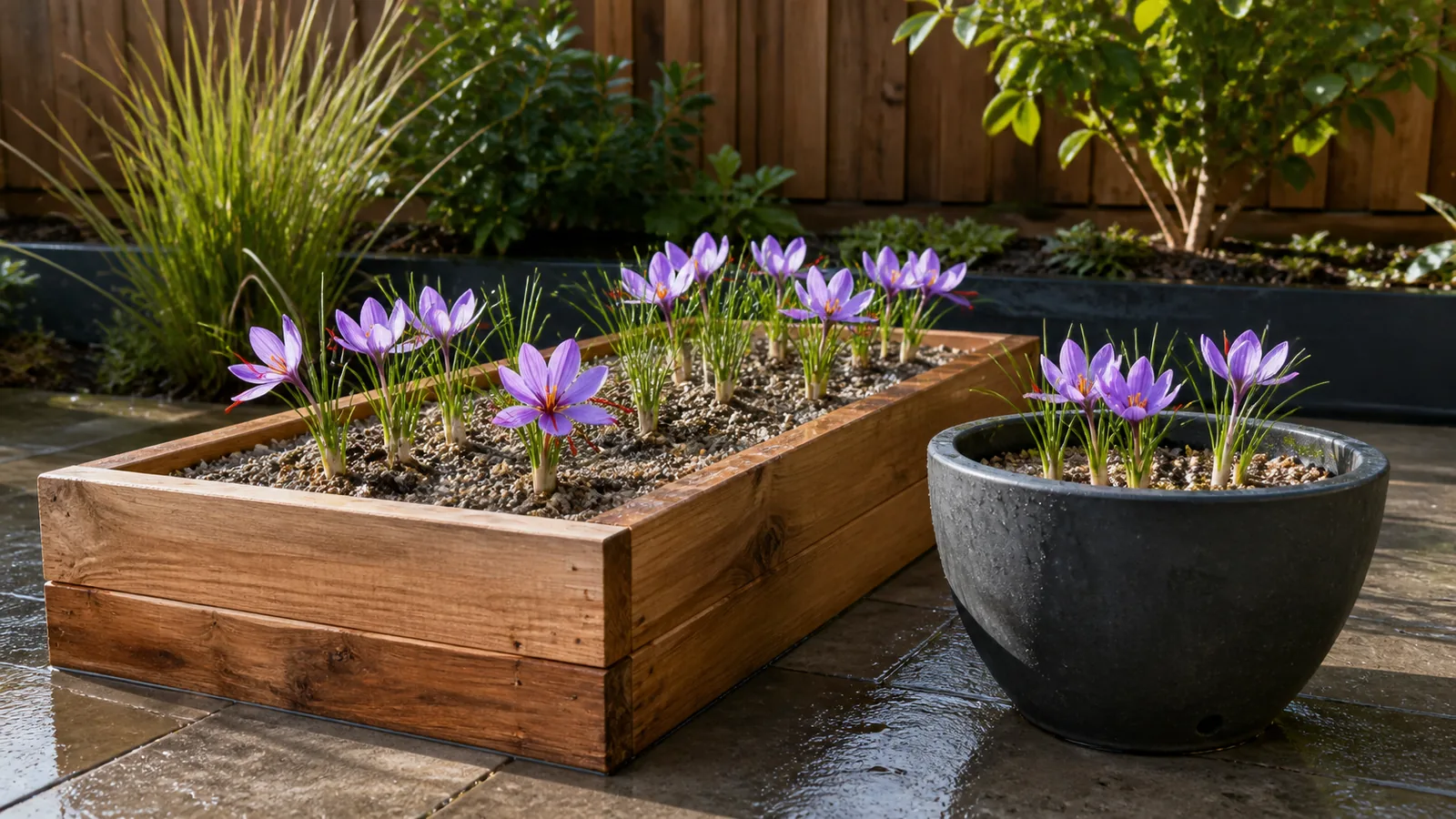
Yes, you can grow saffron in a garden, raised bed or deep container if you can give Crocus sativus full sun and soil that drains freely. The plant is hardy in many temperate climates. Persistent wetness, especially while the corms are dormant, is usually a bigger obstacle than winter cold.
Where saffron grows
Saffron is associated with hot, dry production regions, but it is not confined to them. Iran leads world production; the FAO’s profile of Iran’s qanat-based saffron system describes its large-scale cultivation in an arid and semi-arid setting. Spain, India, Greece, Morocco, Italy and other countries also grow the crop.
Traditional growing descriptions often mention hot, dry summers and a cool winter, but at home you do not need to reproduce an Iranian field. You need to reproduce the plant’s useful seasonal pattern: a bright growing period, enough moisture for active growth, and a well-drained site that does not stay sodden. Local rainfall, soil and summer conditions matter more than the name of the country.
Can you grow saffron in Ireland or another wet climate?
Yes, but drainage needs more attention. The Royal Horticultural Society’s guide to growing saffron recommends a bright, sunny site with rich but well-drained soil and notes that the plant is relatively easy to grow. In a rainy climate, a raised bed, gravel garden, sloping position or pot with an open drainage hole can be safer than a low patch of heavy ground.
That is especially relevant in Ireland. Teagasc’s guidance on Irish soil drainage explains that drainage problems vary with soil, topography and underlying permeability. Test the actual site after sustained rain. If water sits on the surface or the soil remains sticky and airless, improve the growing position rather than simply adding more corms.
What you need before planting
- The correct species: buy Crocus sativus, not an ornamental spring crocus or a plant sold as meadow saffron.
- Firm corms: choose sound planting material without soft patches, mould or obvious damage. “Bulb” is commonly used in shops, but saffron grows from corms.
- Direct light: use the sunniest practical position. Shade can reduce the energy available for later flowering.
- Free-draining soil: sandy loam or a prepared raised bed works well. A container mix should hold some moisture without becoming waterlogged.
- Room to multiply: corms produce daughter corms, so do not pack them tightly together.
- Time during flowering: the autumn harvest is brief and the flowers need checking regularly.
Our saffron corm guide explains how to recognise sound planting stock and why the underground structure changes from year to year.
How to plant saffron
- Prepare the site before the corms arrive, removing perennial weeds and correcting poor drainage.
- Plant in late summer or early autumn, with the pointed growing end facing upward.
- Use the supplier’s depth guidance for your climate. A depth and spacing of roughly 10 cm is a common home-garden starting point.
- Water the newly planted corms in, then adjust later watering to rainfall and active growth. Do not keep dormant corms continually wet.
- Protect the bed from rodents if they are common in your garden.
Avoid adding rich compost by habit. Compost can help structure in an appropriate soil, but partly decomposed organic matter or a poorly drained mix may hold too much water around the corms. The goal is a clean, fertile-enough root zone that still drains quickly.
What happens after planting?
Narrow, grass-like leaves emerge around the autumn growing season, and flowers may follow within weeks. First-year flowering is variable, so a quiet start does not necessarily mean failure. Each open flower has three red stigmas: these are the culinary saffron threads. The shorter yellow-orange stamens are not the spice.
Leaves remain after flowering and continue feeding the developing corms. Let them die back naturally in late spring or early summer. During dormancy, the original corm is replaced by daughter corms. An established clump can produce more flowers, but it eventually needs dividing if crowding reduces performance.
How to harvest saffron threads
Check the planting daily when buds begin to open. On a dry morning, collect fresh flowers or remove the red stigmas with clean tweezers. Work gently so pollen, pale flower parts and soil do not enter the batch.
Dry the threads promptly using a controlled home method. They should lose moisture without scorching. Once completely dry, transfer them to a clean airtight container and keep it away from light, heat and dampness. Correct harvesting protects flavour, colour and aroma; it cannot turn weak planting material into guaranteed premium saffron.
How much saffron will you harvest?
Each flower supplies three stigmas, so a small bed produces a small dry weight. Around 150 flowers are commonly needed for one gram, though corm size, climate, bed age and crop care affect the result. A few threads can still season a dish, which makes a home harvest useful before it reaches a full gram.
Do not expect every corm to flower immediately or assume that one good autumn predicts every year. Record how many corms were planted, how many flowers appeared and how the bed handled rain. Those notes will tell you whether to expand, divide or move the planting.
Common problems
- No flowers: the corms may be small, newly planted, crowded, shaded or stressed.
- Soft or disappearing corms: investigate excess moisture, overwatering, rot and rodents.
- Leaves but declining harvests: an old clump may need division during dormancy.
- Threads with weak aroma: review harvest timing, drying, age and storage rather than blaming origin alone.
- Container failure: make sure water can leave the pot and that a saucer is not keeping the base wet.
Can anyone grow saffron?
Many gardeners can, but not every site is suitable without adjustment. The labour is concentrated around planting and the short harvest; the reward is a small crop whose handling you know from start to finish. A sunny balcony may work with a deep pot; a wet garden may need a raised bed; a very warm, humid area may require extra care during dormancy. Start small and use one season as a site test.
For a detailed home sequence, read how to grow saffron at home. If you are deciding whether the time and small first harvest make sense for you, the companion guide asks whether growing your own saffron is worth it.