There is not enough clinical evidence to say that saffron removes dark spots. Saffron contains interesting pigments and antioxidant compounds, but laboratory findings do not prove that threads, oil, serum or a homemade mask will fade hyperpigmentation on human skin.
Dark spots also have different causes. Post-inflammatory marks after acne, melasma, sun-related spots and a changing mole should not be treated as one problem. The first useful step is to identify the cause, protect the skin from further darkening and choose an ingredient with evidence for that condition.
What “dark spots” usually means
Hyperpigmentation happens when an area contains more pigment than the surrounding skin. It can follow acne, eczema, psoriasis, a burn or an irritating product. Sunlight and visible light can deepen some forms, while hormonal changes and medicines may contribute to melasma.
The American Academy of Dermatology explains that post-inflammatory hyperpigmentation can fade after its trigger is controlled, but superficial spots may still take six to twelve months and deeper color can last longer. Its dark-spot guidance starts with finding the cause and using sun protection—not with saffron.
What is known about saffron for skin pigmentation?
Saffron contains crocin, crocetin and safranal. These compounds are studied for antioxidant and anti-inflammatory activity in laboratory systems. That can justify further research, but it does not establish that topical saffron reaches pigment-producing cells at an effective concentration or lightens a visible spot safely.
Claims that saffron reduces pigmentation, stimulates collagen production, repairs sun damage or creates smoother skin often join several separate ideas into one marketing promise. We did not find a robust randomized human trial showing that saffron alone removes dark spots. Evidence about oral saffron for other outcomes cannot be transferred to a topical pigmentation treatment.
There is also no good basis for promising an “anti-aging” result or a brighter, more even skin tone from regular culinary-saffron masks. A yellow tint immediately after application is not the same as reduced melanin.
Claims of improved skin texture and guaranteed results with consistent use need the same skepticism: neither outcome has been established for a saffron-only home treatment.
Why homemade saffron masks can backfire
Mixing saffron with honey or milk and leaving it on for 15–20 minutes is widely repeated online. Neither the familiar ingredients nor the short contact time proves that the mixture can treat pigment. Milk is not a sterile skincare base, food mixtures lack preservatives, and any ingredient can irritate or trigger allergy.
Irritation matters because inflammation can produce or worsen post-inflammatory hyperpigmentation, especially in medium and dark skin tones. If a mask burns, stings, itches or causes a rash, wash it off and stop. Repeated use in the name of consistency can make the original problem harder to fade.
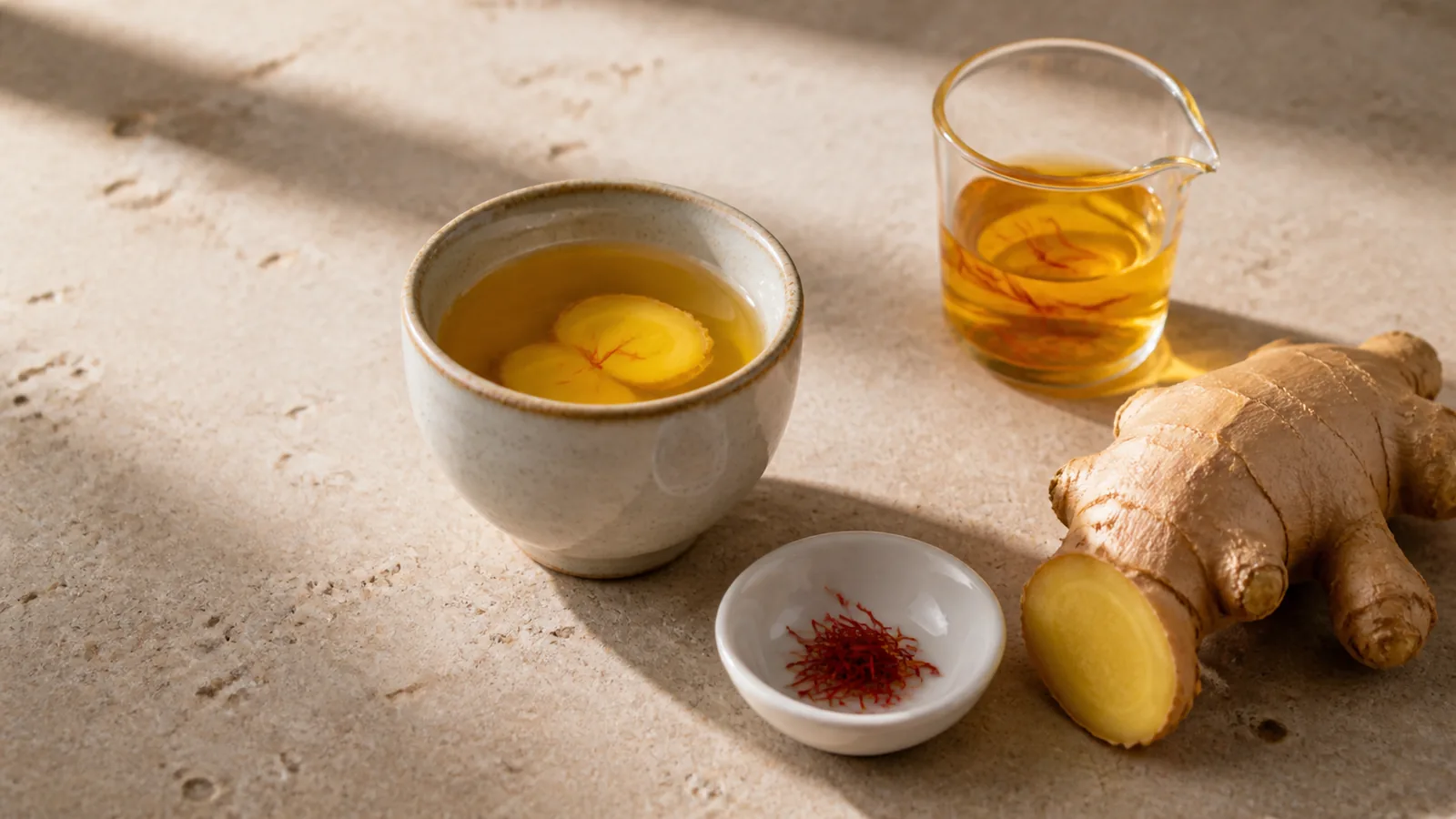
Saffron-infused oil has another limitation: oils vary and may be unsuitable for acne-prone skin. A homemade serum is not chemically equivalent to a tested cosmetic formulation. It has no verified active concentration, stability, preservative system or contamination control.
If a skincare product contains saffron
Judge the complete formula rather than the featured botanical. A commercial serum may also contain an evidence-based pigment ingredient, and that other ingredient—not saffron—may account for a result.
- Read the full ingredient list and directions.
- Patch test a small area as the manufacturer directs.
- Do not apply to broken or already irritated skin.
- Stop if the product burns or causes persistent redness, itching or swelling.
- Photograph the spot in the same neutral light every few weeks instead of judging it day to day.
“Natural” does not mean non-irritating, and a more expensive saffron ingredient does not prove that a finished cosmetic works. Our broader review of saffron and skin health claims separates plausible chemistry from established human outcomes.
What has better support for dark spots?
Daily sun protection is foundational. The AAD recommends broad-spectrum, water-resistant SPF 30 or higher; for people prone to hyperpigmentation, a tinted sunscreen containing iron oxide can also help protect against visible light. The organization’s sunscreen guidance explains how to choose for skin type and sensitivity.
Depending on the cause, over-the-counter options with better clinical support include azelaic acid, glycolic acid, kojic acid, a retinoid or vitamin C. Not every ingredient suits every skin type, and combining several strong products can create the irritation that worsens pigment. A dermatologist can diagnose the pattern and tailor treatment, including prescription options or procedures where appropriate.
When a dark spot needs examination
Do not try to “lighten” a new or changing mole. The AAD advises a dermatology examination for a spot that differs from the others or changes in size, shape or color, and for one that itches or bleeds. Review the ABCDE warning signs.
Also seek professional help when pigmentation appears suddenly without a clear cause, spreads, follows a medicine change, or persists despite gentle care and consistent sun protection.
Bottom line
Can saffron remove dark spots? Current human evidence does not show that it can. Crocin and safranal are scientifically interesting, but they do not turn a homemade mask into a proven pigmentation treatment. Protect the skin from light, avoid irritation, identify the cause and choose a well-formulated treatment with evidence.