


The best saffron fungicide is not one bottle that works in every field. The right response depends on what is damaging the corm, whether that problem is fungal at all, and which products are legally registered for saffron in the country where the crop is grown. A fungicide chosen before diagnosis can miss the cause, waste a season and make future disease control harder.
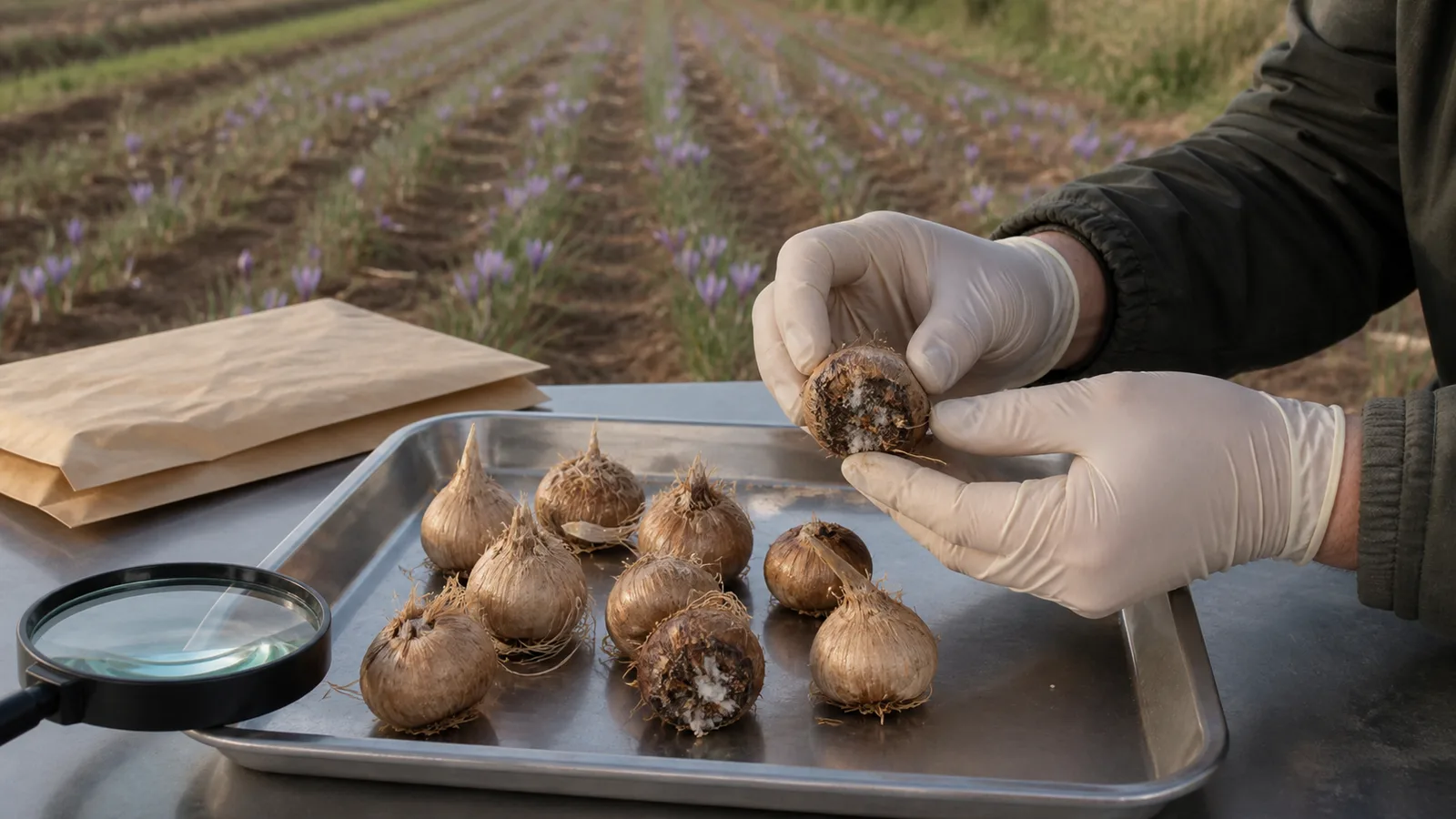
If corms are soft, discoloured or collapsing, begin with drainage, sanitation and a close examination of affected plants. Keep suspect corms away from healthy planting stock, photograph the symptoms and ask a local plant-disease laboratory or agricultural extension service to identify the cause. That evidence should come before a product recommendation.
What saffron corm rot looks like
Corm rot may first show as weak or uneven emergence, yellowing foliage, wilting, leaf scorch or plants that pull away from a decayed base. After lifting a plant, the corm may have sunken patches, soft tissue, dry brown rot, white or grey fungal growth, or small resting bodies around the lesion. Root and stem-base decay can occur as the infection advances.
Those signs overlap with waterlogging, mechanical injury, storage damage, mites and several diseases. “Saffron smut,” “Rhizoctonia disease” and “saffron blight” are sometimes used as broad descriptions, but a description is not a laboratory diagnosis. Even corms from the same field can carry more than one organism.
Which organisms cause the damage?
Fusarium species are strongly associated with saffron corm rot. Recent work has also shown that the group is diverse: a pathogen study of rotted corms identified Fusarium nirenbergiae, F. commune and F. annulatum, while a 2024 characterization study described a saffron-specialized form of F. oxysporum. Rhizoctonia and Penicillium species have also been reported, and Sclerotium rolfsii has caused destructive sclerotial rot in Indian saffron fields.
Burkholderia is a bacterial genus, not a fungus. A conventional fungicide should not be expected to treat a bacterial disease. Likewise, corm mites require their own identification and management plan; adding more fungicide does not turn it into a miticide.
Management of corm rot of saffron
Good management combines several measures rather than asking one treatment to carry the whole job. A detailed review of saffron corm rot epidemiology describes an integrated approach because pathogens can move in infected planting material, persist in soil and enter through damaged tissue.
- Start with sound corms. Buy from a traceable source. Reject corms with cuts, bruises, softness, staining, mould or an unexplained smell. Do not mix suspect stock with a clean lot.
- Protect corms from injury. Handle them gently during lifting, grading, transport and planting. Control rodents and other causes of wounds that create infection sites.
- Keep water moving. Poor drainage and prolonged wetness favour several soil-borne diseases. Correct compacted soil, low spots and irrigation faults instead of relying on a chemical to compensate for standing water.
- Remove inoculum carefully. Lift diseased plants with surrounding debris where practical, keep contaminated tools and crates away from clean corms, and follow local guidance for disposal. Do not compost visibly diseased material unless the process is known to destroy the pathogen.
- Plan the next planting. Crop rotation, summer soil management and clean storage may reduce pressure, although the useful interval and non-host crop depend on the organism found. Keep records of affected beds, weather, irrigation and treatments.
A 2025 ICAR-hosted assessment of threats to Indian saffron places particular emphasis on sorting out injured or diseased corms, field sanitation and preventing rodent damage. These steps are useful before, alongside and after any justified treatment.
How to choose the best fungicide for saffron
Once a fungal pathogen is reasonably identified, take the diagnosis to the local crop adviser or pesticide regulator. The label must cover the crop or permitted crop group, the intended site, the disease and the proposed application method. It also sets the rate, timing, number of applications, personal protective equipment, re-entry interval and any pre-harvest interval. Those requirements differ between countries and can change when registrations are reviewed.
Published saffron studies have tested chemical and biological treatments. For example, a Kashmir field study evaluated Trichoderma viride isolates and several fungicides, while a later field experiment compared Trichoderma asperellum, bacterial biocontrol agents and carbendazim against confirmed Fusarium oxysporum. A treatment working in one experiment does not make that organism or chemical registered, suitable or safe for every field.
Do not copy a concentration from a paper, social-media post or another country’s label. The US Environmental Protection Agency’s label guidance, for example, limits food-crop use to species or crop groups covered by the label. Other jurisdictions have their own registration systems. If saffron is absent, ask the competent local authority rather than assuming that an ornamental-crocus or bulb treatment transfers to an edible spice crop.
Is potassium phosphite a saffron fungicide?
Potassium phosphite is sold in different places as a fertilizer, plant-health product or registered fungicide. Its status and permitted claims depend on the exact formulation and local law. That makes “potassium phosphite fertilizer” an unsafe universal answer to a search for the best saffron fungicide.
A product containing phosphite should not be described as curing damaged cells, controlling every corm disease or becoming more effective merely because its marketing says “nanotechnology.” Nor can a claimed 52% phosphorus, 34% potassium and 14% amino-acid formula be treated as a standard composition for this category. Check the actual guaranteed analysis and pesticide registration on the container. Never improvise a corm dip or soil drench from fertilizer directions.
When should treatment happen?
Timing follows the label and the disease cycle, not a universal calendar. Symptoms may become obvious after autumn irrigation or in spring, but an application made after extensive internal decay cannot rebuild a rotted corm. Mark the affected area, investigate irrigation and lift representative plants while there is still tissue to diagnose.
Pre-plant corm treatment is sometimes part of a validated local programme. It should use a product specifically permitted for that method, with the stated exposure time and worker protections. Morning or evening application may reduce heat or drift for some sprays, but it does not override label weather limits, drying time or rainfastness.
Prevention details that need local adjustment
Planting depth affects emergence, daughter-corm development, moisture and exposure to heat or frost. Twenty centimetres is used in some systems, but it is not an ideal depth for every soil and climate. Match depth and spacing to regional research, drainage and corm size. Our broader saffron cultivation tips explain the rest of the planting sequence, while the saffron irrigation guide covers water timing in more detail.
Sulfur is a plant nutrient and is used against certain pests or diseases in labelled situations; it is not a general corm disinfectant. Unnecessary sulfur can alter soil chemistry or injure plants under unsuitable conditions. Nutrition can support normal growth, but fertilizer does not sterilize an infected corm. Base nutrient applications on soil testing and local recommendations.
A practical decision sequence
- Isolate suspect corms and stop moving soil, tools or planting stock from the affected bed.
- Check drainage, irrigation, storage conditions, wounds and mites; record what changed before symptoms appeared.
- Submit representative corms and surrounding tissue for diagnosis where that service is available.
- Use cultural, sanitation or biological measures supported for the identified problem.
- If a fungicide is still justified, choose a locally registered product and follow its current label exactly. Rotate modes of action only under qualified resistance-management advice.
- Reinspect the marked area and record the result. Do not interpret fresh foliage alone as proof that a soil-borne pathogen has gone.
So, which is the best fungicide for saffron? It is the treatment that matches a confirmed fungal problem, is registered for the crop and site, and sits inside a sound corm-rot management plan. Until those conditions are met, clean planting stock, careful handling, drainage and diagnosis are safer than a confident product claim.

![Exporting Saffron to Turkey + Price Guide [Complete 0 to 100]](https://img.rowhanisaffron.com/20260827003933/saffron-export-turkey-quality-inspection.webp)



