Does saffron interfere with thyroid medication? There is not enough reliable human evidence to say that saffron directly interacts with levothyroxine or antithyroid medicines. That is not the same as proving that every saffron supplement is safe to combine with them. A few threads used in food and a concentrated daily extract are different decisions.
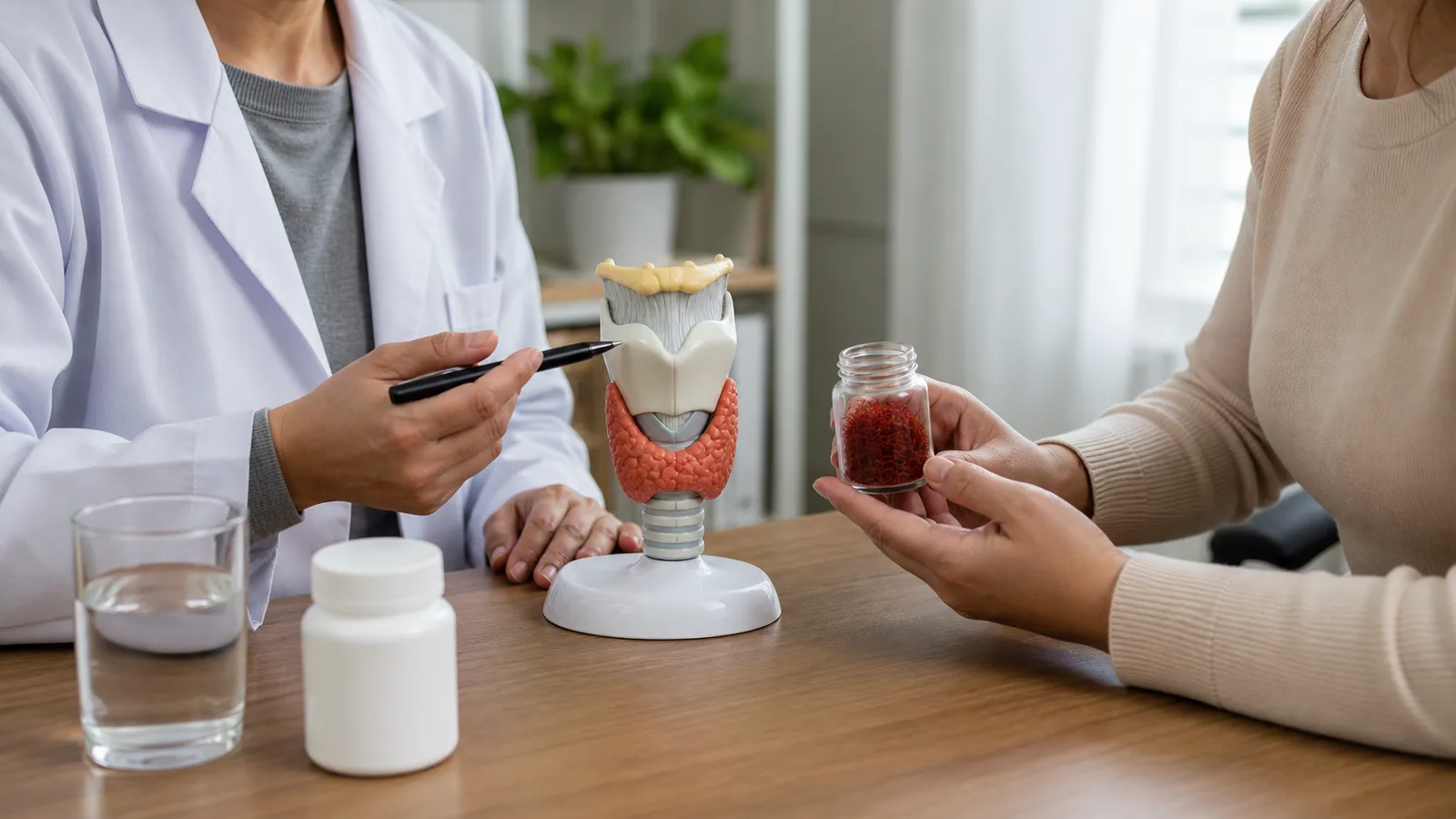
Research also does not show that saffron corrects an underactive or overactive thyroid. For people interested in saffron for thyroid health, the practical priorities remain accurate thyroid tests, consistent medication use and checking any supplement with the clinician or pharmacist who knows the full treatment plan.
What the thyroid does
The thyroid is a small gland at the front of the neck. Its hormones influence energy use, temperature, heart rate, digestion and many other processes. Hypothyroidism means the body has too little thyroid hormone; hyperthyroidism means it has too much. The symptoms can overlap with other conditions, so neither problem should be diagnosed from fatigue, weight change, mood or temperature sensitivity alone.
Clinicians use blood tests—commonly thyroid-stimulating hormone (TSH) and free T4, with other tests where indicated—to assess thyroid function and investigate the cause. The National Institute of Diabetes and Digestive and Kidney Diseases explains how those results are interpreted together.
Saffron and thyroid function: what is known?
Saffron contains crocin-related pigments, crocetin and safranal. Laboratory and clinical research in other fields has examined antioxidant, inflammatory and mood outcomes. Those findings do not establish a thyroid effect. An antioxidant mechanism in cells cannot show that saffron changes a person’s TSH or free T4, protects the thyroid from autoimmune disease, or restores damaged thyroid tissue.
Current human evidence does not provide a proven saffron dose for thyroid hormone regulation. It also does not show that culinary saffron prevents thyroid disease. Calling it “thyroid support” would therefore go beyond the evidence, even though it can still be enjoyed as a spice.
Is saffron good for the thyroid?
There is no demonstrated thyroid benefit to promise. Saffron adds aroma and colour to food, and small culinary amounts may fit an ordinary balanced diet. It should not be used to raise or lower thyroid hormones, shrink a goitre or nodule, or treat fatigue without finding its cause.
Stress deserves similar care. Saffron supplements have been studied separately for mood, but feeling calmer does not prove that the thyroid is working differently. If tiredness, low mood, palpitations or weight change persists, thyroid testing is more informative than trying to infer hormone levels from symptoms.
Can saffron help with hypothyroidism or Hashimoto’s disease?
Saffron is not a treatment for hypothyroidism. Hashimoto’s disease is an autoimmune condition and the most common cause of hypothyroidism. According to the NIDDK’s Hashimoto’s guidance, levothyroxine replaces the hormone a damaged thyroid can no longer make. Saffron does not replace that hormone.
No reliable clinical evidence shows that saffron reverses Hashimoto’s, normalizes thyroid antibodies or allows a person to reduce levothyroxine. Dose changes are based on symptoms, medical circumstances and repeat laboratory results. Stopping or altering treatment because an herb is described as anti-inflammatory can leave hypothyroidism undertreated.
Saffron for hyperthyroidism and Graves’ disease
There is likewise no established use for saffron in hyperthyroidism or Graves’ disease. The NIDDK’s hyperthyroidism overview describes treatment with medicines, radioiodine or surgery, chosen according to the cause and the person. Saffron does not block thyroid-hormone production or substitute for any of those options.
A racing or irregular heartbeat, chest pain, marked shortness of breath, fever with severe agitation, fainting or confusion needs urgent medical attention. Do not respond by taking saffron or an extra dose of thyroid medicine.
Does saffron interfere with thyroid medication?
No well-designed human interaction study has established a direct saffron–levothyroxine interaction. Official levothyroxine information does not list saffron as a named interaction. The evidence gap means the answer is “not known,” particularly for extracts and larger medicinal amounts, rather than a confident “no.”
How levothyroxine is taken still matters. MedlinePlus drug guidance says it is usually taken on an empty stomach, 30 minutes to one hour before breakfast. Calcium carbonate and iron supplements need at least four hours of separation. Follow the instructions for the prescribed formulation, because tablets, capsules and liquid products may have different details.
- Swallow levothyroxine in the manner stated on its label—normally with water, not saffron tea or saffron milk.
- Do not assume that adding saffron to milk removes the calcium issue or changes the empty-stomach instruction.
- Do not move, split or skip a thyroid dose to accommodate a supplement unless the prescriber or pharmacist tells you to.
- If a saffron extract is being considered, show the complete label and ingredient list; blends may contain more than saffron.
A 2025 drug-interaction review found that saffron and its constituents can affect some drug-metabolizing enzymes in laboratory or preclinical evidence, while stressing that the clinical significance and interaction doses still need research. Levothyroxine is not a reason to invent an interaction that has not been shown, but its narrow, individualized dosing is a good reason to avoid experimenting silently.
Culinary saffron versus a daily supplement
A few threads divided through a meal provide a far smaller and less standardized exposure than a capsule or concentrated extract. Safety evidence for one cannot simply be transferred to the other. A 2026 systematic review of human saffron safety found that medicinal preparations were generally tolerated, but adverse effects did occur and clinical monitoring may be appropriate with higher or prolonged use.
For ordinary cooking, bloom a modest pinch and use it for flavour. Our saffron cooking guide explains that process without turning it into supplement advice. If a thyroid test is due, tell the clinician about every supplement being taken rather than stopping it only on the morning of the test.
When to ask for a medication review
Contact the prescriber or pharmacist before starting a saffron supplement, and ask sooner if thyroid symptoms return after any change in food timing, supplement use, brand or formulation. A review is especially important during pregnancy, after major weight change, with heart disease, or when calcium, iron, antacids and other medicines are part of the same routine.
The most useful answer to “does saffron interfere with thyroid medication?” is transparent: a direct interaction has not been established, but concentrated use has not been cleared by good interaction trials either. Keep thyroid treatment consistent, separate medicine from food as directed, and treat saffron as a culinary ingredient unless a qualified professional has reviewed the exact product.