


Saffron cultivation in Bonab and Marand developed as growers in northwest Iran looked for a valuable crop suited to a dry climate and a cool-season growing cycle. Reports from the region describe small but expanding plantings, a shift away from water-intensive onions in Bonab, and a persistent commercial problem: much of the local saffron was sold in bulk and packaged elsewhere.
The two local accounts consolidated here describe different parts of that story. Agricultural researcher Saeideh Alizadeh Soltah discussed cultivation, harvest and processing in Bonab and Marand. Bonab governor Valiollah Farajollahi described the water crisis behind a proposed change in cropping patterns. Their numbers are historical statements, not a current acreage survey or a promise that saffron will perform equally on every field.
Why Bonab and Marand began growing saffron
Bonab and Marand lie in East Azerbaijan Province, far from Iran’s best-known saffron districts in the three Khorasan provinces. Alizadeh Soltah, a medicinal-plants academic at the University of Tabriz, identified the two towns and Tabriz as emerging production areas in an interview reported by ISNA.
The attraction is understandable. Saffron grows actively from autumn into spring and is dormant through much of the hot summer. Its marketable crop is the dried red stigma, so a small physical harvest can carry substantial value. The plant is also adapted to dry environments, although that does not mean it can produce a good crop without timely water.
The United Nations Food and Agriculture Organization describes Iran’s qanat-based saffron system as a response to severe water scarcity and notes that saffron requires comparatively little water. Field research in Iran adds an important qualification: water demand changes through the season, and inadequate irrigation can reduce flower yield. In other words, choosing saffron can reduce pressure compared with some alternatives, but field design and irrigation timing still matter.
Bonab’s water crisis and the change from onions
At a Lake Urmia restoration workshop, Farajollahi said four hectares in Bonab had been planted with saffron. He also identified more than 100 hectares with potential for the crop, provided growers could obtain government support and low-interest finance.
The governor linked that proposal to wells drying in the district and to the removal of about 500 hectares of onion cultivation. He reported that producing one kilogram of onions required approximately 500 litres of water and that reducing the onion area had saved about 132,000 cubic metres.
Those figures should be read as separate statements from the historical report. It did not provide the onion yield, irrigation period, measurement method or precise share of the 500 hectares used to calculate the saving. Combining the numbers without those missing denominators would create an unreliable water-use estimate.
Replacing a crop also involves more than comparing litres. Soil, water quality, corm health, labour at harvest, drying facilities and access to buyers all affect whether a saffron field is viable. Farajollahi therefore framed the transition as a supported change in cropping pattern, not as an instant remedy for Lake Urmia or for every farm with a failing well.
How the crop fits the local season
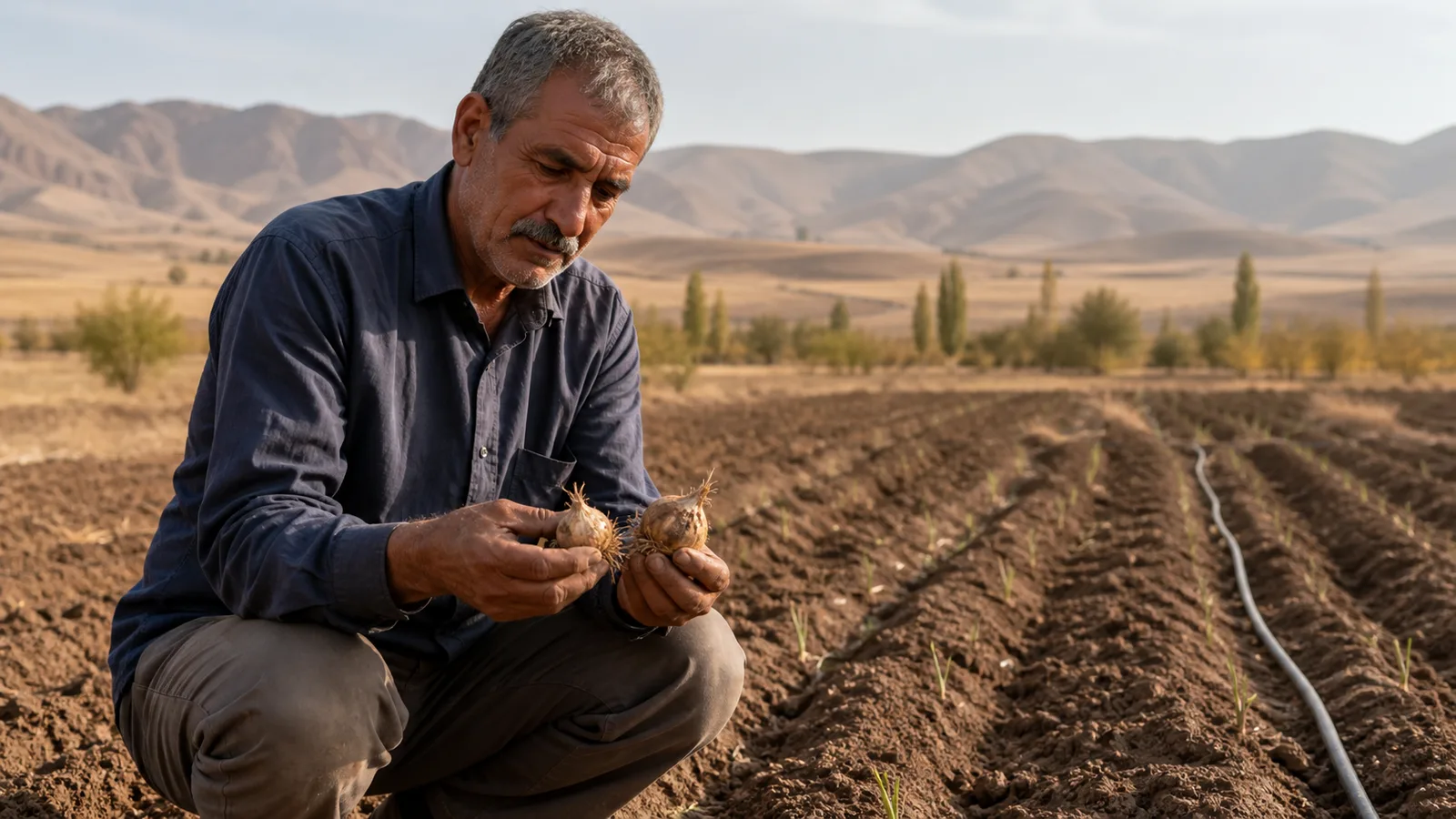
Saffron is a perennial Crocus sativus crop. Growers plant corms—underground storage organs often called bulbs locally—because cultivated saffron does not reproduce through viable seed. Once established, a planting can remain productive for several years before crowding, disease pressure or declining yield makes lifting and replanting advisable.
In the regional account, corms were generally planted in September and flowered in November. Purple flowers appear before or around the emergence of the narrow leaves, which continue growing through the cooler months. Exact dates move with altitude, soil temperature, rainfall and irrigation; September and November are a local description rather than universal calendar dates.
Alizadeh Soltah described two planting approaches. The traditional method placed three to five corms together in a hole around 20 centimetres deep. Row planting was presented as the method more compatible with mechanized field work. Research confirms that planting depth, corm size and density interact with flower and daughter-corm production, so the reported 20-centimetre practice should not be copied without local agronomic advice.
Water-efficient does not mean water-free
The plant’s summer dormancy and cool-season growth can align part of its demand with autumn and winter precipitation. This is one reason saffron is considered for arid and semi-arid districts. It still needs sufficient moisture at the stages that initiate growth, flowering and corm development.
A two-year Iranian study found saffron’s crop coefficient changed substantially across its cycle, while another field experiment found that supplying only half of the calculated water requirement reduced flower and corm yield in the second year. These results support a careful claim: saffron can have high water productivity and use less irrigation than many conventional crops, but drought tolerance is not immunity to water stress.
For a new Bonab or Marand field, a responsible assessment would therefore examine water availability across the whole growing season, not just an annual total. Drainage is also important because corms are vulnerable in persistently wet soil. Fertile, well-drained land and properly managed organic matter were among the conditions emphasized in the local cultivation report.
Harvest, yield and the work behind each kilogram
Flowers are picked during a short harvest window, then the three red stigmas are separated and dried. The small usable portion of each flower explains why finished saffron weighs so little relative to the field and labour behind it.
The Bonab-Marand account placed typical local yield at roughly four to five kilograms of dried saffron per hectare. That is a reported regional benchmark, not a guaranteed result. Field age, corm size and density, irrigation, soil, temperature, harvest timing and drying losses can move the number considerably. Our guide to understanding saffron yield per hectare explains why production totals and planted area do not always share the same denominator.
The original account also said a planting might be harvested for seven or eight years. That describes a possible field life, not necessarily its most profitable life. Growers need to monitor crowding, daughter-corm size, disease and the trend in stigma yield rather than replacing every field on a fixed date.
Processing and identity remain commercial challenges
Alizadeh Soltah said growers in Bonab and Marand lacked mechanized drying and packaging capacity and commonly sold the crop in bulk. According to her account, some was later packaged and sold under the better-known Khorasan name for domestic or export markets.
That practice can hide the true origin of the crop and prevent local growers from capturing value from grading, packaging and traceability. Better equipment alone is not enough: moisture control, clean handling, batch records and objective quality testing are needed if a regional name is to mean something to a buyer.
She also considered local saffron higher in quality than Khorasan saffron and associated part of the regional difference with planting depth. This remains an attributed opinion. The reports supplied no side-by-side laboratory results for colour strength, aroma, bitterness, moisture or adulteration, so they do not establish that one origin is categorically superior.
What gives saffron its colour, taste and aroma
Crocin compounds are principally responsible for saffron’s colour, picrocrocin for much of its bitter taste, and safranal for its characteristic aroma. These compounds are useful when explaining quality, but their presence does not by itself prove a geographical origin or a health effect.
The local interview also noted research into petals and stamens, which are normally separated from the commercial stigmas. Laboratory studies have explored antioxidant compounds and possible uses in food, dyes, cosmetics and pharmaceuticals. Such research may create future value from harvest by-products, but laboratory activity should not be rewritten as evidence that saffron prevents or treats disease in people. For a broader introduction to the plant, see our guide to Iranian saffron.
What would show whether the transition succeeded
A current evaluation needs more than the historical four-hectare starting point or the proposed 100-hectare capacity. It should compare planted and bearing hectares by year, irrigation supplied, dried-stigma yield, corm survival, labour cost, grade-test results and the share sold with traceable Bonab or Marand origin.
Those measurements would answer the practical question left open by both reports: whether saffron became a durable, water-conscious business for local growers rather than simply a promising replacement crop. Until such data are available, the sound conclusion is narrower. Bonab and Marand had suitable seasonal conditions and a clear reason to experiment with saffron, while reliable water, skilled production and local processing remained essential to the outcome.
Sources and research context
- Regional cultivation statements attributed to Saeideh Alizadeh Soltah in an ISNA interview preserved in the destination report.
- Bonab acreage, onion-replacement and Lake Urmia statements attributed to governor Valiollah Farajollahi in the Mehr News report preserved in the source article.
- FAO: Qanat-based Saffron Farming System in Gonabad, Iran.
- Journal of Arid Environments: crop and pan coefficients for saffron in semi-arid Iran.
- Scientia Horticulturae: irrigation level and planting density effects on saffron.

![Exporting Saffron to Turkey + Price Guide [Complete 0 to 100]](https://img.rowhanisaffron.com/20260827003933/saffron-export-turkey-quality-inspection.webp)



