


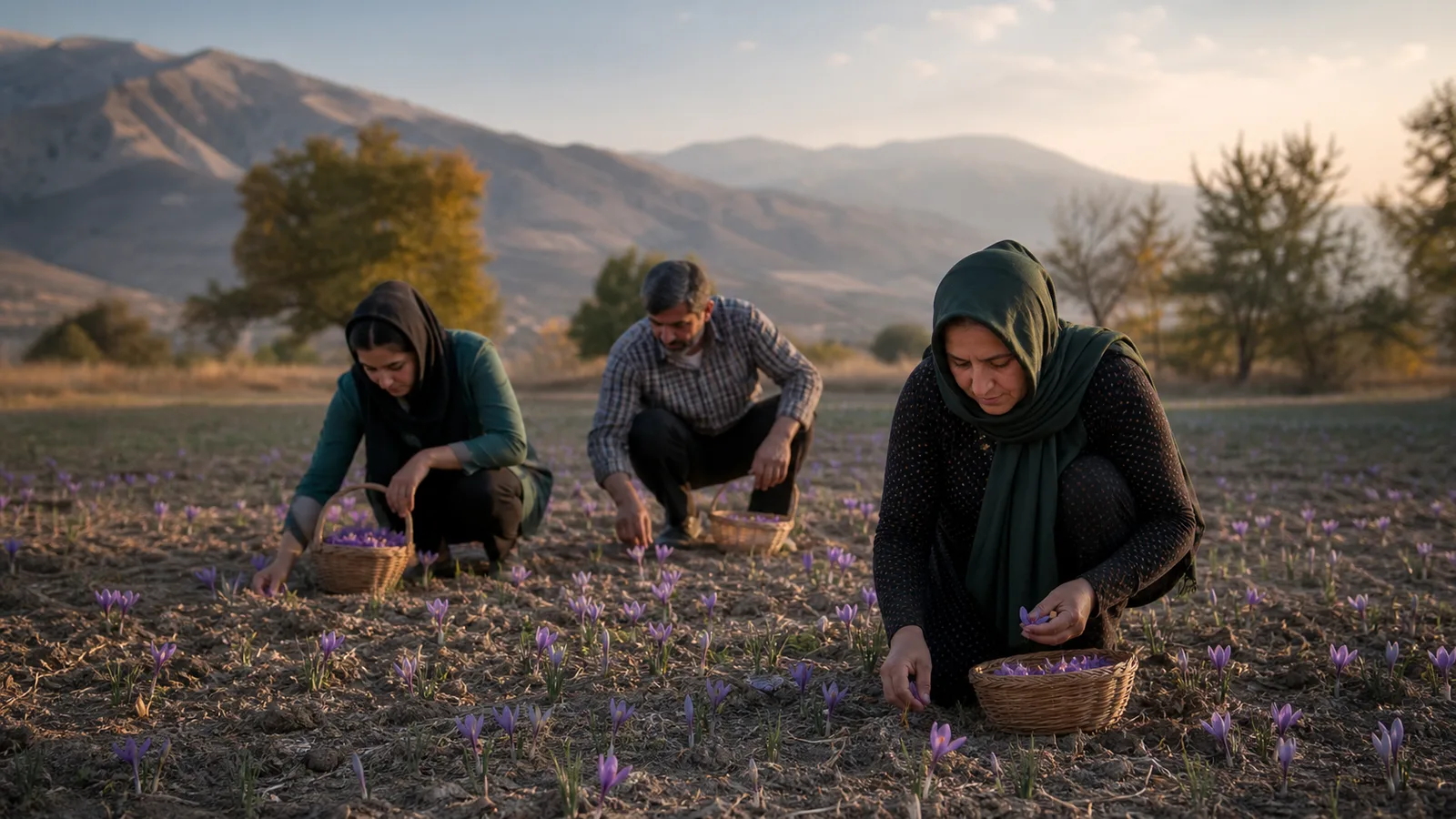
The headline Saffron was removed in Yasuj came from a machine-translation error. The original report meant that saffron was harvested in Yasuj, in Iran’s Kohgiluyeh and Boyer-Ahmad Province. It followed one family that expanded a small field, handled the crop from planting through packaging and brought its saffron to market.
The story is useful because it shows what small-scale saffron production looks like outside Iran’s main Khorasan growing areas. Its figures are historical, not current prices or provincial totals, and several claims need translation or evidence corrections.
Saffron harvest in Yasuj: what was reported
IRIB News said saffron was being grown in Kohgiluyeh and Boyer-Ahmad through small household enterprises. Across the province, the report put more than one hectare under saffron and said about four kilograms of dried spice had been harvested.
Those totals appear to refer to the collection of small farms, not only the featured household. They describe an early, limited production base rather than an established large industry.
The old translation called saffron a “subtropical herb” that preferred mild winters and “hot and cold summers.” That climate sentence is internally inconsistent. Crocus sativus is a perennial corm crop adapted to dry summer dormancy and autumn flowering, but site response depends on temperature, elevation, drainage, soil and the timing of irrigation.
The Yasuj family’s field
The family said it began in the Iranian year 1393 with 2,000 square metres of agricultural land. The translation merged those details into “93.2 thousand metres.” The report said the family later expanded the planted area to 5,000 square metres, or half a hectare.
In the season covered, it harvested 200 grams of dried saffron and attributed the result partly to weather. Spread over the stated half-hectare, that is a low first-level output, but the article did not report field age, productive area, corm density, irrigation, disease, flower count or drying loss. It cannot establish the normal yield for Yasuj.
Saffron fields often change as corms multiply and the stand matures. A useful farm record should separate planted area from bearing area and record flower weight, dried stigma weight, labour and moisture conditions for every season.
Jobs created by the small enterprise
The original Persian context said the activity created work for four people directly and 25 indirectly. The English translation incorrectly turned the second group into “directly unemployed.” Saffron can require many hands during a short harvest because flowers are picked promptly and stigmas are separated before deterioration.
The family reportedly managed every stage itself: planting, field care, harvesting, stigma separation, packing and sale. That vertical approach can keep more value near the farm, but each stage needs controls. Flowers should be kept clean, separated without delay, dried consistently and protected from moisture and contamination. Packaging should identify the lot and responsible producer rather than merely look attractive.
The six-million price was in tomans, not dollars
The source put saffron at six million tomans per kilogram at the time. The old English article changed that to “6 million USD,” which was a serious unit error. It was a historic local-price statement in Iranian currency, not a present quotation and not six million US dollars.
Price alone also says little about farm profit. A grower has to account for corms, soil preparation, irrigation, weeding, flower picking, stigma separation, drying, grading, packaging, rejected material and sales costs. A price from one season should never be copied into a current business plan.
The national figures in the old report
The article said Iran produced more than 250 tonnes of saffron annually, valued above 625 billion tomans, held the leading global position in production and trade, and exported to 46 countries. These were national figures published with the historical Yasuj story; they are not current trade data.
National scale does not automatically create a buyer for a new local farm. Yasuj producers still need repeatable quality, honest grading, traceability and a route to packers or customers. The Codex standard for dried saffron provides a shared reference for identity, quality, hygiene, contaminants and labelling.
Health claims included in the news item
The old report briefly said saffron was used for asthma, skin and eye diseases, stomach pain and anaemia. That list combines traditional uses and medical conditions without naming a preparation, dose, trial or outcome. It should not be read as evidence that culinary saffron treats any of them.
Clinical research has examined standardised saffron preparations for several outcomes, but an evidence map of saffron meta-analyses found uneven review quality and called for larger, high-quality trials in multiple countries. Asthma symptoms, visual changes, persistent stomach pain and suspected anaemia need appropriate diagnosis; a spice cannot identify the cause.
What a grower should check before expanding
- Site: test drainage, soil texture and salinity, and map frost and water availability.
- Corms: use healthy, traceable planting material and prevent movement of pests or disease.
- Labour: plan for the concentrated flower-picking and stigma-separation window.
- Drying: standardise time, temperature, cleanliness and final moisture protection.
- Market: agree on grade, test method, pack size and buyer before assuming a selling price.
- Records: compare several seasons before attributing a result to climate or technique.
For a half-hectare family enterprise, these checks matter more than a national production headline. A small field can be worthwhile when it fits the land and household labour, but expansion magnifies mistakes as well as successes.
The lasting point of the Yasuj story
The article did not report that saffron had been removed from Yasuj. It reported a harvest: a family had grown from 2,000 to 5,000 square metres, collected 200 grams in the featured season and handled the chain through market, while the province’s small plots together exceeded one hectare and about four kilograms.
Its strongest lesson is the family’s control over the whole process. If that work is supported by accurate records, clean drying, honest packaging and realistic pricing, a small Yasuj crop can build local value without exaggerating yield, medicine or market size.
Historical source: IRIB News, as cited in the original post.

![Exporting Saffron to Turkey + Price Guide [Complete 0 to 100]](https://img.rowhanisaffron.com/20260827003933/saffron-export-turkey-quality-inspection.webp)



