


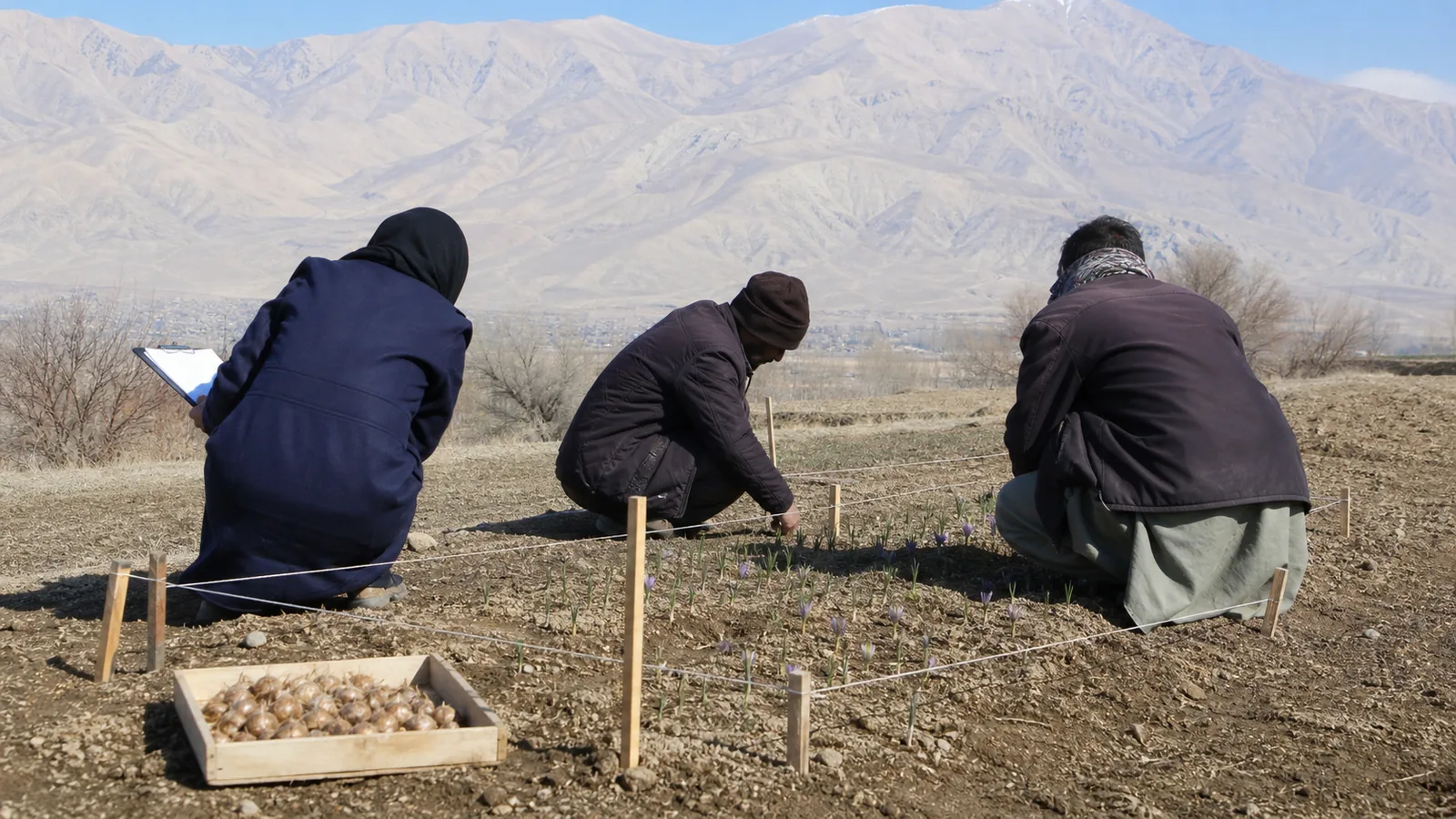
Bamyan’s first saffron plantings were demonstration trials, not proof that the crop should replace potatoes across the province. In 2017, agricultural officials reported encouraging results from small plots in central Bamyan and Kahmard, while also finding that the cold province, corm supply, local water, and the economics of established crops made the decision highly site-specific.
The trials matter because they tested saffron beyond Afghanistan’s established production centre in Herat. They also offer a useful lesson for any new growing region: the first flowers answer only one question. Long-term suitability depends on several seasons of yield, healthy corm multiplication, labour, processing quality, and a dependable market.
What Bamyan’s first saffron trials involved
Mohammad Ayub Ahmadi, then extension director in Bamyan’s Department of Agriculture and Livestock, told Pajhwok Afghan News that farmers planted nine demonstration plots in the first year and five in the second. The work covered central Bamyan, Kahmard, and Yakawlang.
Ahmadi said the most favourable results appeared in Kahmard and central Bamyan. In the earliest demonstration plots, the reported dry saffron yield was 80 grams per jerib. A jerib is the local land unit used in the source; the article did not give a surveyed area for each plot, so the original unit is retained rather than creating false precision.
The full 2017 Pajhwok report makes clear that this was experimental cultivation over the preceding two years. It should not be read as a current production estimate.
Correcting two errors in the old English version
The earlier machine translation changed two important quantities:
- Farmer Mohammad Nasim had planted two jeribs of saffron in central Bamyan, not two hectares.
- The provincial horticulture programme reported 1,322 orchards, each with 66 fruit saplings, not 1,382 gardens.
The fruit list in the source included apple, apricot, plum, grape, and walnut. That orchard programme was separate from the saffron trial, but it shows the wider agricultural diversification work being discussed at the same time.
Herat corms supplied the Bamyan trial
Abdul Wahhab Mohammadi, then head of agriculture in Bamyan Province, said saffron corms had been brought from Herat. The intention was to multiply planting material within Bamyan so growers would not remain dependent on transport from another province.
The Aga Khan Development Foundation also distributed saffron corms to selected farmers for demonstration plots in Waras, Panjab, and Shibar, working through the provincial extension programme. These distributions expanded the test into districts with different local conditions.
Corm multiplication can add value, but it should not be counted as guaranteed profit. Daughter corm size, health, storage, demand, and the cost of lifting and grading all affect what can actually be sold or replanted.
Why Bamyan was a demanding place to test saffron
Cold conditions vary within the province
Bamyan is a high, cold province, while saffron’s flowering and leaf cycle responds strongly to temperature. Ahmadi noted that warmer districts generally gave better results. A favourable plot in Kahmard did not make every colder field equally suitable.
Trial records should include elevation, planting and irrigation dates, emergence, flowering, winter damage, spring leaf growth, and the time when foliage becomes dormant. Without those observations, a yield number is difficult to transfer to another district.
Water availability changes the comparison
Mohammad Nasim said central Bamyan had substantial water and that potato yield there was higher than saffron yield. This is an important counterweight to the common claim that saffron should automatically replace a more water-demanding crop. Where farmers already have a productive potato system and market, saffron has to be compared against that real alternative.
Corm transport adds cost and risk
Nasim also identified the shortage of local saffron corms and the difficulty of bringing them from Herat. Long transport can add expense and exposes planting material to heat, moisture, injury, mixing, and delay. A local multiplication programme needs careful health and grading practices so that independence from imported corms does not spread weak material.
Saffron versus potatoes in Bamyan
The 80-gram trial result generated less immediate revenue per jerib than potatoes, according to Ahmadi. Officials and farmers saw potential for saffron income to rise as corms multiplied and could be sold. That is a two-part business model: dry spice plus planting material.
A fair comparison should separate the two:
- revenue from dry saffron threads;
- revenue from genuinely saleable graded corms;
- labour for picking, separating, drying, lifting, and grading;
- storage and transport costs;
- the establishment years before a mature result;
- water and land opportunity cost; and
- price risk for both saffron and potatoes.
Selling daughter corms can look attractive while cultivation is expanding, but that market may change once local demand is filled. A farm plan should still make sense when corm sales are lower than hoped.
What a successful demonstration plot should measure
Flowering is encouraging, yet it is not the only outcome. A serious multi-season trial records dry yield, grade, flower-to-dry conversion, labour hours, corm survival and multiplication, irrigation, pest or disease observations, processing losses, and the price actually received.
It should also keep each location separate. Combining a warm Kahmard plot with a colder highland plot can produce an average that describes neither field well. Site-level records help extension staff recommend where expansion is justified and where another crop remains the better choice.
The right lesson from Bamyan’s first planting
The early Bamyan programme did not show that saffron was universally superior to potatoes. It showed that farmers and extension staff could establish the crop in selected locations, obtain an initial dry yield, and begin learning which districts offered better conditions.
That is exactly what a demonstration should do. It reduces uncertainty before large investment. Bamyan’s first saffron planting is best remembered as a careful test—with promising plots, real constraints, corrected numbers, and enough mixed evidence to justify measurement rather than hype.

![Exporting Saffron to Turkey + Price Guide [Complete 0 to 100]](https://img.rowhanisaffron.com/20260827003933/saffron-export-turkey-quality-inspection.webp)



