


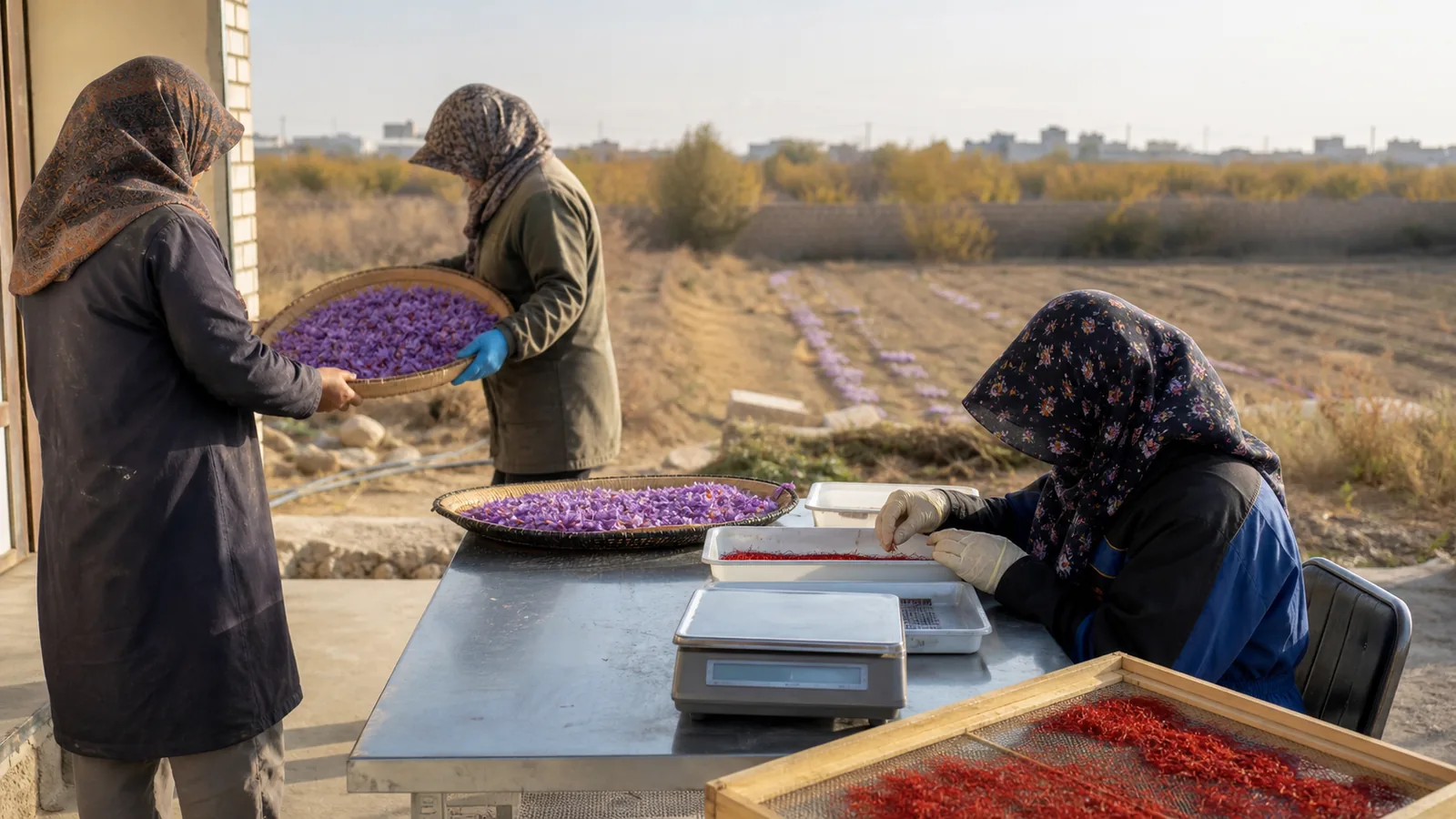
Varamin produced a reported 18 kilograms of dried saffron from a little over six hectares when this local account was published. The implied average—about three kilograms per hectare—showed that saffron had established a small but visible place in the county’s agriculture. It did not yet make Varamin a high-volume saffron centre.
The numbers are historical, not a current production forecast. Their value today is as a case study in how a new crop moves from a handful of growers toward a more organised local sector, and why planted area alone does not guarantee profitable growth.
Varamin’s reported saffron production
The original report gave three connected figures:
- more than six hectares of arable land were under saffron;
- the average dry yield was about three kilograms per hectare; and
- more than 18 kilograms of saffron were produced and marketed in the county.
Those figures are internally consistent: six hectares multiplied by three kilograms per hectare gives 18 kilograms. They describe a modest production base in the late 2010s, not “lots” by the standards of Iran’s major saffron provinces.
A separate contemporaneous agriculture report cited more than five hectares, an average of four to five kilograms per hectare, and 20–25 kilograms in an annual harvest. The 2017 Varamin agriculture report shows why year, field maturity, and reporting date must accompany any production number. This page preserves its own 18-kilogram figure rather than blending the two into a false average.
Who described the local saffron sector?
Reza Tajik, introduced as a local agricultural and economic activist, argued that Varamin had the climate and farming capacity to produce more saffron. He connected the crop with farm profitability, regional income, and the possibility of reaching domestic and export markets.
Mohammad Hussein Tajik, then head of the local Agriculture Jihad office, said Varamin had made progress in cultivation and praised the growers working in the sector. He cited the area and average yield figures and said the autumn harvest began around November.
Both speakers called for more support and farmer effort. The report used the policy language of the “resistance economy” to frame domestic production and non-oil exports. That is part of the article’s historical setting; it is not a substitute for a field budget or evidence of current support programmes.
Why Varamin could grow saffron
Varamin lies southeast of Tehran and has a long agricultural tradition. Saffron’s summer dormancy and autumn flowering can fit dry regions, while the crop’s low bulk makes careful processing and transport possible without moving large tonnage.
Suitability still varies within a county. A grower needs well-drained soil, healthy corms, timely irrigation, manageable salinity, suitable temperatures, and enough labour for the flowering peak. The statement that a region is “prone to agriculture” is too broad to answer those field-level questions.
Drainage and salinity
Corms are vulnerable when water remains around them. Soil structure, compacted layers, irrigation quality, and salinity should be assessed before planting. A crop promoted for lower water demand can still fail if the available water or soil is unsuitable.
Heat and flowering timing
Summer dormancy does not remove the effect of temperature. The corm’s seasonal development and autumn emergence respond to conditions over time. Local trials and records from nearby successful fields are more useful than a calendar copied from Khorasan.
Harvest labour
Flowers may appear in concentrated waves. Each day’s crop needs prompt picking, careful transport, stigma separation, and controlled drying. A small six-hectare sector can coordinate this informally; expansion requires a deliberate labour and processing plan.
What three kilograms per hectare does—and does not—mean
A county average hides differences between young and mature plots, corm density, field condition, harvest efficiency, and season. Three kilograms from one carefully managed hectare is not the same business result as the same yield from a field with higher labour or corm costs.
For a meaningful comparison, growers should record:
- field age and planted corm weight or count;
- flower number and dry saffron weight;
- labour hours for picking, separating, and drying;
- grade and rejected material;
- irrigation and crop-care costs;
- corm survival and multiplication; and
- the price actually received for each batch.
These records reveal whether yield is improving and whether additional hectares would strengthen the farm or simply multiply its bottleneck.
From local production to a real market
The report said Varamin saffron was sent to different markets and imagined a larger role in domestic and international sales. Reaching an export customer requires more than producing a recognisable spice. Buyers may expect a defined grade, batch identity, food-safety controls, appropriate testing, reliable quantity, compliant packaging, and repeatable delivery.
A small origin can build value through traceability and consistency. Growers or processors can keep lots separate, record drying conditions, use accurate weights, protect threads from moisture and light, and identify the county honestly. An origin name should help a buyer trace the product, not merely decorate a package.
How Varamin could judge future growth
More saffron is worthwhile only if quality and grower returns remain sound. A local programme should monitor productive area rather than announced area, dry yield and grade, water and labour use, processing capacity, corm health, buyer concentration, and farm-gate price.
The historic 18-kilogram harvest showed potential at a small scale. The better question is not whether Varamin can plant more saffron. It is whether each new field can be supported from healthy corm to a traceable, well-dried batch with a buyer. That is how a promising crop becomes durable local production.

![Exporting Saffron to Turkey + Price Guide [Complete 0 to 100]](https://img.rowhanisaffron.com/20260827003933/saffron-export-turkey-quality-inspection.webp)



