


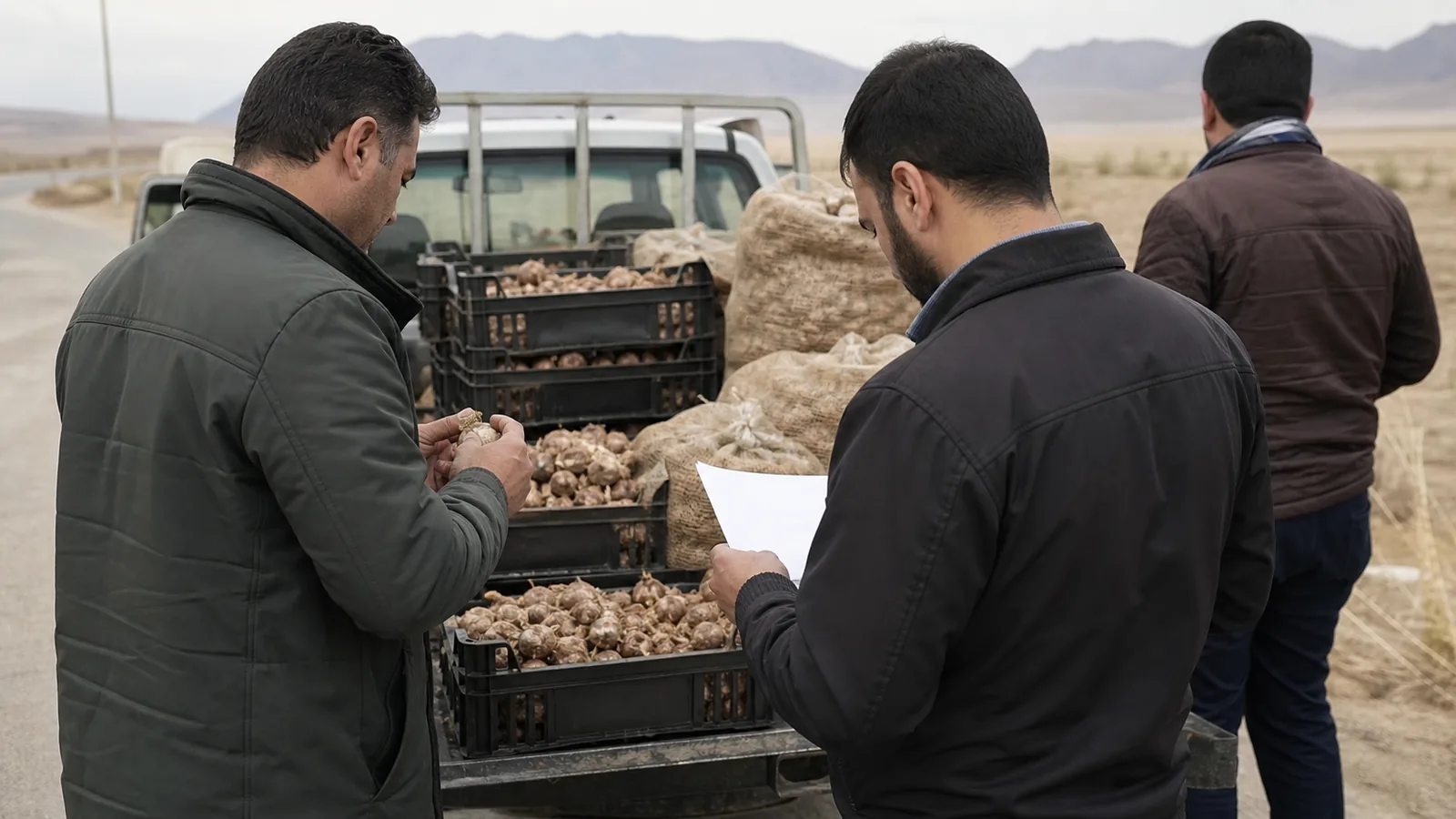
Police in Sarayan reported seizing two tonnes of saffron corms being transported without the required permit in a Nissan pickup. The 2018 news item valued the load at 80 million rials, said the vehicle was detained, and stated that a case and the accused driver were referred to the prosecutor’s office.
The event was about planting material, not dried saffron spice. It is also more accurate to describe it as a reported seizure and legal referral than to declare a named person guilty. The original item did not identify the driver or provide a later court outcome.
What happened in the Sarayan saffron-corm case?
According to the provincial Young Journalists Club report from Birjand, officers at a checkpoint in the Doostabad area became suspicious of a passing Nissan pickup and stopped it for inspection.
The police account said they found two tonnes of saffron corms without a transport permit. Experts estimated the consignment’s value at 80 million rials. The pickup was impounded, a file was opened, and the accused was sent to the prosecutor’s office for the legal process.
The commander’s name was mistranslated in the old English version as “Colonel Brothers,” and the county appeared as “Sariyan.” The place is Sarayan in South Khorasan. Without the original Persian name in the surviving page, the officer’s surname should not be reconstructed from the English error.
The corms were seized, not reported destroyed
One sentence in the earlier translation could be read as saying that the corms were “seized and destroyed by Nissan carriers.” That is not a coherent account of the event. The reported meaning is that police discovered and seized the corms in a Nissan pickup.
The article did not state that the corms were destroyed, returned, sold, quarantined, or otherwise disposed of. It also did not report a conviction. Those outcomes remain unknown.
Why saffron corm transport may be controlled
Saffron corms are live propagation material. Moving them between farms or regions can carry more than a commercial value: a load may also move soil, pests, disease, mixed grades, or poorly handled planting stock. Traceable movement helps agricultural authorities and buyers understand where corms came from and where they are going.
Controls can also be used to protect a regional crop and monitor large commercial movements. The exact permit, timing, inspection, and documentation requirements depend on place and date. A rule reported in a 2018 police story should not be treated as a complete current legal guide.
Contemporaneous reporting from Sarayan described growers’ wider concern about unregulated corm movement, alongside water, prices, intermediaries, and farm management. A 2017 report on Sarayan growers also emphasised the importance of field records for water, soil, corm source, planting, pests, disease, irrigation, and flowering.
What a lawful corm consignment should document
Before moving a commercial quantity, the grower, seller, and carrier should confirm the current requirements with the relevant agricultural and transport authorities. Depending on the route, useful records may include:
- the owner and source farm;
- the destination and intended planting use;
- weight, count, or grade of the corms;
- lifting and dispatch dates;
- health or inspection records where required;
- invoice or transfer document; and
- the applicable movement or transport permit.
This list is a traceability framework, not a declaration of the present law. Requirements can change, and cross-border movement can involve additional plant-health and customs controls.
Why corm quality matters to the buyer
A permit does not by itself guarantee that planting material is good. Buyers should inspect a representative sample for size, firmness, injury, decay, excessive soil, and signs of poor storage. The lot should be consistent with its description and kept dry and ventilated during transport.
Large corms generally carry more reserves than small daughter corms, but size alone is not a health certificate. A cheap two-tonne load can become costly if it establishes poorly, spreads a problem, or includes a high proportion of unusable material.
Responsible transport protects both farms
The source farm needs a clear record of what left. The receiving farm needs enough information to isolate, inspect, grade, and plant the material appropriately. Containers and vehicles should not expose corms to crushing, trapped moisture, excessive heat, or contamination from a previous load.
For the carrier, the safest approach is to confirm documentation before loading rather than discovering a missing requirement at a checkpoint. The buyer should keep copies with the batch records instead of treating transport as separate from crop traceability.
A legal report, not a verdict
The headline “Arresting saffron smuggler” compresses a police allegation and procedural step into a verdict. The more precise historical record is that Sarayan police reported an unpermitted two-tonne corm shipment, detained the vehicle, identified an estimated value, and referred the accused and case to prosecutors.
That distinction protects accuracy while preserving the story’s practical lesson. Saffron corms are valuable live planting material. Moving a large load without the required records can expose the consignment, vehicle, seller, buyer, and farms themselves to avoidable risk.

![Exporting Saffron to Turkey + Price Guide [Complete 0 to 100]](https://img.rowhanisaffron.com/20260827003933/saffron-export-turkey-quality-inspection.webp)



