


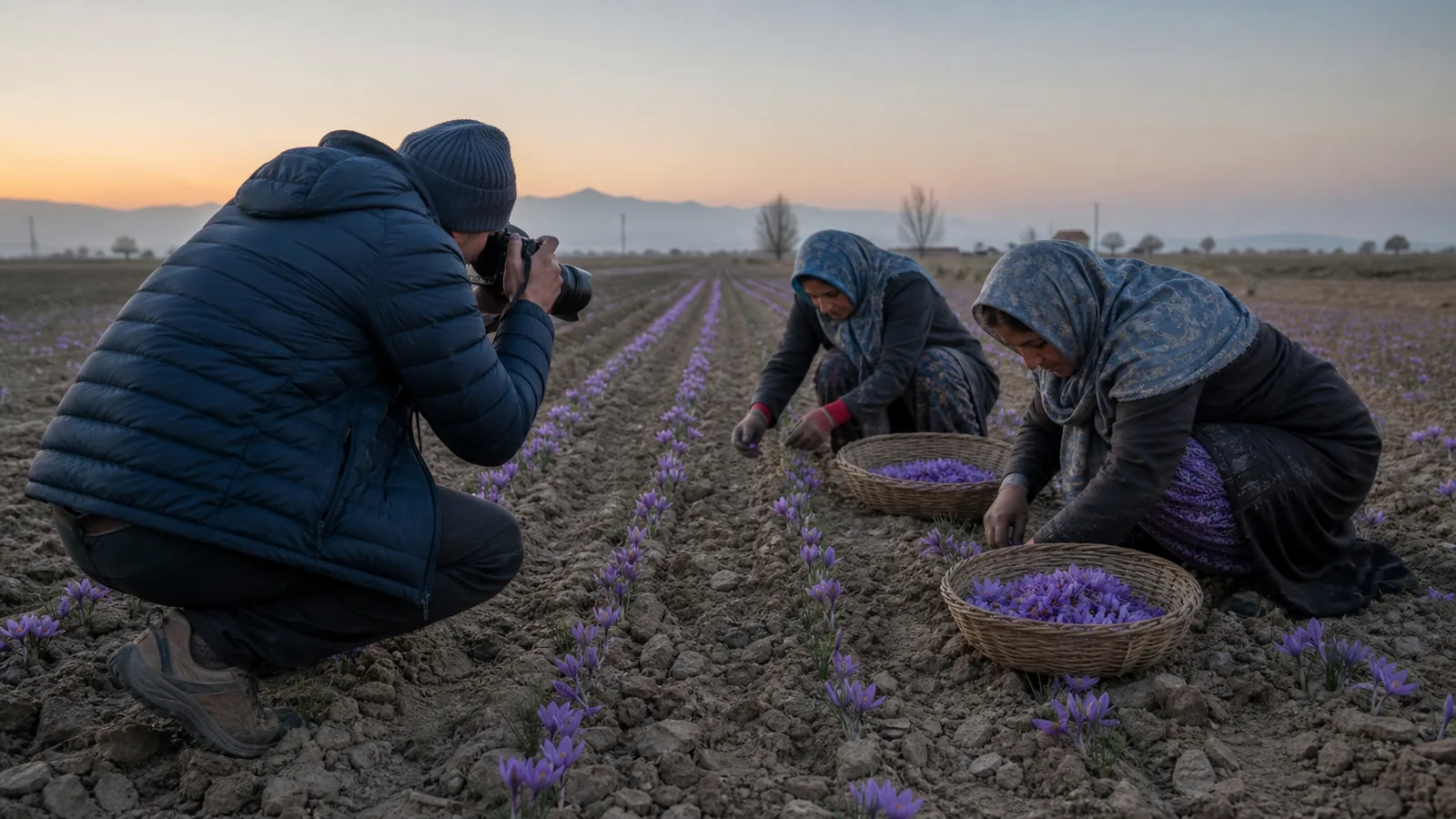
The Saffron Photo Festival in Torbat-e Heydarieh and Zaveh was created to document more than a colourful autumn harvest. Its photographers followed saffron from the field through separation, processing and packaging, recording the work and local economy behind one of Khorasan’s best-known crops.
The reports preserved here cover the festival’s second and fifth editions. They are historical accounts, not an announcement of a current event. Together they show how a regional photography programme grew into a gathering that drew national photographers, international news organisations and plans for a wider international future.
The second national Saffron Photo Festival
The destination article describes the second national festival in Zaveh and Torbat-e Heydarieh. Seyyed Mohammad Mohammadi, identified as the festival secretary in that report, said 100 photographers from around Iran took part. Photographers working with the Associated Press, Agence France-Presse and Turkey’s Anadolu Agency also came to the saffron fields while the festival was underway.
Participants were asked to photograph the complete cycle of the crop: picking flowers, separating the stigmas, processing the threads and preparing saffron for sale. The main section used digital cameras, while a separate mobile-photography section opened the event to another form of visual reporting.
That structure gave the festival two jobs. It created a record of a brief seasonal harvest, and it showed consumers that saffron does not begin in a jar. Each image could connect the finished spice with the people, timing and careful handwork required to produce it.
The production landscape behind the photographs
The second-edition report placed the festival in a large saffron-growing area. It gave historical figures of 70,000 hectares of saffron in Khorasan Razavi, including about 11,000 hectares in Zaveh and 8,400 hectares in Torbat-e Heydarieh. It also said 117,000 households across the province were involved in cultivation, with 14,000 to 15,000 of those households in Torbat-e Heydarieh.
Average yield was reported at about four kilograms per hectare for Khorasan Razavi and about 4.2 kilograms in Torbat-e Heydarieh and Zaveh. These numbers reflect the period covered by the festival report. Acreage, output and household participation change, so they should not be used as current statistics without a dated official dataset.
The geographic context still explains the festival’s subject. In the weeks of flowering and harvest, whole communities move through fields and processing rooms. Our article on saffron in Khorasan looks more closely at that regional production story.
How the fifth edition expanded
By its fifth consecutive year, the festival report described a larger event held across Torbat-e Heydarieh and Zaveh for four days beginning on 11 November. The account named Suleiman Goli as secretary and said 2,500 photographs had reached the secretariat.
More than 300 résumés were submitted from the beginning of October, with over 100 photographers invited. The numbers refer to applications and photographs, not necessarily 300 on-site participants. Making that distinction preserves the scale of the response without inflating attendance.
Photographers and journalists were reported from Turkey, Germany and France. Media participation included Anadolu Agency, France 24, Al-Alam, the Associated Press and Greek media, along with other international networks. The source uses broad wording and does not provide a complete accredited-media list, so the names are retained as the organisers reported them.
A new Torbat-e Heydarieh section
Goli said a special section devoted to Torbat-e Heydarieh was added for the first time in the fifth edition. That gave photographers space to show the city itself, not only close views of purple flowers and red stigmas.
A place-focused section can hold the parts of the saffron story that a product photograph misses: dawn travel to the fields, temporary harvest work, family sorting, local markets, transport, landscape and the relationship between the city and nearby villages.
What the festival asked photographers to record
Mohammad Reza Mohammadi, described in the report as an arts and cinema official in Khorasan Razavi, outlined several themes:
- harvesting and the short flowering season;
- processing, separation and packaging;
- the crop’s effect on work and daily life in Torbat-e Heydarieh and Zaveh;
- saffron tourism and the experience of visiting the region;
- hygiene during harvest and post-harvest handling; and
- the identity of Khorasan as a major centre of production and supply.
The organisers also spoke of increasing per-capita saffron consumption. Photography cannot establish a product’s quality or make a health claim, but it can help people understand how saffron is grown and why clean handling, careful separation and suitable packaging matter.
Documentary value beyond promotion
A harvest festival naturally promotes its host region, yet its most durable value may be documentary. Saffron flowers for a short period, and much of the labour happens before many visitors are awake. A systematic photo archive can preserve work methods, clothing, tools, field layouts, processing spaces and the roles of different family members across years.
That archive is most useful when captions retain the basics: photographer, date, location, activity and the names or consent status of identifiable people. A striking photograph without context can travel widely, but a documented photograph can also support local history, agricultural education and responsible tourism.
Images of hygiene need similar care. A clean-looking scene is not a food-safety inspection, and a dramatic image of a worker is not proof of working conditions across the region. Festival photography should invite closer attention without claiming more than the frame can show.
From a national festival toward an international one
Mohammadi said the organisers hoped to hold the festival internationally in the future and bring more photographers to the region. The fifth edition’s overseas media and photographer participation was a step in that direction, although the source article did not say that the event had already become a formally international competition.
Later public festival activity indicates that the programme continued beyond the editions described here, but this article keeps its detailed counts tied to the second and fifth editions. A future event should be checked against a current organiser announcement before anyone relies on dates, submission rules or attendance information.
Why the Saffron Photo Festival matters
Torbat-e Heydarieh and Zaveh did not need photographs to prove that saffron was grown there. They used photography to make the production story visible: thousands of flowers picked in a narrow window, stigmas separated by hand, threads protected during processing and families whose seasonal work rarely appears on a retail label.
The second edition established that documentary focus with 100 photographers and field access. The fifth drew 2,500 submitted images, more than 300 résumés, international media attention and a dedicated Torbat-e Heydarieh section. Read together, the reports describe a cultural record becoming larger and more outward-looking while keeping the harvest, the workers and the region at its centre.

![Exporting Saffron to Turkey + Price Guide [Complete 0 to 100]](https://img.rowhanisaffron.com/20260827003933/saffron-export-turkey-quality-inspection.webp)



