


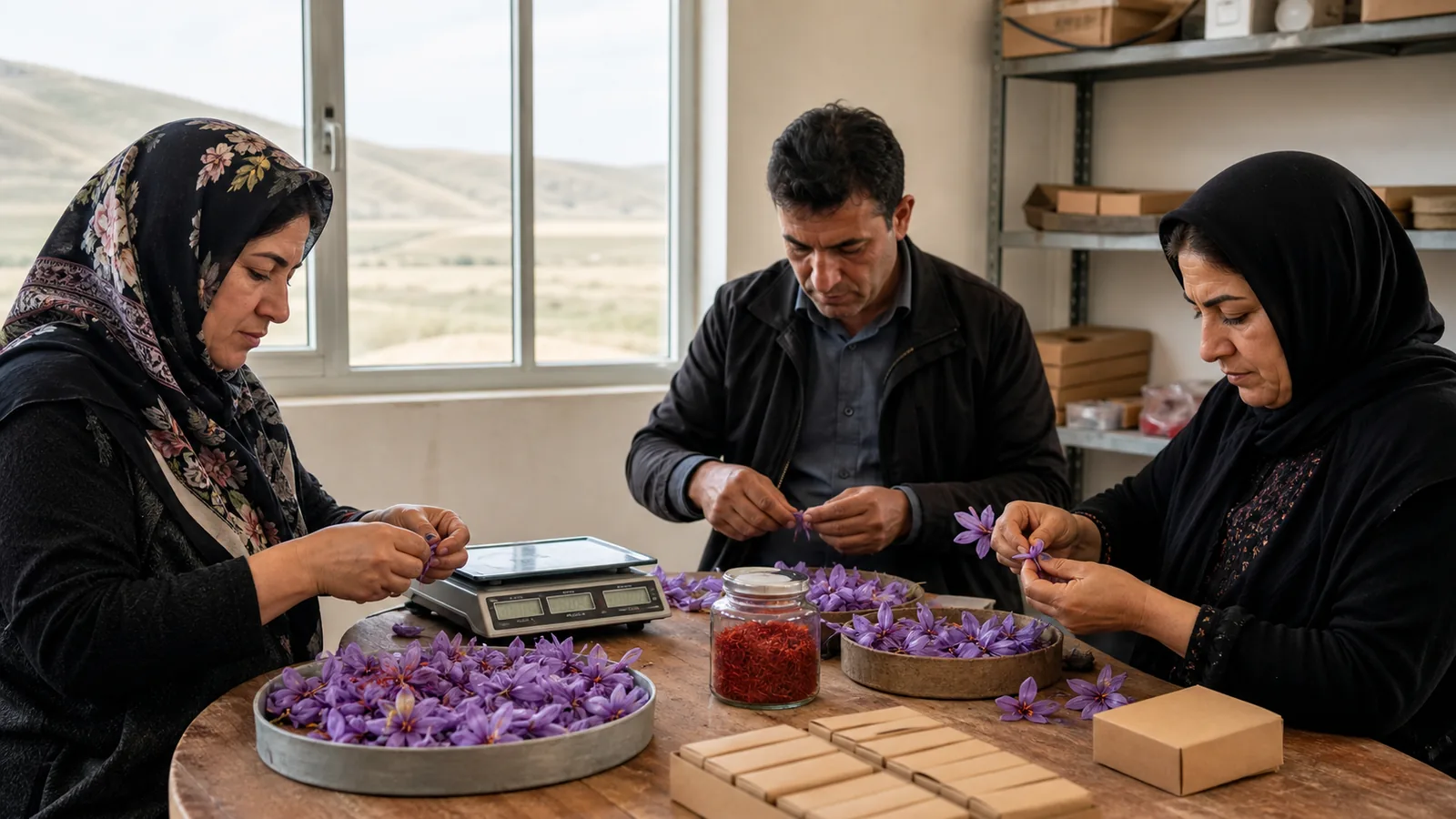
A saffron cooperative covering 240 households was announced in Germi County as a way to help growers produce, process, package, and sell their crop more effectively. The historical report also said 12 local areas had been identified for possible saffron development, with modern irrigation and lower water demand shaping the plan.
The announcement described a support structure, not a guarantee of profit or proof that every field in Germi is suitable for saffron. Its practical value lies in showing what small growers can do together that is difficult to manage alone.
What was announced for Germi saffron growers
According to the original ISNA report, Germi County Governor Imami said the first local saffron-production cooperative had been formed with coverage for 240 households. The cooperative was intended to organise production and improve how saffron reached the market.
The earlier English translation repeatedly changed Germi into “Garmi,” “Grammy,” and even “grams.” These were translation errors, not different places. The report concerns Germi in Ardabil Province in north-western Iran.
Imami said the cooperative could provide a route for several forms of assistance, including access to bank facilities and saffron planting corms. The Persian reference was to saffron corms, sometimes loosely called bulbs, not to “production basins” as the old English text stated.
Why a cooperative can matter
Saffron production involves short, demanding windows of work. Flowers must be picked promptly, stigmas separated cleanly, and the crop dried with close control. A household may be able to grow a small plot but struggle to buy suitable equipment, train seasonal labour, test quality, package small lots, or negotiate with buyers.
A well-run cooperative can pool those needs while keeping each member’s crop traceable. Useful shared services may include:
- verified sourcing and grading of planting corms;
- field and irrigation training suited to local conditions;
- clean collection points during the flower harvest;
- consistent stigma separation and drying procedures;
- batch records and quality testing;
- packaging that protects saffron from moisture, light, and contamination; and
- clear sales terms for members and buyers.
None of these benefits follows automatically from registering a cooperative. Members need transparent rules for costs, grading, rejected lots, payment timing, decision-making, and the use of shared facilities. Without those details, collective marketing can simply move the same problems into a larger organisation.
The 12 proposed cultivation areas
The governor said 12 points in Germi County had been identified for expanding saffron cultivation. The report did not name those locations or publish their soil and water assessments, so it should not be read as a planting recommendation for any particular farm.
A field decision requires more than a county-level climate description. Prospective growers need to examine drainage, soil texture and salinity, winter cold, summer conditions, water availability and quality, previous crops, labour access, and the health of the planting material. A trial plot can reveal local problems before a household commits a large area or takes on debt.
The report described Ardabil Province and Germi as semi-arid and receiving moderate annual rainfall. Rainfall totals alone do not show when water arrives or whether moisture is available at the crop stages that need it. Local farm records are more useful than a broad regional label.
Modern irrigation is not optional context
Imami linked the saffron plan with modern, lower-consumption irrigation. Saffron is often chosen where water is limited because its crop cycle and irrigation schedule can compare favourably with more water-demanding alternatives. It still needs water, and poorly managed irrigation can reduce establishment, encourage disease, waste a scarce resource, or damage soil.
The appropriate system depends on the field. Good design should distribute water evenly, match the soil’s infiltration, prevent standing water, and allow the grower to record how much was applied. The aim is not simply to install equipment; it is to produce a healthy crop with a defensible use of water.
Support should extend beyond planting
Providing corms or finance may help a grower start, but saffron does not become market-ready when the flowers emerge. The crop’s value can be lost during late picking, rough transport, unclean separation, inconsistent drying, or storage in a container that admits humidity and light.
That is why the report’s emphasis on processing, packaging, and supply is important. A cooperative can establish one handling standard, document member batches, and present buyers with a more consistent product. It can also give farmers better information about grade and market requirements before the harvest, when there is still time to prepare.
Bank facilities need the same realism. Repayment assumptions should account for the time a new saffron field takes to mature, variation in yield, seasonal labour costs, equipment, packaging, and the price actually available to the grower. Saffron is valuable by weight, but that does not make every planting profitable.
A practical measure of support
Support for saffron growers in Germi should ultimately be judged by what changes at farm and household level: healthier planting stock, sensible water use, cleaner processing, documented quality, fewer avoidable losses, and fairer access to buyers.
The 240-household cooperative offered a framework for doing those things collectively. Its announcement remains a useful historical record of Germi’s interest in saffron, while the careful conclusion is narrower than the old translation suggested. The county had identified an opportunity and a cooperative model; each field, investment, and crop still required its own evidence.

![Exporting Saffron to Turkey + Price Guide [Complete 0 to 100]](https://img.rowhanisaffron.com/20260827003933/saffron-export-turkey-quality-inspection.webp)



