


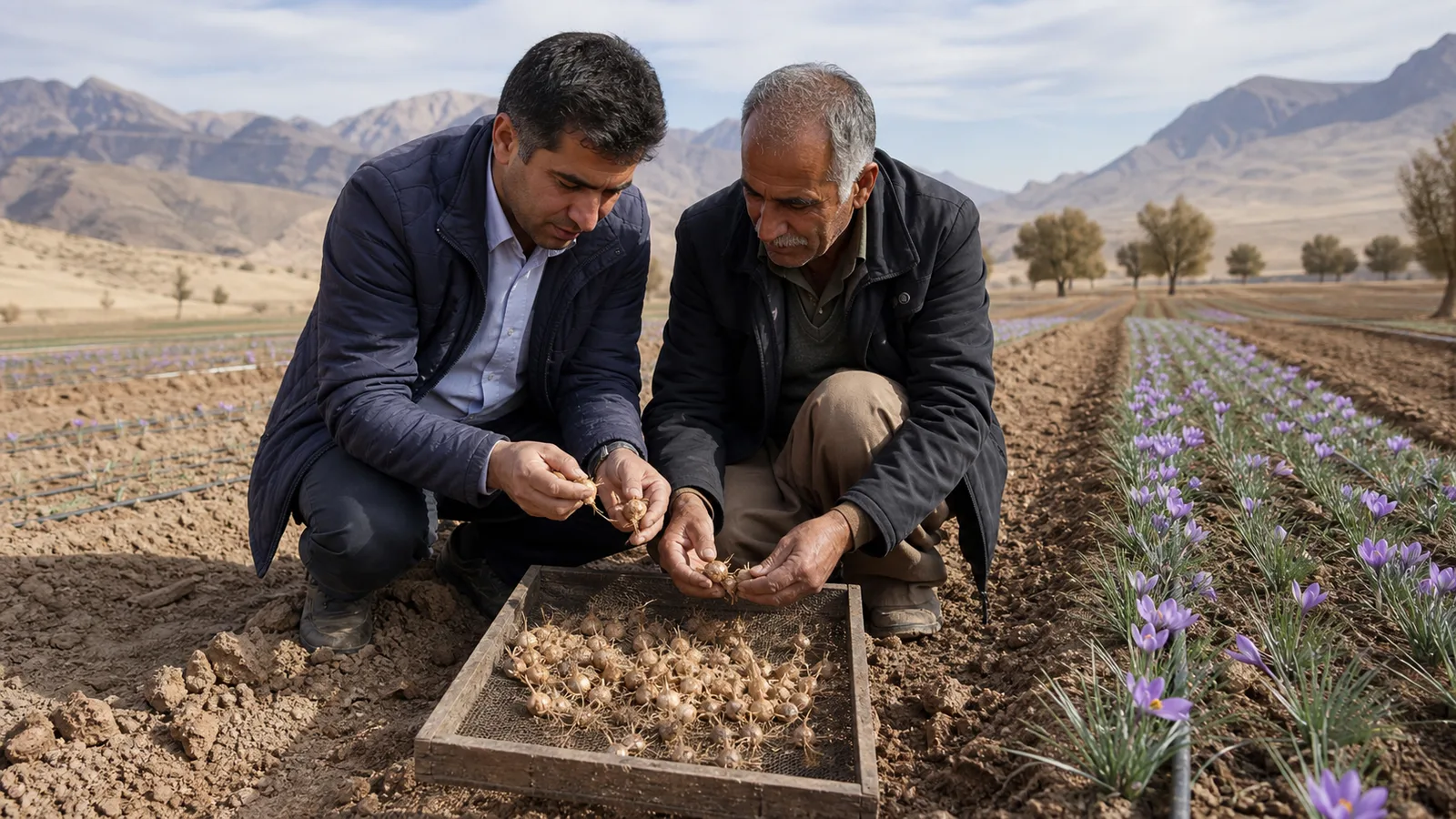
“Wild saffron” in Chaharmahal and Bakhtiari can mean two different plants, and the distinction matters. The province lies in the Zagros range, where genuinely wild Crocus species occur. The commercial fields described in the agricultural reports, however, were planted for dried saffron production and corm multiplication. Those fields should be understood as cultivated saffron, Crocus sativus, unless a botanical identification says otherwise.
Historical provincial figures recorded about 100 hectares under saffron, an average near four kilograms per hectare and a forecast around 400 kilograms. A later development plan aimed to reach 130 hectares. Ben and Farsan were named as the leading counties, and a six-hectare mother-corm farm in Ben was established to produce planting material inside the province.
Wild crocus and cultivated saffron are not the same
Commercial saffron is the dried stigma of Crocus sativus. The crop is sterile and is propagated by planting corms, often loosely translated as “bulbs” or “onions.” It does not establish a commercial field by scattering seed or collecting an unidentified wild flower.
Western Iran also has native wild crocuses. Kew’s Plants of the World Online recognizes Crocus haussknechtii as a separate species native from northern Iraq to western Iran. Botanical literature places it and other wild Crocus species in the Zagros region and describes C. haussknechtii as related to cultivated saffron.
The destination’s historical phrase “Zagros saffron” may therefore refer to a wild regional crocus, while the acreage and harvest numbers concern a managed spice crop. A wild plant should not be marketed as ordinary saffron without verified species identification, food-safety assessment and applicable legal approval. Protecting native populations is also different from establishing a commercial corm field.
The province’s 100-hectare saffron snapshot
Zabihollah Gharib, then director-general of provincial agriculture, reported 100 hectares allocated to saffron and forecast approximately 400 kilograms at four kilograms per hectare. The arithmetic is internally consistent. He said the largest concentration was in Ben and noted that farmers in Chaharmahal and Bakhtiari had cultivated saffron for more than 20 years.
The report described demand inside and outside the province, but its broad claim of exceptional quality is not treated as laboratory evidence. Regional origin does not by itself determine saffron quality. Field health, harvest timing, stigma separation, drying, storage and purity all contribute, and comparisons need representative testing against a named specification.
An unsupported statement that saffron metabolites inhibit tumour cells is also removed from the agricultural account. Laboratory findings are not proof that eating saffron treats or prevents cancer, and they do not belong in a planting recommendation.
From 100 to a proposed 130 hectares
A later provincial update from Hamidreza Danesh recorded the same 100-hectare baseline and projected an increase to 130 hectares. It described planting from late August and harvest in November. Saffron was grown in most parts of the province, with Ben and Farsan holding the greatest reported areas.
Extension classes and planting instructions were offered to farmers, and financial facilities were proposed for the crop. Those are useful support measures, but the 130-hectare number remains a historical target. It should not be quoted as current acreage without a later verified survey.
The province’s altitude and cold-season conditions can support saffron in suitable fields. Suitability still has to be checked plot by plot. Drainage, soil condition, corm health, irrigation timing, spring growth and exposure to damaging weather can all affect establishment and yield.
Why the six-hectare mother-corm farm mattered
The most practical addition to the expansion plan was a six-hectare mechanized mother-corm farm at the national medicinal-plants site in Ben. Provincial officials described it as the first project of its kind in Chaharmahal and Bakhtiari and expected it to provide local growers with planting material within three years.
A mother-corm farm is not a seed field in the usual sense. Because cultivated saffron is propagated vegetatively, selected corms multiply below ground and produce daughter corms. A dedicated propagation field can reduce dependence on imported planting stock, but only if it maintains identity and plant health.
The program needed to document:
- the identity and source of the original Crocus sativus stock;
- corm size, disease and pest inspections;
- field history, rotation and drainage;
- lifting, sorting, storage and transport conditions;
- how daughter corms were allocated to growers;
- performance after those corms reached commercial fields.
Mechanization can improve field capacity and consistency, but it does not replace plant-health controls. Moving infected corms efficiently would spread a problem just as efficiently.
What growers should verify before planting
The historical program demonstrates that cultivated saffron was already established in Chaharmahal and Bakhtiari and that local corm production was being developed. It does not prove that any wild crocus is interchangeable with commercial saffron or that every local plot can achieve four kilograms per hectare.
Before planting, a grower should confirm the species and source of the corms, inspect the field for drainage and soil constraints, plan irrigation from local conditions, and separate newly planted area from bearing area in all yield records. Harvest labour and hygienic drying also need to be arranged before November flowering.
For the dried product, the ISO 3632-1 saffron specification provides a defensible quality reference. For the plant itself, botanical identity comes first: a labelled commercial corm lot and a wild Zagros crocus are related subjects, not synonyms.
References: Kew Plants of the World Online: Crocus haussknechtii; Frontiers in Plant Science review of cultivated saffron’s genetics and sterility; ISO 3632-1:2025. Provincial area, output, calendar and corm-farm details are identified as historical figures preserved from the three local reports consolidated here.

![Exporting Saffron to Turkey + Price Guide [Complete 0 to 100]](https://img.rowhanisaffron.com/20260827003933/saffron-export-turkey-quality-inspection.webp)



