


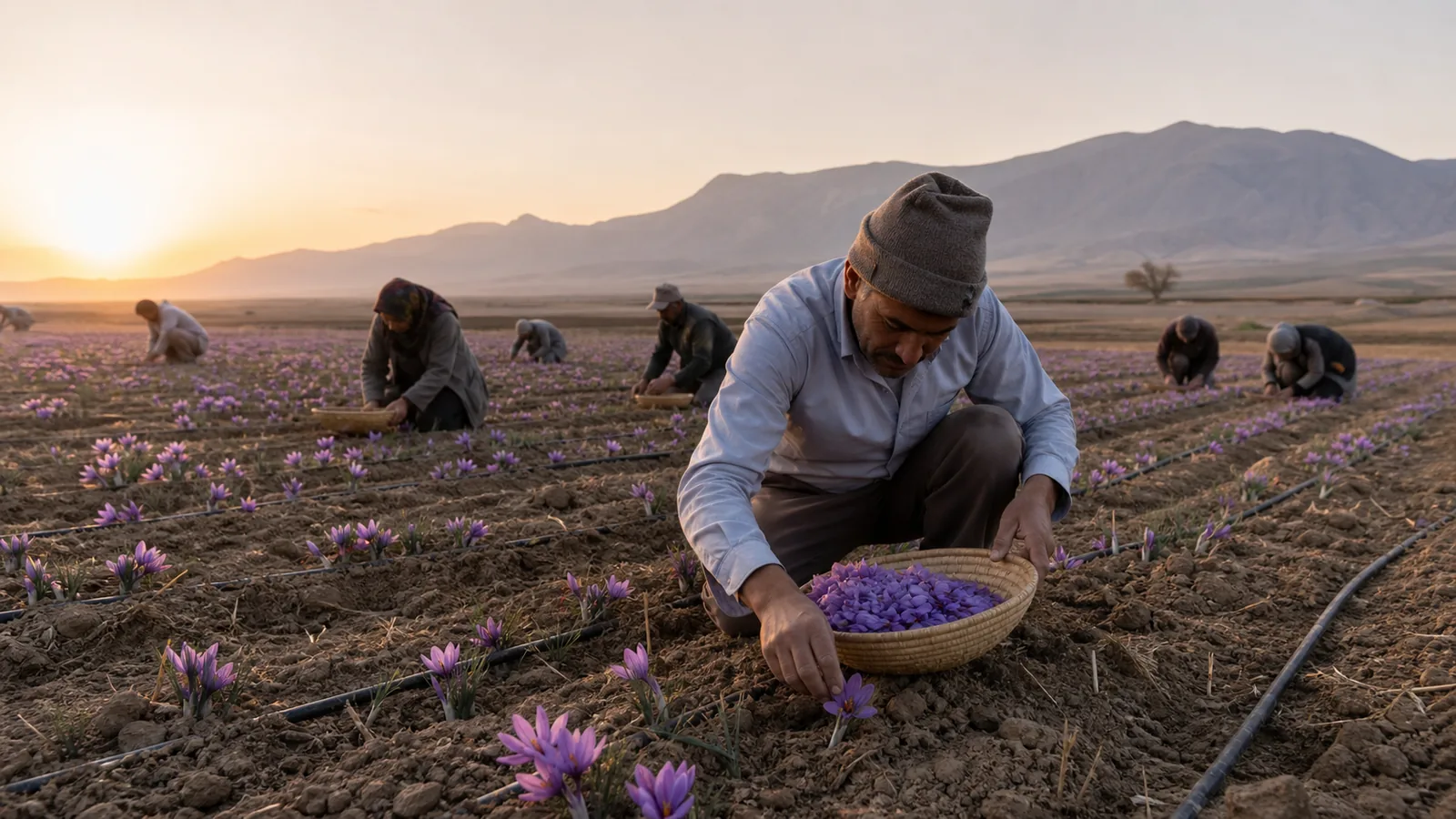
Farmers in Quchan were giving more attention to saffron after the county reported a 25% increase in cultivated area, 400 hectares of productive fields, and a harvest of about 200 tonnes of fresh flowers. More than 1,000 households were said to work directly in saffron production, making the crop part of both the agricultural calendar and the rural economy.
These figures come from the historical IRIB report on which this article was based. They are not current estimates, but they explain why saffron gained ground in Quchan and what growers had to manage as production expanded.
Quchan’s reported saffron figures
Quchan agricultural director Ali Yeganeh-Moghaddam said the county had 400 hectares of fertile saffron fields following a 25% rise in cultivated area. He reported an average harvest of 500 kilograms of fresh saffron flowers per hectare and a county total of 200 tonnes.
The arithmetic is internally consistent: 400 hectares at 500 kilograms of flowers per hectare equals 200,000 kilograms, or 200 tonnes of fresh flowers. That is flower weight, not dry spice. Only the red stigmas are separated and dried to make saffron, so the finished weight is a small fraction of the harvested flowers.
The old translation mistakenly called them “zucchini flowers.” The Persian text clearly referred to saffron flowers. It also rendered Quchan as Qouchan in one sentence; both spellings point to the same county in Razavi Khorasan Province.
More than 1,000 households were involved
Yeganeh-Moghaddam said over 1,000 households worked directly in Quchan’s saffron production. That number gives the harvest a human scale. A short flowering period creates an intense need for people to pick blossoms, transport them without crushing, separate stigmas, and begin drying before quality declines.
As acreage grows, coordination becomes as important as field yield. Growers need enough trained hands at the right hour, clean work surfaces, shallow containers that do not compress the flowers, and drying capacity matched to the daily intake. Expanding a field without expanding those practical resources can shift the bottleneck from cultivation to processing.
Why the crop fitted Quchan’s water calendar
The agricultural director identified irrigation timing as one advantage of saffron. Its main water demand does not coincide with the peak period for many summer crops. In a farming area where users share limited water, moving part of the demand away from that peak can be valuable.
The old English text split the statement into “peak demand” followed by “no water consumption.” Saffron does consume water. The intended point was that its irrigation schedule falls outside the period of highest agricultural demand, not that the crop grows without irrigation.
That distinction matters. A sound plan still has to account for water quality, soil moisture, field drainage, seasonal rainfall, and the needs of a multi-year saffron stand. Efficient timing can reduce pressure on a shared system, but it does not remove the need to measure and manage water.
What increasing attention requires on the farm
Interest in a high-value crop can lead to quick planting decisions. Quchan farmers can reduce avoidable risk by treating a new field as a long-term system rather than a one-season purchase.
- Choose suitable ground: saffron needs drainage and should not sit in waterlogged soil.
- Use healthy corms: source, condition, size, and handling affect establishment and later production.
- Plan labour before flowering: flowers do not wait for workers or processing space.
- Record flower and dry yields separately: the conversion helps reveal losses during separation and drying.
- Protect each batch: keep flowers and stigmas clean, dry them consistently, and store finished saffron away from moisture and light.
- Know the buyer: expected grade, test requirements, packaging, and payment terms should be clear before harvest.
Flower yield is only one measure of success
A fresh-flower figure shows the scale of picking work, but it does not by itself establish the quality or value of the finished spice. Two fields can deliver similar flower weights and produce different results after separation and drying.
Useful farm records connect the number or weight of flowers with dry stigma yield, labour hours, drying conditions, moisture, and the grade accepted by the buyer. Over several seasons, those records help a grower distinguish an agronomic issue from a processing loss or a marketing problem.
The age of the stand matters as well. Newly planted corms and established productive fields should not be compared as if they are at the same stage. The original report specifically described 400 hectares as fertile or productive area, which is more precise than treating every planted hectare as fully yielding.
Growth needs a market as well as land
A 25% increase in area brings more flowers into a narrow harvest window. If processing, testing, storage, and buyer access do not grow with it, farmers may have to sell quickly or accept poor terms. Local collection and transparent grading can help, provided batches remain traceable to the farm and are not mixed without records.
For buyers, Quchan’s regional identity should be supported by product evidence: clean handling, consistent drying, an accurate description, and appropriate quality testing. A place name alone cannot prove grade or authenticity.
What the Quchan report still tells us
The increasing attention of farmers in the city of Quchan to saffron was tied to three clear features: productive acreage was expanding, more than a thousand households were involved, and the crop’s irrigation schedule avoided the period of highest demand for water.
Preserving those details gives a more useful picture than the old machine translation. Quchan’s 400 hectares and 200-tonne flower harvest marked meaningful agricultural activity, while the lasting measure of success is how well growers convert that short purple harvest into clean, traceable, marketable saffron without putting unnecessary strain on water or household finances.

![Exporting Saffron to Turkey + Price Guide [Complete 0 to 100]](https://img.rowhanisaffron.com/20260827003933/saffron-export-turkey-quality-inspection.webp)



