


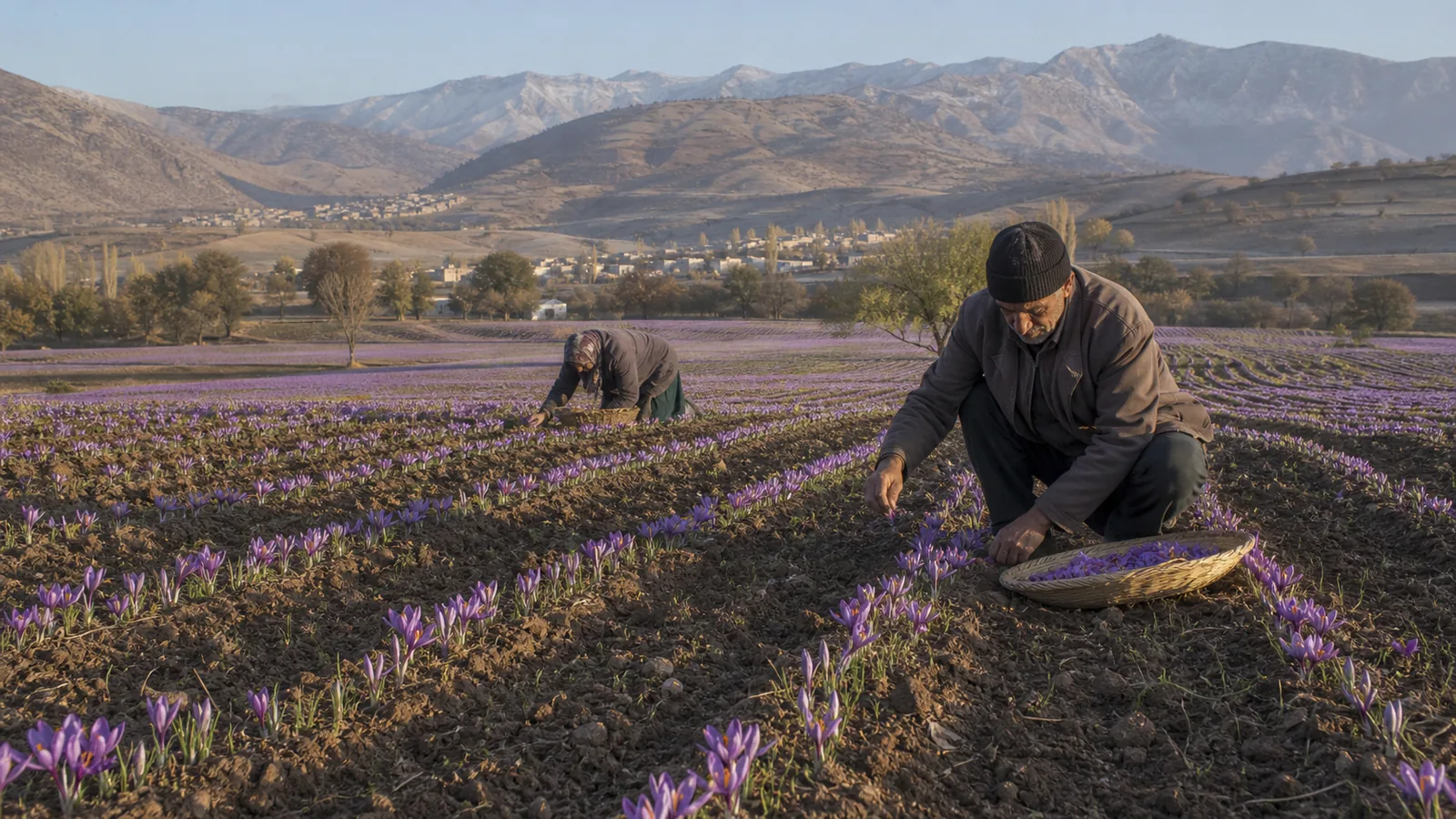
A historical agricultural report recorded 135 hectares of saffron cultivation in Chaharmahal va Bakhtiari. Provincial horticulture official Ebrahim Shirani connected the crop with rural employment, productive use of lower-yield land, improved agricultural productivity, greener landscapes, and potential tourism interest.
The 135-hectare figure is the central fact of the original Mehr News item. It describes the area reported at that time, not the province’s current saffron acreage, and it should not be used as a present-day production estimate.
What the 135-hectare report said
Speaking in Shahrekord, Shirani said 135 hectares of farms in Chaharmahal va Bakhtiari had been allocated to saffron cultivation. He was identified as the director of horticultural affairs for the provincial Agricultural Jihad organisation.
The earlier English version was brief and repeated the acreage without explaining what it represented. It referred to cultivated area, not the weight of saffron produced and not necessarily to 135 hectares at full mature yield. A newly established saffron field and an older productive stand should not be counted as equivalent when assessing output.
Why saffron was part of the rural plan
Shirani described rural employment and reducing migration from villages to cities as important goals. Saffron can add concentrated seasonal work during flower picking and stigma separation, and its high value relative to its finished weight makes transport from rural areas more manageable than bulky crops.
Those advantages are real only when the surrounding work is planned. Harvest labour must be available during a short flowering period. Flowers need clean handling and prompt separation. Drying must be controlled, and growers need a route to buyers who recognise and pay for quality.
The report also referred to deprived areas. In that context, a crop-development programme should be judged by household outcomes, not merely by hectares planted. The relevant questions include who owns or leases the field, who bears the establishment cost, who performs the harvest work, when farmers are paid, and how much value stays in the producing community.
Making use of lower-yield land
One stated aim was to bring lower-yielding agricultural land into more productive use. That does not mean saffron can succeed on any poor field. The plant still needs suitable soil structure, drainage, healthy corms, an appropriate climate, and enough well-managed water.
A sensible field assessment considers:
- soil texture, depth, organic matter, salinity, and drainage;
- the source, health, and size range of planting corms;
- available water, its quality, and the proposed irrigation schedule;
- frost, heat, rainfall, and local elevation;
- access for planting, maintenance, harvest, and transport;
- labour and clean processing capacity during peak flowering; and
- realistic sales, quality, and price assumptions.
A small trial area can be more informative than committing an entire farm on the strength of a provincial target. Records from the trial should separate fresh-flower yield, dry-saffron yield, labour, water, and market grade.
Productivity means more than acreage
Shirani also mentioned increasing agricultural productivity. Hectares are easy to count, but they reveal little about what reaches the market. A useful productivity measure follows the crop from land and water through to clean, saleable saffron.
Growers can compare dry yield with the age of the field, corm condition, irrigation, weather, flower weight, and processing losses. At community level, productivity also includes the cost of labour, shared equipment, testing, packaging, rejected batches, and the price growers actually receive.
This broader view protects against a common mistake: treating expansion itself as success. More planted land can create more rural work, but it can also create a concentrated labour shortage or force growers to sell flowers quickly if drying and market capacity do not expand with it.
Green space and tourism need careful interpretation
The original report listed expansion of green space and tourism attraction among the province’s goals. A flowering saffron field can be visually striking, particularly when purple blossoms appear across an autumn landscape. Yet a working field is not automatically a public attraction.
Any farm visit needs the grower’s permission and a plan for parking, foot traffic, crop hygiene, safety, and photography. Visitors should not step between rows, handle flowers, or interfere with the urgent harvest. Tourism can support a local story through guided visits, food, crafts, and direct sales, but the crop and the farmer’s working day come first.
Keeping more value in the province
The strongest rural benefit comes when Chaharmahal va Bakhtiari is able to preserve quality after picking and sell saffron with traceable regional identity. Clean separation, consistent drying, protective packaging, accurate grading, and suitable testing all influence whether the finished product earns more than an anonymous bulk lot.
Collaboration can help small farms share training, drying capacity, batch records, and access to buyers. It should not erase the identity of individual lots or make payment terms less transparent.
What the historical acreage still means
The 135 hectares of saffron in Chaharmahal va Bakhtiari marked a deliberate attempt to connect horticulture with rural employment and more productive land use. The figure is worth preserving because it records the scale of that effort at a specific point in time.
The larger lesson is that acreage is a beginning, not an outcome. Healthy fields, sensible water use, timely harvest, careful processing, honest grading, and dependable markets determine whether saffron genuinely supports rural households and gives the province a recognisable product of its own.

![Exporting Saffron to Turkey + Price Guide [Complete 0 to 100]](https://img.rowhanisaffron.com/20260827003933/saffron-export-turkey-quality-inspection.webp)



