


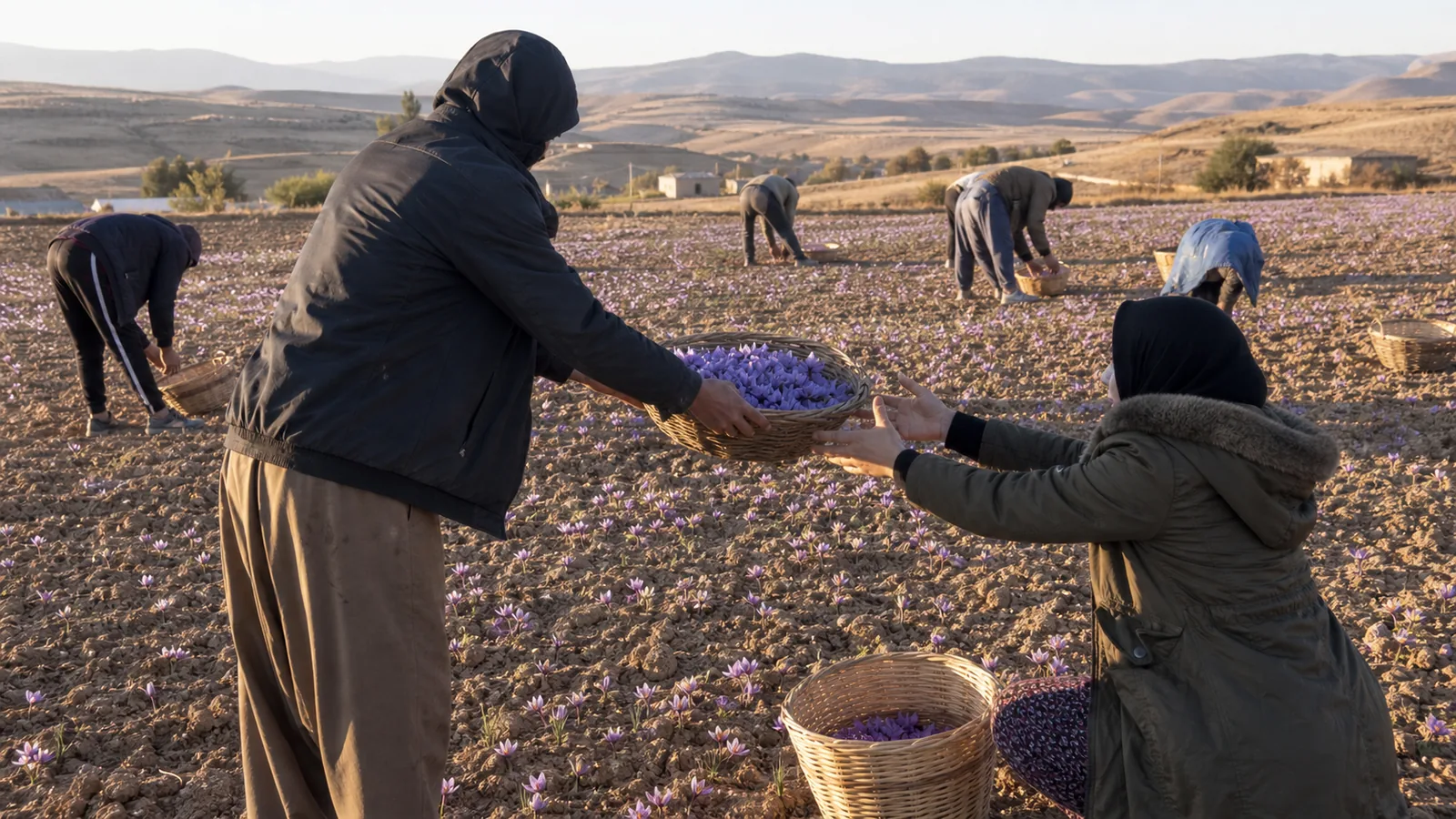
In Qader Marz, a village in Dehgolan County, Tayeb Qader-Marzi turned a small saffron operation into direct seasonal work for eight people. The original 2018 report said he was 32, had been growing saffron for three years, and sold the harvest within Kurdistan Province. It was a brief story, but it captured something important: a high-value crop can create work well beyond the person who plants the corms.
The village name appears in several English forms, including Qader Marz, Qadar Marz, and Qadermarz. The farmer’s surname was also awkwardly transliterated in the old text as “Qadmourzizi.” This article uses Qader-Marzi, reflecting the place-based family name, while preserving the identity and facts reported at the time.
Saffron growing in Qader Marz village
Qader Marz is in the Bolbanabad district of Dehgolan County, Kurdistan Province. Its dry highland setting is far from Iran’s best-known saffron centres in Khorasan, which makes the story a useful example of the crop’s spread into other suitable parts of the country.
The report described Tayeb’s work as traditional planting and harvesting. “Traditional” here does not mean casual. Saffron production asks for careful decisions across the year: selecting and planting healthy corms, managing weeds and irrigation, organising a concentrated flower harvest, separating stigmas, drying them consistently, and finding a buyer.
At the time, three years of production would still have placed the field within an early establishment cycle. Saffron is perennial, and the corm population changes underground from season to season. A farmer learns not only from the first flowers but from how the plot behaves as daughter corms multiply and the stand becomes denser.
How one saffron field created eight jobs
The phrase “eight direct jobs” needs context. Saffron work is not evenly distributed through the calendar. The sharpest demand arrives during flowering, when each morning’s blooms need to be collected and processed quickly. Eight people can represent a vital harvest team even when not every role is full-time throughout the year.
A small operation may divide the work like this:
- picking flowers early enough to keep them fresh;
- moving shallow containers from the field without crushing the crop;
- separating the three red stigmas from each flower;
- operating or monitoring the drying process;
- sorting, weighing, and packing dry threads; and
- keeping the work area, containers, and records organised.
The exact roles in Tayeb’s team were not listed, so they should not be invented. The reported employment figure still shows why flower harvest and post-harvest capacity have to grow alongside planted area.
A harvest morning in Kurdistan
Saffron flowers grow low to the soil and can appear in quick waves during autumn. Pickers work close to the ground, gathering blooms into baskets or shallow crates. Deep sacks and compressed piles make handling easier for a moment but can warm and bruise the flowers.
Once indoors, the team opens each bloom and removes the stigmas. Every flower contributes only three, so the volume shrinks dramatically from a field of purple flowers to a small quantity of red threads. The stigmas then need controlled drying and protection from moisture, strong light, heat, contamination, and strong odours.
That sequence explains the employment effect better than the retail price alone. Saffron’s value comes with concentrated handwork, and the quality of the final batch depends on how well that work is coordinated.
Selling within Kurdistan Province
The 2018 account said the saffron was sold at the provincial level. A local market can be a practical starting point for a new grower: travel is shorter, relationships are easier to maintain, and buyers can become familiar with the crop’s origin. It can also limit price discovery if only a few intermediaries are available.
A farmer moving from occasional sales to a repeatable business needs more than an attractive sample. Useful steps include keeping batches separate, recording harvest and drying dates, using accurate scales, defining the thread grade, protecting the product in storage, and presenting a consistent net weight. Those records make it easier to compare seasons and answer a buyer’s questions.
What another village can learn from Qader Marz
Test the crop before expanding
A successful plot in one village does not prove that every nearby field will perform the same way. Soil drainage, winter conditions, water timing, corm health, labour, and field history should be assessed. A representative trial provides local evidence before a large corm purchase.
Plan labour for the busiest morning
An average labour estimate can hide the real bottleneck. Flowering may rise suddenly, and yesterday’s team may be too small tomorrow. Growers should decide who will pick, who will transport, where separation will happen, and how drying capacity will cope at the peak.
Protect value after the flowers are picked
More flowers do not guarantee more saleable saffron. Delays, poor hygiene, inconsistent separation, and uncontrolled drying can weaken the result. Training and a simple workflow often matter as much as adding another row in the field.
Be precise about employment claims
Seasonal work, recurring part-time work, and year-round jobs are all valuable, but they are not interchangeable. Recording workdays and roles gives a clearer picture of the crop’s local economic contribution than one headline number.
A small profile worth preserving
The surviving report did not give the size of Tayeb Qader-Marzi’s field, the dry yield, the price, or a later business outcome. Those details remain unknown and should stay unknown unless a reliable source supplies them.
What the report does establish is enough for a grounded local story: a 32-year-old grower in Qader Marz had spent three years producing saffron, supplied buyers within Kurdistan Province, and directly engaged eight people through traditional planting and harvest. Behind those few facts is the daily organisation that turns a new crop into village work.

![Exporting Saffron to Turkey + Price Guide [Complete 0 to 100]](https://img.rowhanisaffron.com/20260827003933/saffron-export-turkey-quality-inspection.webp)



