


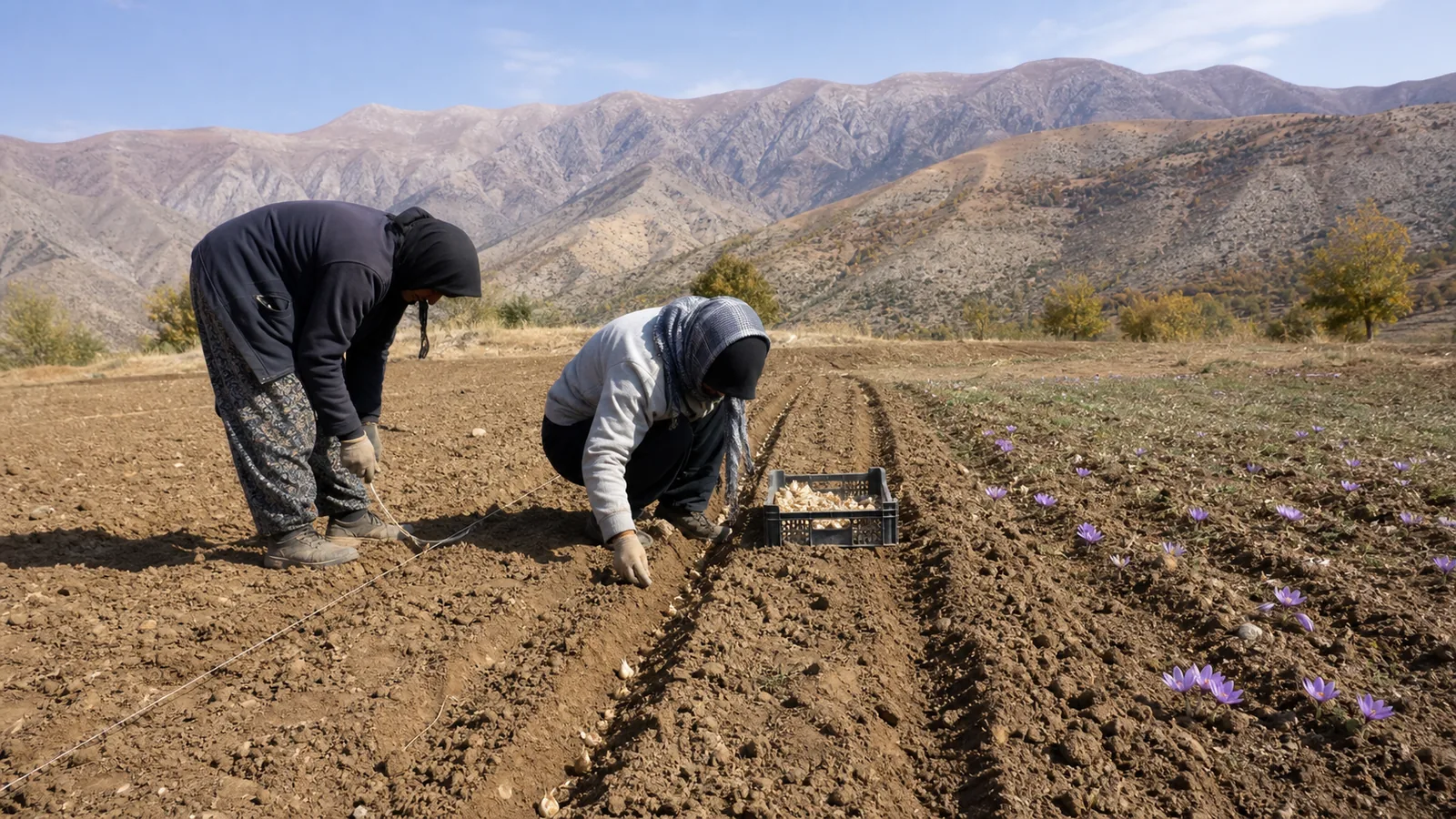
Saffron cultivation was expanding in Chaharmahal and Bakhtiari when this report was published in 2018, with provincial officials citing 135 hectares under the crop. The attraction was easy to understand: saffron can suit cold-winter, dry-summer districts and has a high value relative to its weight. Expansion, however, is sensible only where soil, drainage, temperature, irrigation timing, labour, and market access have been checked together.
The province name also appears in English as Chaharmahal va Bakhtiari. Both forms refer to the same mountainous province in southwestern Iran, with Shahrekord as its capital.
The 2018 plan to increase saffron planting
Zabihullah Gharib, then identified as head of the provincial Agriculture Jihad organisation, told Mehr News that saffron cultivation in Chaharmahal and Bakhtiari was developing. He said the climate offered suitable conditions, described the province’s saffron as high quality, and named cultivation expansion as an important agricultural programme.
The figure reported at the time was 135 hectares allocated to saffron cultivation. That number is a historical benchmark, not a claim about the province’s present planted area. Cultivation can rise or fall as fields age, new plots are planted, old plots are lifted, and official reporting methods change.
Gharib also called for the province’s wider agricultural capacity to be used. In practical terms, increasing the area is only one part of that work. Healthy corm supply, grower training, clean processing, quality control, and a route to buyers determine whether expansion creates lasting value.
Why parts of Chaharmahal and Bakhtiari can suit saffron
Crocus sativus is a perennial corm crop. It is dormant through the hottest part of the year, flowers in autumn, and develops leaves through the cool season. Cold winters can be compatible with the crop, but “suitable province” does not mean every village, slope, or field is equally suitable.
Temperature and elevation
The province’s elevation creates cold winters and local differences in frost, snow cover, spring temperature, and the timing of dormancy. A grower should compare the field’s actual conditions with nearby successful saffron plots, not rely on a province-wide label. Severe events at the wrong growth stage can still damage a crop.
Drainage and soil
Saffron corms need soil that drains. Water held around them for too long increases the risk of rot and poor establishment. Before expanding a field, inspect what happens after irrigation or heavy rain, check compacted layers, and test soil where salinity, texture, or nutrient status is uncertain.
Water timing rather than a slogan
Saffron is often described as low-water, especially in comparison with some summer crops. It still needs water at useful times, and requirements vary with rainfall, soil, temperature, and the production system. An expansion plan should confirm both water quantity and the ability to deliver the first irrigation and later irrigations when the crop needs them.
Labour during the flowering rush
A larger planted area creates a larger demand for labour during a narrow autumn window. Flowers must be picked promptly, then moved to a clean area for stigma separation. Planting hectares without planning the daily harvest capacity can reduce quality at the most valuable stage.
What responsible cultivation expansion involves
Start with a representative trial
A new district or farm benefits from a smaller trial block before a large commitment. It reveals emergence, flowering time, drainage, weed pressure, labour needs, and the behaviour of the chosen corm stock under local conditions. Records from the trial are more useful than a profit estimate borrowed from another province.
Use healthy, graded corms
Corm size and condition influence establishment and flowering potential. Planting material should be sourced from a traceable lot, examined for injury or decay, handled gently, and stored appropriately before planting. Expansion based on mixed or unhealthy corms can spread problems across the new area.
Plan the field for several seasons
Saffron normally remains in the ground for more than one year. Row layout, planting depth, spacing, irrigation access, weed control, and future corm lifting should therefore be decided as a system. A layout that is fast to plant but difficult to weed or harvest can carry extra cost for years.
Match processing capacity to peak harvest
The processing room needs clean surfaces, shallow collection containers, suitable drying equipment, and enough trained people for the busiest days. Dry threads should be cooled and protected from moisture, strong light, heat, and contamination. A provincial reputation for quality is built batch by batch after the flowers leave the field.
Know the buyer before adding hectares
Growers should understand whether they will sell fresh flowers, fresh stigmas, dried bulk threads, graded saffron, or a packaged retail product. Each route has different labour, equipment, documentation, and margin. A promised headline price for retail saffron is not the same as the amount a farmer receives for an ungraded lot.
How to judge whether expansion is working
Planted hectares are an easy number to announce, but they do not measure the whole result. A useful provincial or farm review also tracks:
- the proportion of fields that establish successfully;
- dry saffron yield and grade by area and season;
- flower-to-processing time and rejected material;
- water use and irrigation reliability;
- labour availability and earnings during harvest;
- corm health and multiplication;
- the share sold with traceable origin and consistent specifications; and
- the price growers actually receive, not only the final retail price.
These measures can show whether the programme is producing a healthy crop and stronger farm income rather than simply a larger map of planted land.
Expansion should follow evidence from the field
The 135-hectare figure marked a period of active interest in saffron planting in Chaharmahal and Bakhtiari. It showed that provincial officials saw potential in the crop and wanted to develop it. The safest reading today is historical: it records where the programme stood when the statement was made.
Future growth should be judged field by field. Where drainage, climate, water timing, corm health, labour, processing, and buyers align, saffron can be a valuable part of the province’s agriculture. Where one of those pieces is missing, adding hectares first may only make the weakness more expensive.

![Exporting Saffron to Turkey + Price Guide [Complete 0 to 100]](https://img.rowhanisaffron.com/20260827003933/saffron-export-turkey-quality-inspection.webp)



