


Iran creates the value of “red gold” long before saffron reaches a shop. The chain begins with corm selection and field work, then moves through a short, labour-intensive harvest, careful stigma separation, rapid drying, laboratory assessment, packaging, traceability and export. Weakness at any stage can reduce the aroma, colour, purity or income attached to the final product.
This is why the Iranian saffron value chain matters. Iran produces most of the world’s saffron, but production volume alone does not guarantee that growers and Iranian businesses keep the value created after harvest.
Iran and the Value of Red Gold: How Saffron Reaches the Market
Why Iran remains central to the saffron trade
The Food and Agriculture Organization of the United Nations described Iran in 2025 as the global leader, producing about 85–90% of the world’s saffron. Cultivation is particularly important in Khorasan Razavi and South Khorasan, where it supports many smallholder livelihoods and carries generations of local knowledge. The FAO report on saffron quality and value-chain development also identifies modern challenges: climate pressure, water scarcity and growing global competition.
“Red gold” is therefore more than a price nickname. Each flower produces only three red stigmas. Flowers must be gathered during a narrow seasonal window, and the useful threads must be separated and dried promptly. A large volume of fragile, short-lived flowers becomes a small amount of stable spice.
1. The field creates the first layer of value
Saffron is a perennial crop grown from corms rather than seed. The grower chooses planting material, field spacing, irrigation and soil management before seeing a harvest. Those choices affect plant health, labour access and the future productivity of the plot.
The older article behind this page argued that fully mechanised field work was difficult because of planting patterns and the risk that machinery could damage corms. The broader point remains useful: mechanisation must fit saffron’s biology and local field design. A machine that saves labour but crushes corms, contaminates flowers or delays collection does not create value.
2. Harvest is still a race against time
Flowers are commonly gathered by hand, often early in the day. The work is repetitive and seasonal, and a large portion of the crop may open within a short period. Labour availability, clean collection containers and quick transport to a separation area all matter.
Mechanisation may help with transport, sorting or particular post-harvest tasks. It should be judged by measurable outcomes: less delay, less contamination, lower damage and safer working conditions—not by the presence of machinery alone.
3. Separation and drying protect quality
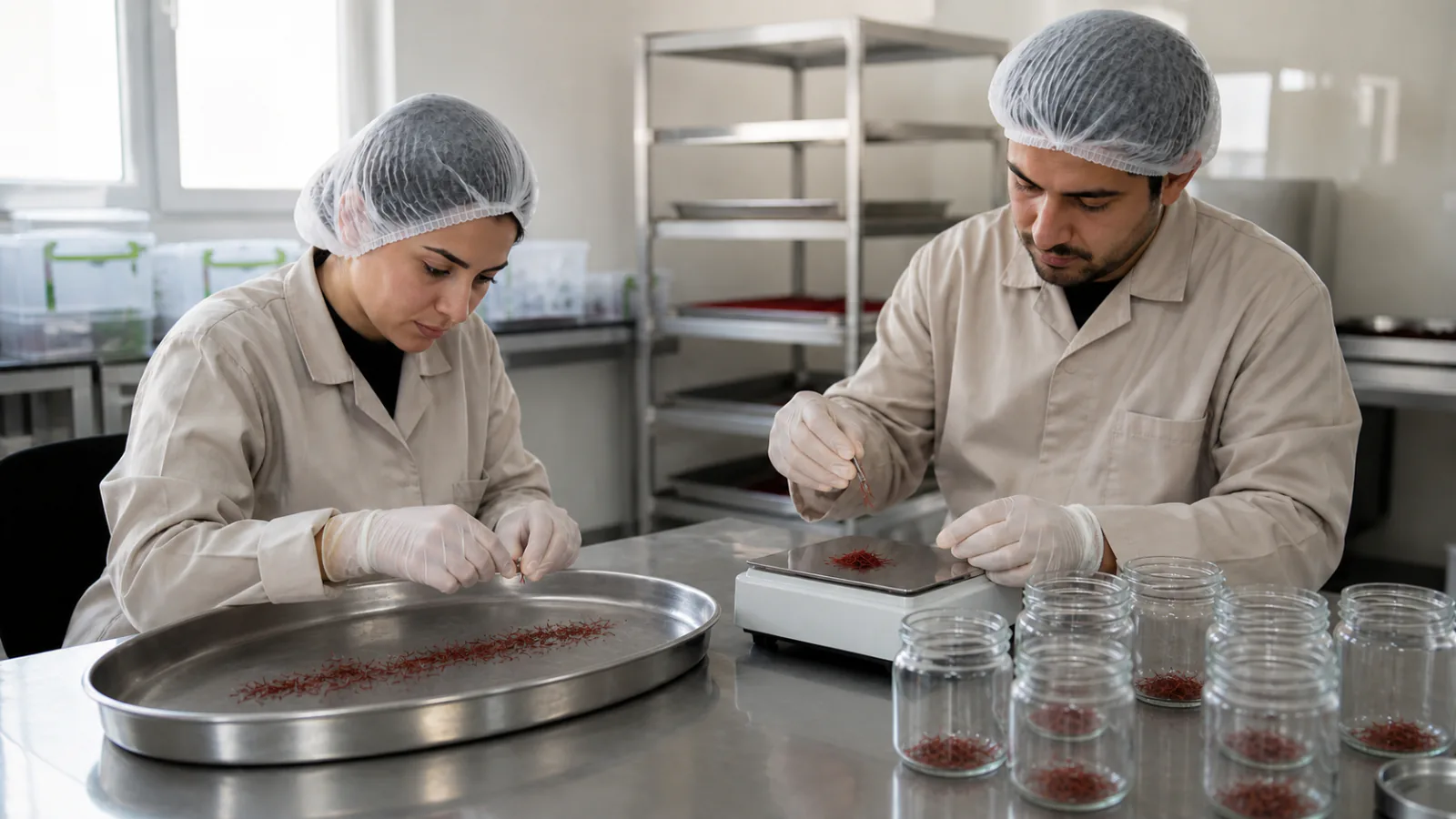
After harvest, workers separate the red stigmas from the rest of the flower. This step determines the grade and the amount of yellow style or other plant material in the lot. Clean work surfaces, trained handling and separation from dust, hair and unrelated material are basic controls.
Fresh stigmas contain moisture and deteriorate quickly. Drying must reduce that moisture without burning the threads or stripping away the characteristics buyers want. Slow, uncontrolled drying can raise the risk of quality loss; excessive heat can also damage the product. The answer is not one universal machine setting, but a controlled, documented process suited to the lot.
FAO’s 2025 field visit to Mashhad highlighted both traditional harvesting and modern processing and packaging, with a focus on post-harvest practices, standardisation and quality control. That farm-to-processing account shows where heritage and technology can complement each other.
4. Laboratory evidence turns appearance into specification
A buyer cannot judge every quality attribute by colour alone. The ISO 3632 series provides specifications and test methods for dried saffron in filament, cut-filament and powder forms. The current ISO 3632-1:2025 specification also includes recommendations related to storage and transport.
Laboratory assessment can examine characteristics linked to colouring strength, flavour and aroma, as well as moisture and foreign matter. A high number should never be treated as a free-standing marketing boast without the method, sample identity and laboratory context. Batch-level records make a result useful; an unsupported label does not.
5. Packaging and traceability keep value attached to origin
When saffron leaves Iran only as anonymous bulk material, later businesses can capture much of the value through grading, retail packaging, storytelling and distribution. A 2014 UNIDO diagnostic study of Iran’s saffron value chain mapped growers, dealers, processors, packers, exporters and domestic and foreign retailers. Its durable lesson is that value is created across the chain, not only at the farm gate.
Good packaging protects saffron from moisture, light, odours and physical damage. Good traceability connects the pack to a defined lot, supplier, process and test record. Clear net weight, product identity and business information help a customer know what is being sold. Read our article on Iranian saffron packaging in international stores for the retail side of that challenge.
6. Authenticity protects growers and customers
Saffron’s high value creates an incentive to add moisture, cheaper plant material, colourants or substitutes. Powder is especially difficult for a shopper to inspect. Whole threads are not immune to fraud, but their shape, colour distribution and aroma give the buyer more information.
ISO explains that saffron is considered pure under its standard when the applicable requirements are met and no external matter has been added. Testing, supplier approval, sealed packaging and lot records work together; no single home trick can certify purity. Our guide to buying high-quality saffron covers the consumer checks that remain practical.
7. Price stability and market access affect export value
The original report described price fluctuations as a problem for exporters asked to quote a fixed price for future delivery. That commercial tension still makes sense even though its old price and export figures should not be presented as current statistics. Growers need a viable return, processors need predictable supply, and international buyers need consistent specifications and delivery.
Long-term export value depends on more than selling the greatest number of kilograms. It depends on dependable contracts, recognised quality systems, market-specific compliance, honest branding and the ability to deliver the same grade repeatedly.
What a stronger Iranian saffron value chain looks like
- Healthy corms and field practices suited to local water and soil conditions.
- Timely harvest with clean collection and rapid movement to separation.
- Safe working conditions and fair recognition of seasonal labour.
- Controlled separation, drying and storage with recorded lot identity.
- Representative laboratory testing against relevant specifications.
- Packaging that protects the threads and communicates traceable origin.
- Contracts and branding that allow more value to remain with responsible producers.
Iran already supplies the world with most of its saffron. The next measure of success is how consistently the chain protects quality, proves authenticity and connects value back to the people who create it. That is how a delicate flower becomes red gold without losing its identity along the way.

![Exporting Saffron to Turkey + Price Guide [Complete 0 to 100]](https://img.rowhanisaffron.com/20260827003933/saffron-export-turkey-quality-inspection.webp)



