


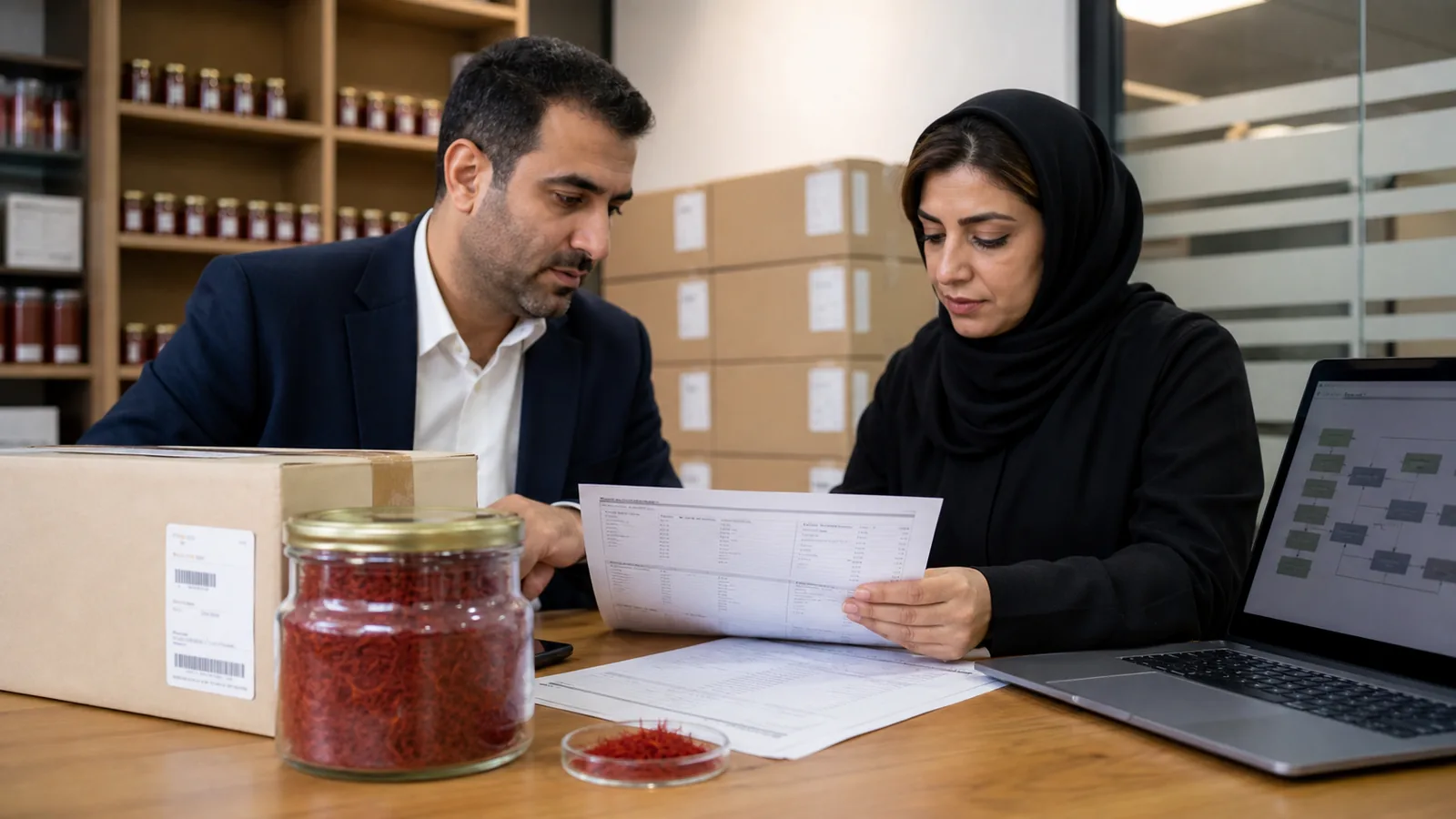
Iran sanctions in terms of saffron exports did not trouble the physical shipment of every order, according to Gholamreza Miri’s 2016 account. The harder problem was getting paid and bringing export currency back into Iran. He said saffron continued to move during the sanctions period, while banking and finance remained unresolved even after some restrictions eased. That distinction is the central point of this historical report.
Who made the statement
Gholamreza Miri, then identified as head of the Razavi Khorasan Saffron Exporters’ Union, spoke to ISNA about the post-sanctions trade environment. The old translation shortened his surname to “Mir” in places, but other contemporary reporting identifies him as Miri.
His comments belong to the period after implementation of the 2015 nuclear agreement. They are not a description of the legal position today. Sanctions, designated parties, banking rules and country-specific import restrictions change, so a current shipment requires current advice for every party, currency, bank, carrier and destination.
Shipping saffron and receiving payment are separate problems
An exporter may be able to prepare customs documents and send a food product while still finding that ordinary payment channels are unavailable. Banks can decline a transaction because of sanctions exposure, internal risk policy, incomplete origin information or a party that appears on a restricted list. A permitted product does not make every related transaction permitted.
Miri said the possibility of exporting to destinations such as the United States had changed after sanctions relief, but financing remained difficult. He believed the problem had become smaller, not disappeared. The original headline therefore needs a narrow reading: saffron exports had not stopped entirely, yet returning foreign currency was still a serious obstacle.
Current U.S. rules should be checked directly. The Office of Foreign Assets Control maintains the official Iran sanctions programme, regulations, guidance and lists. OFAC describes broad authorizations and exceptions concerning agricultural commodities and food in some contexts, but those provisions do not authorize every transaction or dealings with every person. This article is historical analysis, not legal clearance.
Trust sometimes kept orders moving
Miri described long-standing relationships in which an overseas buyer would request saffron by phone or fax and an Iranian colleague would send it without a newly signed document. He offered this as evidence that personal trust had helped exporters continue working when formal systems were difficult.
That practice should be preserved as part of the story, not copied as present-day procedure. A modern export needs a written specification, invoice, verified counterparty, sanctions screening, payment terms, transport documents and traceable batch records. Trust matters, but it does not replace compliance or protect either side when quality, delivery or payment is disputed.
The Saudi market and the growth figures
The union reported that saffron exports had grown by about 6% by the end of the period it measured. Miri said growth could have been higher if Iran had not lost Saudi Arabia as a major market. He estimated that resolving the Saudi restriction could have raised exports by as much as 25%.
Both percentages were statements from that reporting period. The article did not provide the customs table, base year, weight, value or exact month needed to reproduce them. They should not be used as current export statistics.
Miri also said Saudi buyers were not simply abandoning saffron. In his account, they could obtain product associated with other origins, including Afghanistan or Spain, while avoiding Iranian goods. That made origin, re-export routes and political access part of the competitive picture.
Saffron corm movement and Afghanistan
The interview raised concern about saffron corms leaving Iran without authorization. Miri said the issue had been discussed in meetings and letters and called for more sensitive monitoring. He expected wider access to planting material to help cultivation expand in countries such as Afghanistan.
Afghanistan’s saffron production is legitimate in its own right and should not be reduced to an allegation about Iranian corms. The historical statement combined two questions: unlawful movement of planting material and the growth of a neighbouring producer supported by different international programmes. Evidence about one shipment cannot establish the origin of an entire national crop.
For Iran, the practical concerns are phytosanitary control, plant health, lawful export rules and traceability. Healthy corm multiplication at home also matters because disease or poor planting material can damage growers before international competition is considered.
Competition is about more than raw production
Miri argued that overseas companies bought Iranian saffron and turned it into medicines, cosmetics, candy, sprays and saffron tea. He wanted more funding for research teams so Iranian businesses could create processed goods and retain more value.
Those examples describe possible product categories, not proof that every derivative is effective or compliant. A medicinal claim requires evidence and regulatory approval. A cosmetic, food or drink also needs formulation, stability, safety, labelling and destination-market compliance. Value is created by completing that work well, not merely by adding saffron to a product.
FAO’s current work with Iran similarly emphasizes authenticity, post-harvest handling, traceability, quality, innovation and marketing. These capabilities can make an exporter more resilient, although they cannot remove a banking or sanctions restriction.
The warning about unplanned expansion
The interview said saffron was being cultivated in 22 provinces beyond Razavi Khorasan, sometimes following encouragement from local authorities and parliamentarians. Miri warned that expanding output without a plan could create a large crop before buyers and processing markets were ready.
He also said around 95% of production still relied on traditional methods and referred to an export approach developed roughly 60 years earlier. Those were broad industry estimates, not measurements supplied with a methodology. Their intended message was clear: production, processing and export practice needed to modernize as new competitors entered established markets.
Expansion should begin with suitable land and water, healthy corms, realistic yields, labour capacity and a defined outlet. Export planning should add quality specifications, residue limits, traceability, packaging, buyer due diligence and payment feasibility. More hectares are not a strategy by themselves.
What exporters should take from the report
The 2016 interview should not be summarized as “sanctions did not matter.” It says something more precise: experienced exporters found ways to keep saffron moving, but payment, lost markets and official support remained difficult. Informal trust reduced friction for some relationships while creating risks of its own.
A current exporter should verify the product, destination, end user, bank, carrier and intermediaries before accepting an order. Legal advice must be specific to the transaction. Commercially, the strongest response remains a traceable product, documented quality, multiple lawful markets and enough processing capability to sell more than an anonymous raw commodity.
Sources reviewed: the historical Miri statements preserved on this page; the official OFAC Iran sanctions programme page and OFAC FAQ 637 on agricultural commodities and food for current U.S. context; and FAO’s current Iranian saffron value-chain work. The article does not provide legal advice or a current transaction authorization.

![Exporting Saffron to Turkey + Price Guide [Complete 0 to 100]](https://img.rowhanisaffron.com/20260827003933/saffron-export-turkey-quality-inspection.webp)



