


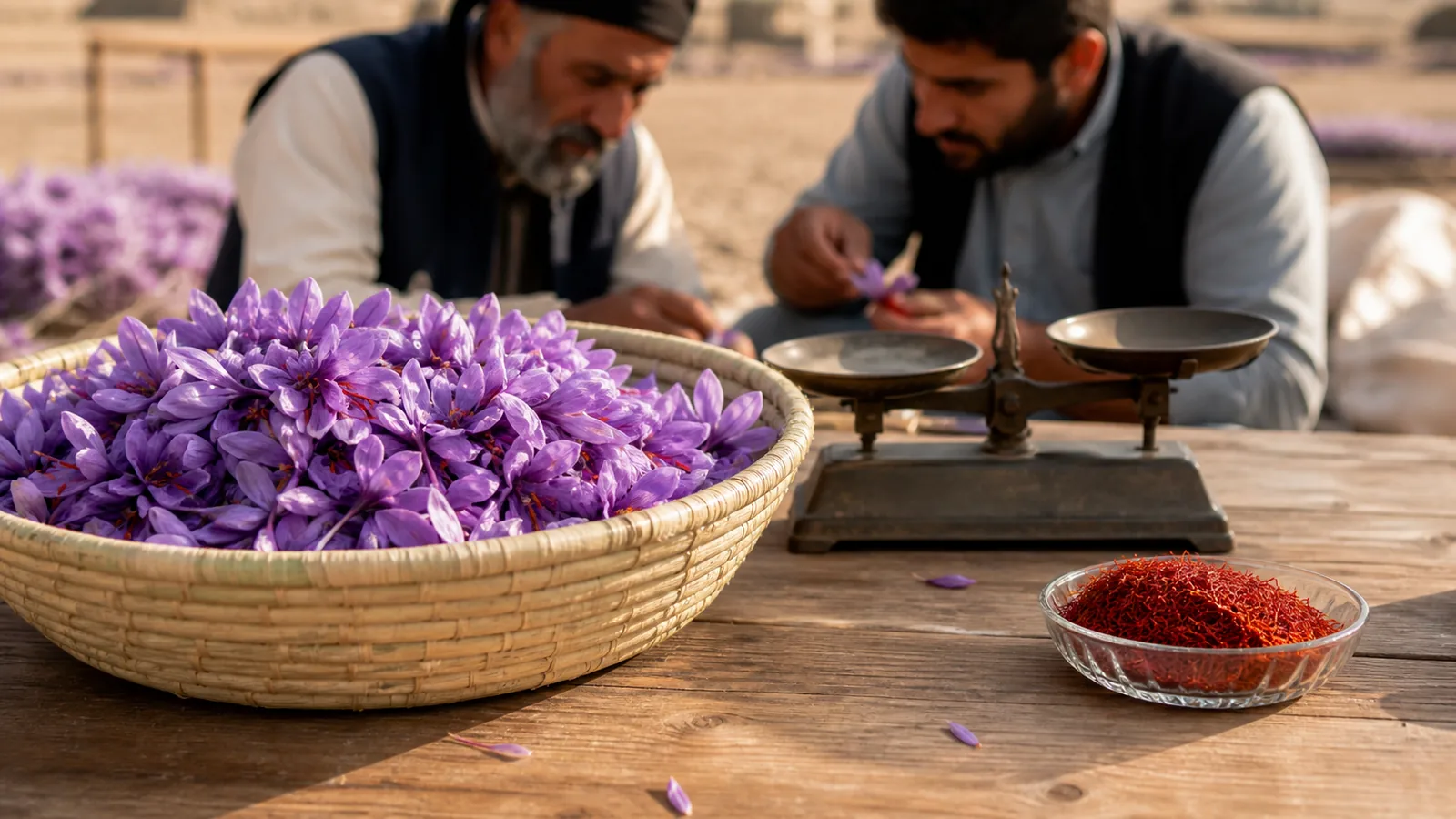
“Gul” in this article means fresh saffron flower. The report records a late-2016 Khorasan market update in which an agricultural official said saffron flower price fluctuations had not been significant. Fresh flowers were quoted at about 53,000 tomans per kilogram, while dried saffron was quoted at roughly 6.2 million tomans per kilogram. These are historical figures, not current prices.
The two prices describe different products
A kilo of fresh saffron flowers and a kilo of dried saffron are not comparable units. The flower contains petals, stamens, stems and moisture. Only the three red stigmas are separated and dried for the spice market. A large weight of flowers therefore produces a small weight of saleable threads.
The damaged English translation called the second product “stone saffron” and placed the currency awkwardly. In context, the intended comparison appears to be 53,000 tomans for one kilogram of flower and 6.2 million tomans for one kilogram of dry saffron. The original report did not identify the dry grade, moisture specification or transaction size, so the figures cannot support a precise conversion margin.
What Javadi said about the harvest market
Javadi, described as an adviser to the head of the Razavi Khorasan Agricultural Jihad Organization, told ISNA that prices tended to soften when the volume of harvested flowers entering the market increased. This is a familiar seasonal pattern: flowers arrive during a short harvest, they must be processed quickly, and many growers need to pay pickers and other immediate costs.
He did not say that every price movement was harmless. His point was that the fluctuations observed at that stage of the season were not considered significant. The title preserves that historical assessment; it should not be read as a forecast for a later crop.
Why fresh saffron flower prices move quickly
Fresh flowers are unusually time-sensitive. Once picked, they need careful transport and prompt separation of the stigmas. A buyer must have enough labour and drying capacity for the flowers arriving that day. When a large volume reaches the local market at once, that capacity can become the practical limit on demand.
Price also depends on flower condition, time since picking, moisture, the expected stigma yield and local labour costs. Two apparently similar flower lots can produce different quantities and qualities of dried saffron. A dated quote should therefore include the location, lot condition and whether collection or transport is included.
The proposed role of rural cooperatives
The report said the Rural Cooperative Organization was prepared to buy saffron from producers if prices fell below an acceptable threshold. The stated purpose was market control and support for growers, not the permanent replacement of private buyers.
Any intervention of this kind needs a published grade, purchase period, delivery location, payment timetable and available budget. Without those details, an announced support price may not translate into an offer that an individual farmer can actually use. The old article records readiness to buy; it does not document the volume ultimately purchased.
Coordination across the three Khorasan provinces
Razavi Khorasan is a central saffron-production region, but the meeting described in the report also involved managers from South Khorasan and North Khorasan. That wider participation matters because harvest timing, output and trading conditions in one province can affect the others.
A coordinated view of production and supply can reduce conflicting public figures. It can also help buyers distinguish between a short local surge in flower deliveries and a lasting change in the available dry crop.
A saffron value chain, not a single market price
The official outlined an initiative to connect the “rings” of the saffron chain: growers, flower buyers, processors, complementary industries and exporters. University researchers were expected to contribute work on reducing production costs and improving yield.
That is a more useful frame than watching one daily price. Value can be lost through delayed flower processing, uneven drying, weak grading, contamination, poor storage or an export lot that lacks traceability. It can be added through reliable post-harvest handling, laboratory verification, suitable packaging and a buyer relationship built around a defined specification.
FAO’s current work in Iran follows the same broad logic. It brings together farmers, processors, cooperatives, traders and researchers to improve production, post-harvest handling, safety, traceability and marketing. That does not validate a 2016 price, but it confirms why coordination across the chain remains important.
The reported 5% to 10% production increase
The horticulture director for Razavi Khorasan said production was expected to rise by about 5% to 10% compared with the previous year. At the time of the statement, only around half of the harvest had been completed. He therefore warned that a final estimate was premature because output still depended on weather and water conditions.
This was a forecast, not a completed crop total. It should not be converted into tonnage without the prior-year baseline, nor should it be presented as a current growth rate. Later reports need their own harvest year and official dataset.
How to compare saffron flower and dry-saffron quotes
A grower or processor comparing offers should record more than the headline price:
- the date and village or market where the quote applies;
- whether the lot is fresh flower or dried saffron;
- the dry grade, moisture and test specification;
- the expected stigma yield from the flower lot;
- separation, drying, packaging and transport costs;
- the payment terms and time to payment; and
- who bears rejection or quality-loss risk.
Only then can a processor estimate whether the gap between flower and dry-saffron prices covers the real work and risk.
What remains useful in this historical report
The 53,000-toman and 6.2-million-toman quotes belong to the 2016 harvest period. Their lasting lesson is not the amount. It is that fresh flower, dry threads and different dry grades must be treated as separate products, and that a harvest forecast should remain provisional until picking is substantially complete.
Transparent grades, dated regional data and clear cooperative purchasing terms do more for growers and buyers than an isolated price headline. They show what is being sold, at what stage of the chain, and on what conditions.
Sources reviewed: the historical statements preserved in this page and FAO’s current account of saffron quality and value-chain development in Iran. The price and production figures above are explicitly treated as dated statements from the 2016 harvest, not current market data.

![Exporting Saffron to Turkey + Price Guide [Complete 0 to 100]](https://img.rowhanisaffron.com/20260827003933/saffron-export-turkey-quality-inspection.webp)



