


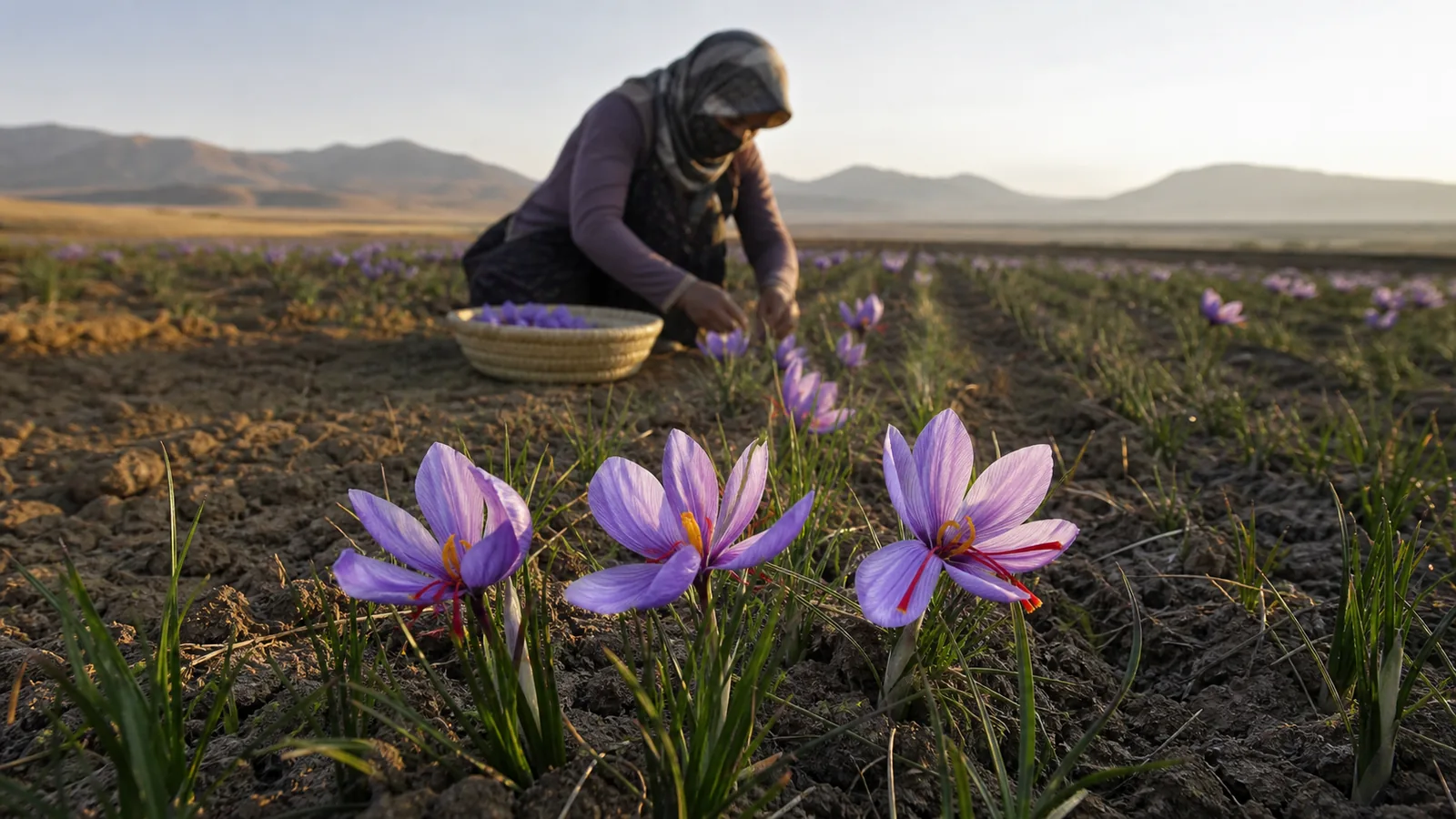
A basic introduction to saffron begins with a surprising fact: the spice is only a small part of a flower. Saffron is the dried red stigma of Crocus sativus. Each purple flower carries three stigmas, which are picked, separated and dried before they can be used in food. That tiny yield, together with the short flowering season and delicate hand work, explains why genuine saffron is valuable.
What saffron is
Crocus sativus belongs to the iris family. Kew Science describes it as a tuberous geophyte, although growers usually call its underground storage organ a corm rather than a bulb or onion. The plant has narrow green leaves and a low autumn flower. The commercial spice comes from the red stigmas, not from the yellow stamens or purple petals.
The stigma contains compounds associated with saffron’s familiar qualities. Crocins contribute colour, picrocrocin contributes bitterness, and volatile compounds including safranal are important to aroma. Drying has a major influence on all three. Saffron that looks red is not necessarily strong or pure, so colour alone is not a complete quality test.
Why a kilogram takes so much work
A field must produce an extraordinary number of flowers for one kilogram of dried saffron. The original version of this article gave a range of 110,000 to 170,000 flowers and said roughly 40 hours of labour were needed to pick 150,000 flowers. Published estimates vary with flower size, stigma weight, moisture and whether the calculation is for picking alone or the complete harvest.
ISO has published estimates ranging from more than 75,000 to about 250,000 flowers per kilogram in different explanatory material. That spread is a useful warning against presenting one universal number. What does not vary is the basic reason for saffron’s price: each flower supplies only three stigmas, the crop blooms in a brief window, and careful separation remains labour-intensive.
How saffron grows
Saffron does not usually set viable seed. Growers propagate it by planting daughter corms. A corm can remain in the ground for several seasons, producing leaves and new corms before the field is lifted and replanted. Planting density, corm health, soil drainage, summer heat, autumn temperature and disease pressure all affect the result.
The plant is well suited to regions with dry summers, but “drought tolerant” does not mean it needs no water. The old article said Khorasan farmers watered twice—once before flowering in November and again near the end of the harvest in December—and relied on rain or snow later. That describes one traditional schedule, not a rule for every farm. Irrigation timing must match soil, rainfall, temperature, corm stage and local agronomic advice. Waterlogging is especially dangerous because corms need well-drained soil.
Harvesting and drying the red stigmas
Flowers are normally collected early, before heat and handling damage them. Workers then open each flower and separate the red stigmas. The threads must be dried promptly and evenly. Too little drying leaves excess moisture and raises storage risk; excessive heat can flatten the aroma and darken the product.
After drying, saffron should be protected from light, moisture, heat and strong surrounding odours. A tightly closed, food-safe container in a cool, dark place is more suitable than an open jar by a cooker. Proper storage preserves quality, but it does not turn weak or adulterated material into good saffron.
Colour, aroma and flavour
Good threads release a golden-yellow colour into warm water rather than instantly producing a harsh red cloud. Their aroma is complex—often described as hay-like, floral or honeyed—with a clean, slightly bitter taste. The threads should not taste sweet. Sugar, dyed fibres and other plant material have all been used to increase weight or imitate saffron.
Laboratory testing is the dependable way to evaluate a commercial lot. The current ISO 3632-1:2025 specification covers dried saffron in filament, cut-filament and powder forms, while ISO 3632-2 describes test methods. These standards assess defined characteristics; they are more meaningful than a seller calling a product “premium” without a test report.
Iran and the Khorasan growing regions
Saffron has a long cultural and agricultural history in Iran. Precise claims about a single birthplace or an exact 3,000-year cultivation date are difficult to prove, and botanical sources do not all describe its origin in the same way. Kew currently treats the plant as a cultigen associated with Greece. Iran’s role in developing large-scale production and saffron culture, however, is not in doubt.
Razavi Khorasan and South Khorasan form the heart of Iranian production. The old article referred to a 700-year local history and named Torbat Heydarieh, Taybad, Bakharz, Gonabad, Bajestan, Qaen, Ferdows, Sarayan and Birjand among the communities tied to the crop. It also mentioned Estahban and Eqlid in Fars Province. Saffron income supports harvesting crews, family farms, processors, laboratories, packers and exporters across this wider network.
Historic figures on the page—200 to 300 tonnes for Iran, about 170 tonnes for Khorasan Razavi and a 75.5% provincial share—belonged to an older reporting period and should not be read as current totals. FAO reported in 2025 that Iran produced about 85% to 90% of world saffron, with especially deep rural roots in Razavi and South Khorasan. Annual output and country shares still change with weather, acreage and the source used.
Where else saffron is grown
Spain, Greece, Morocco, India and Afghanistan are established saffron origins, and smaller plantings exist in other countries. The former article also listed Russia, Singapore, Malaysia, Japan, Taiwan, China, France, Italy, Germany and Australia, but its claim that these countries jointly held a specific “third place” with 25 tonnes was not supported by a year or dataset. A current production ranking should use a named agricultural source and reporting year.
Origin alone does not determine the quality of an individual pack. Crop handling, cleanliness, drying, storage, traceability and laboratory results matter wherever the flowers were grown.
How saffron is used
A small quantity can colour and perfume rice, bread, desserts, sauces, tea and other drinks. Crushing threads gently and steeping them in warm water helps distribute the flavour evenly. The spice is also studied and used in pharmaceutical, cosmetic and extract industries, but a culinary product should not be treated as a medicine or advertised as a cure.
For a first purchase, choose threads from a seller who identifies the harvest or packing date, origin, net weight and batch. Ask for a relevant laboratory specification when buying wholesale. Powder is convenient, but whole threads are easier to inspect and generally harder to disguise with added material.
The essentials to remember
Saffron is a dried flower stigma produced through careful field work, hand separation and controlled drying. Iran leads global production, with Khorasan at the centre of its farming tradition. The spice’s colour, aroma and flavour depend on the quality of the lot and how it was handled—not on grand claims or an attractive label.
Sources reviewed: Kew Science’s accepted record for Crocus sativus, the ISO 3632-1:2025 saffron specification, ISO’s explanation of saffron test methods, and FAO’s 2025 account of Iran’s saffron value chain.

![Exporting Saffron to Turkey + Price Guide [Complete 0 to 100]](https://img.rowhanisaffron.com/20260827003933/saffron-export-turkey-quality-inspection.webp)



