


“Saffron with Iranian packaging in European and American stores” records an Iranian industry claim about moving beyond bulk exports and keeping more of the product’s identity and value in Iran. Gholamreza Miri, then vice-president of the National Saffron Council, said Iranian-packed saffron had reached supermarkets in the United States, Germany, France, Italy and Spain.
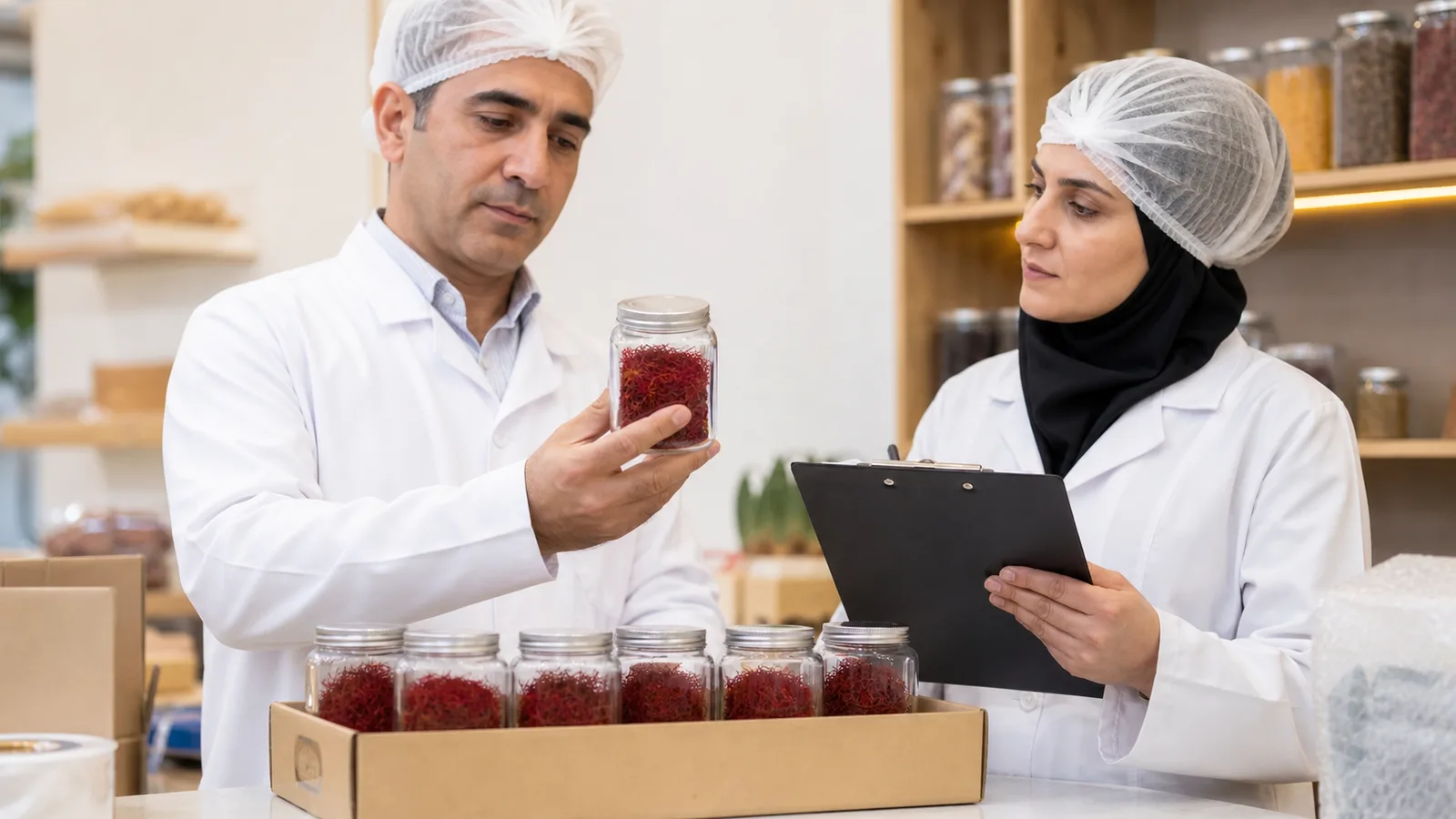
That statement belongs to the period in which it was made; it is not a live inventory of particular stores. The broader issue is still useful. Export-ready packaging can identify origin, protect the threads and present a finished consumer product, but only when the saffron, label, importer and supply chain meet the destination market’s rules.
What Iranian packaging can preserve
When saffron leaves Iran in bulk, later businesses may grade, blend, repackage or brand it. That does not automatically make the product inferior, and repacking can be a legitimate part of distribution. It can, however, make the farm or Iranian processor less visible to the final buyer.
An Iranian consumer pack can keep the producer’s name, declared origin, lot identity and storage instructions together. A suitable container also reduces exposure to light, moisture and odours. Packaging cannot repair poor drying, remove adulterants or prove origin by appearance alone; those jobs require controlled handling, records and testing.
Miri praised the quality and capacity of Iranian packaging companies. His opinion should not be treated as a measured comparison with every European pack. A buyer judges a finished product by whether it protects the saffron, communicates truthful information and remains traceable—not by the country in which the box was printed.
Packaging for Europe and the United States
A pack that is acceptable in one market is not automatically ready for another. In the European Union, the European Commission’s food-information rules require mandatory particulars for prepacked foods, including the food name, net quantity, durability date, storage conditions and responsible food-business operator. Information must be visible and legible in a language consumers in the market can understand. Origin must be stated where leaving it out could mislead the buyer.
For the United States, the Food and Drug Administration says imported food must be safe, produced under sanitary conditions and carry informative, truthful labelling in English. Foreign facilities and U.S. importers also have registration, prior-notice and supplier-verification responsibilities where applicable. FDA does not pre-approve an individual saffron label or shipment simply because it has professional packaging.
Quality specifications matter alongside the label. The international Codex standard CXS 351-2022 for saffron covers dried stigmas, styles and powder, with provisions for quality, contaminants, hygiene, packaging and labelling. Commercial contracts may add ISO tests, buyer specifications or national requirements.
A historical export slowdown and recovery
Ali Hosseini of the South Khorasan Association of Saffron Producers and Exporters described exports returning to their normal flow after a slowdown lasting several months. He said the trade had not fallen year over year at the time despite sanctions and payment difficulties.
His account also shows why shipment volume and exporter income are different measures. Hosseini said the international selling price averaged about $1,400–$1,500 per kilogram and was 20–25% lower in foreign-currency terms than the previous year. He described low world prices as the central export problem even while the Iranian exchange rate had risen.
More than 200 tonnes were reported harvested across Khorasan Razavi and South Khorasan in that season. That is a dated two-province figure, not a current national crop estimate. Recent FAO reporting places Iran at about 85–90% of global saffron production, confirming its continuing importance while avoiding the older claim that Iran invariably produces more than 90% in every season.
Why saffron prices were so variable
A second interview with Miri supplied another historical price snapshot. He placed domestic saffron at roughly 5–6.2 million tomans per kilogram and processed, packaged export saffron at about $1,300–$2,000 per kilogram. He also referred to only a $30–$50 difference between the principal domestic and foreign wholesale markets.
These figures should be kept in their original period and context. The ranges combine different currencies, and the translated account does not define the exchange-rate date, grade, contract terms or point of delivery. They cannot be used as a current quote or converted into a reliable retail margin.
The causes he identified are more durable than the numbers:
- Harvest supply: a large crop can increase product offered during a short period, while weather damage can tighten it.
- Demand: export orders, domestic consumption and buyer inventories do not move in step.
- Grade and processing: whole threads, cut styles, powder and different quality results do not command one price.
- Packaging and compliance: testing, traceability, compliant labels and small consumer packs add work and cost.
- Currency and payment channels: the same toman price can produce a different foreign-currency result as exchange rates and settlement costs change.
- Inventory behaviour: withholding stock can make visible supply look smaller, while a sudden need for cash can return that stock to the market quickly.
Useful intermediaries and harmful speculation
Miri distinguished between two kinds of middleman. The useful kind buys small farm lots, assembles consistent quantities, stores them safely, arranges testing and delivers to a processor or packer. Many small growers cannot perform all those functions for every export customer.
The harmful pattern begins when buyers use information or financial power to acquire a crop cheaply, hold it outside a transparent inventory system and release it only after a speculative price rise—or dump it when their cash runs out. In the archived account, that behaviour created a false sense of scarcity and then a sharp fall in price.
The original destination also repeated allegations of extreme mark-ups involving traders and a rural cooperative. Its English translation corrupts some currencies and units, so those exact numbers are not reliable enough to reproduce as fact. The defensible point is that public or private purchasing does not protect growers unless prices, grades, custody and resale terms can be audited.
Can a fixed-price strategy stop volatility?
Miri proposed stable pricing and forward sales as a way to reduce speculative dealing. Forward contracts can help a grower, packer and buyer agree quantity, grade, delivery and price before shipment. They can reduce uncertainty, but they cannot guarantee a permanent market price or eliminate crop, currency and counterparty risk.
A credible contract needs a defined saffron grade, test method, permitted tolerance, pack specification, payment currency, delivery point and remedy if either party fails. Without those details, “fixed price” can simply move risk from one participant to another.
What buyers should look for on the pack
A consumer does not need to solve the export market to choose saffron carefully. Look for an intact food-grade container, a clear product name and net weight, a responsible business, lot or batch identification, durability information and storage instructions appropriate to the market. The threads should be dry and clean, and the seller should be able to explain origin and quality rather than relying on a decorative box.
Our guide to buying high-quality saffron covers the practical checks a shopper can make. Laboratory analysis remains the stronger safeguard where authenticity or contract grade matters.
Iranian packaging can put an Iranian product and producer in front of European and American consumers. Its success depends on what the package can substantiate: genuine saffron, consistent quality, lawful information, secure handling and a traceable route from crop to shelf.

![Exporting Saffron to Turkey + Price Guide [Complete 0 to 100]](https://img.rowhanisaffron.com/20260827003933/saffron-export-turkey-quality-inspection.webp)



