


There is no fixed price for saffron because one quote can refer to a farm lot, a warehouse lot, a wholesale export contract or a small retail pack—and each may differ in form, tested quality, harvest, currency and delivery terms. Supply is seasonal, but buying, storage and export continue throughout the year. The result is a market that can move even when no new flowers are being picked.
A single daily number is only meaningful when it identifies the weight, grade or form, location, currency, date and whether tax or delivery is included.
Why is there no fixed price for saffron?
Saffron is an agricultural product sold in distinct physical lots. Unlike an identical manufactured item, two lots from the same region can differ after harvesting, drying, sorting and storage. Price discovery therefore happens at several levels rather than through one permanent worldwide tariff.
Harvest size and available stock change
Weather, irrigation, corm health, field age and labor affect the crop. A smaller harvest can tighten supply; stocks carried from a previous season can soften that effect. Estimates made before harvest may also change once flowers are picked and the dried output is measured.
Export and domestic demand compete for lots
When exporters buy more, less stock may be immediately available in a local market. The reverse can happen when freight, payment or import conditions slow trade. A production total alone is not enough: buyers also need to know how much is already committed, stored, consumed or exported.
Form and quality are not identical
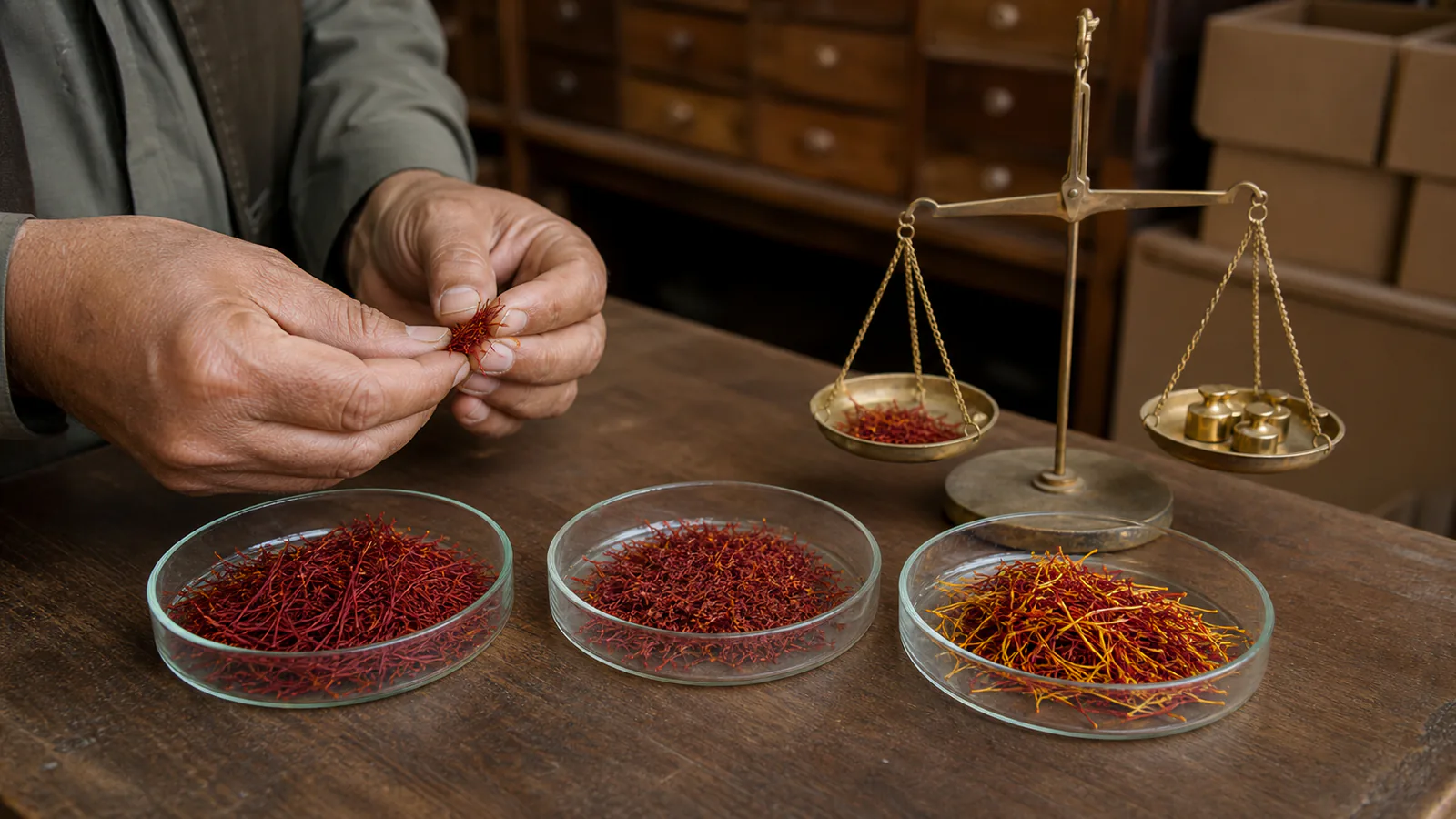
Predominantly red, long, clean stigmas usually trade differently from bundle saffron with more yellow style, broken threads or powder. Moisture, foreign matter, aroma, flavor and coloring strength also matter. The current ISO 3632-1:2025 specification covers filament, cut-filament and powder forms, while laboratory methods help buyers compare actual characteristics instead of relying on a grade word.
Currency and sales channel change the visible number
A farmgate quote in Iranian rials or tomans, a dollar export contract and a euro retail pack are not interchangeable. Exchange rates, finance, packaging, laboratory work, customs, tax and delivery can change the final per-gram cost. Small packs also carry more handling cost per gram than bulk lots.
Inventory decisions and market expectations matter
Growers, cooperatives, traders and packers decide when to sell stored product. Expectations of a short crop or stronger exports can prompt holding or rapid buying. Rumor and speculative behavior can amplify a move, but neither explains every increase. Claims about manipulation should be attributed to the speaker and considered alongside measured production, inventory and trade data.
A historical example from the Mashhad market
The two reports consolidated into this article describe a sharp increase in Mashhad during an earlier market cycle. They were republished on this site in January 2018 but referred to older Iranian crop-year figures. Because the original English translations mixed dates, rials, tomans and dollars, the figures below are preserved as a historical reported snapshot, not a current quotation.
Gholamreza Miri, identified in the report as head of the Khorasan Razavi saffron sellers’ union, said 500,000 rials—50,000 tomans at the conventional ten-rial-per-toman unit—had been added to the Mashhad kilogram price each day for 40 days. That equals a reported total rise of 20 million rials, or 2 million tomans, per kilogram. He also described a 40% jump on 20 Farvardin before the daily increases.
A companion market account said Tehran retail quotations per mesghal had moved from roughly 26,000–30,000 tomans to 30,000–34,000 tomans over about two months. Those nominal historical prices should not be converted into modern dollars without the exact transaction date and applicable exchange rate.
This corrects the old machine translation, which mistakenly turned toman figures into “millions of dollars.” The report was discussing local currency, not a multimillion-dollar price for one kilogram.
The supply-and-export explanation in the source report
Miri attributed the move to an unusual production decline combined with stronger registered exports from Khorasan Razavi. The report gave the following figures:
- about 171 tonnes produced in the province in the previous year, described as roughly 30% below the year before;
- 11 tonnes of registered exports in Farvardin, reported as 29% higher than the same period a year earlier;
- about 148 tonnes exported in the previous year, compared with about 117 tonnes in 2013; and
- a customary provincial carryover of about 40 tonnes that he did not expect to remain after the production decline.
These are attributed figures from that reporting period. They are not current statistics and should not be used to calculate today’s balance sheet.
Why another official gave a different explanation
The destination article also preserved comments from Ali Hosseini, identified as a member of Iran’s National Saffron Council. He argued that rumors of scarcity and opportunistic trading had exaggerated the increase because national stocks remained available.
That account cited roughly 300 tonnes of national production in Iranian calendar year 1392, about 200 tonnes in 1393, and approximately 140 tonnes of exports in 1393. It also described older inventory still being sold and forecast another roughly 300-tonne national crop.
The two accounts should not be pasted into one arithmetic series. One discusses Khorasan Razavi provincial production and registered provincial exports; the other uses national production, exports and carryover in Iranian calendar years. Their definitions and periods differ. Together they show why saffron-price debates can produce conflicting conclusions: one speaker emphasizes the flow of a specific provincial crop, while another includes national stocks and expected output.
What remains relevant now
Iran is still central to the market. In a November 2025 update, FAO said the country produces about 85–90% of the world’s saffron and highlighted ongoing work with Iran’s Ministry of Agriculture-Jahad on authenticity, standardization, post-harvest practice and value-chain governance. Read the FAO value-chain update.
That scale means changes in Iranian harvest expectations, quality control and export conditions can influence international offers. It still does not create one price: every quote must specify the lot and sales terms.
How to compare saffron prices correctly
- Record the date and market. A Mashhad bulk quote and an overseas retail price answer different questions.
- Normalize weight. Convert each offer to a price per gram or kilogram and note whether a local unit such as mesghal is involved.
- Keep currency explicit. Never relabel rials or tomans as dollars; state the exchange rate if you convert.
- Match the form and evidence. Compare similar thread styles, test results, origins and harvest condition.
- Separate product from delivery. Identify packaging, tax, duty and freight so a low base quote is not mistaken for the final cost.
- Check the timestamp on statistics. A dated production or export figure explains its period, not today’s supply.
For the buyer, the answer is simple: saffron has no fixed universal price because the product, market and moment keep changing. A credible seller gives a current per-weight quote and enough information to understand the lot behind it. Our guide to the price of original saffron explains how to assess that retail offer.

![Exporting Saffron to Turkey + Price Guide [Complete 0 to 100]](https://img.rowhanisaffron.com/20260827003933/saffron-export-turkey-quality-inspection.webp)



