


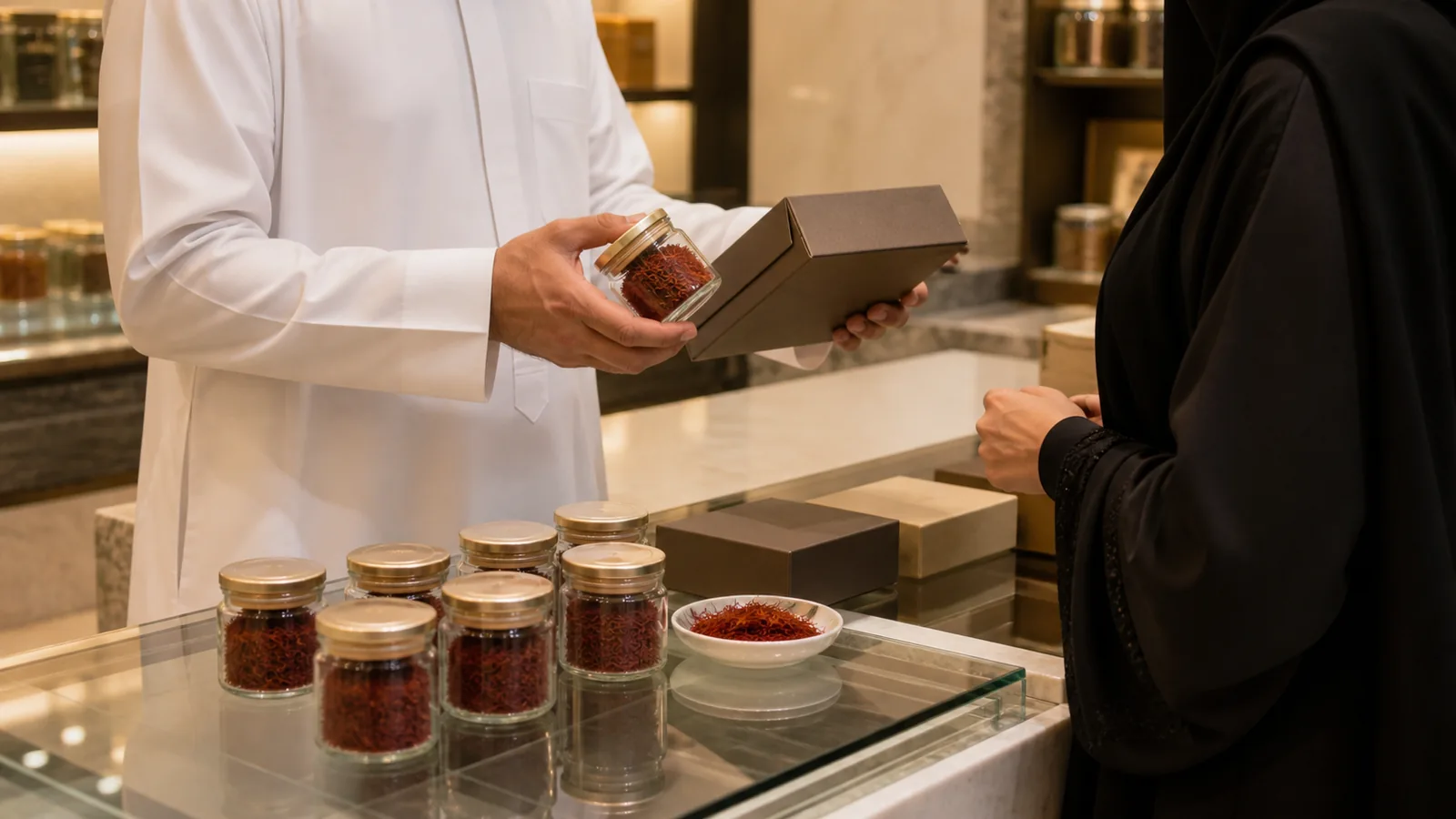
Iranian saffron is sold in Saudi Arabia through supermarkets, spice shops, specialist retailers, and online sellers, but origin alone does not establish purity or value. A careful buyer should compare the actual grade, net weight, batch traceability, packaging, and seller—not simply a red colour or the words “Iranian saffron.”
This page began with a warning about travellers bringing cheap “saffron colour” or powder home from Saudi Arabia as a souvenir. The useful lesson remains: a low-cost colouring product is not a substitute for saffron, and an unlabelled powder should not be assumed safe or authentic. One medical claim in the old warning, however, was too strong and is corrected below.
Buying Iranian saffron in Saudi Arabia
Look for a sealed food pack that clearly identifies the product, responsible business, country of origin, net weight, lot or batch, date information, ingredients, and storage instructions required for its market. The ingredient list for pure saffron should not quietly add a colour, flavouring, starch, salt, sugar, or another plant.
Whole threads offer more visible information than powder. Genuine threads are naturally irregular and usually widen at one end. Their colour ranges through deep red and red-orange rather than appearing as perfectly identical fibres. Visual inspection still cannot certify a batch; good traceability and, for commercial purchases, appropriate testing provide stronger evidence.
Powder can be genuine and useful, especially when it is milled and packed by a traceable producer. It is also easier to extend with cheaper material because the flower structure has disappeared. Our guide to saffron powder safety and authenticity explains what home observations can—and cannot—tell you.
Iranian saffron price in Saudi Arabia
There is no honest permanent figure for the Iranian saffron price in Saudi Arabia. Retail prices move with the harvest, grade, pack size, exchange rates, import and distribution costs, testing, presentation, and the seller’s margin. Gift packs also include packaging value that should not be confused with the spice price.
To compare offers fairly, convert each one to a price per gram:
Price per gram = total pack price ÷ net saffron weight in grams.
A SAR 45 pack containing 1.5 g, for example, is SAR 30 per gram. That arithmetic makes pack sizes comparable, but it still does not tell you whether the two products share the same grade or authenticity evidence. Record the date when comparing online offers because a price copied from an old article quickly becomes misleading.
What changes the price?
- Cut and grade: all-red threads and threads retaining part of the style are different products.
- Whole or ground: powder is not automatically cheaper or fake, but it is harder for a consumer to inspect.
- Pack size: small retail and gift packs usually have a higher cost per gram than a larger plain pack.
- Testing and traceability: controlled batches and meaningful documentation add work and cost.
- Sales channel: airport, hotel, gift, specialist, supermarket, and wholesale prices serve different customers.
- Age and storage: a premium name cannot restore aroma lost through heat, light, moisture, or time.
Saffron, saffron extract, and saffron colour are not the same
Saffron threads are the dried stigmas of Crocus sativus. Saffron powder should be those threads ground into powder. Saffron extract is a processed ingredient whose composition and intended use should be stated. Saffron colour may be a colouring product designed to imitate the yellow hue in rice or sweets and may contain no saffron at all.
A packet can be a legitimate food colour if it is accurately labelled and complies with local rules. It is fraudulent when it is presented as saffron despite containing something else. Buyers should not infer ingredients from a product nickname; read the declaration on the pack.
Correcting the old tartrazine warning
The original report quoted Dr Hussein Rastegar, then described as a food and drug control laboratory official. He warned that some cheap souvenir powders were coloured with tartrazine and said that painted corn silk or added aroma might be sold as saffron.
Those examples describe real categories of food fraud, but the report also called tartrazine inherently and completely carcinogenic. That blanket claim is not supported well enough to repeat. Tartrazine is the colour additive E102, and permitted uses and limits depend on the food category and jurisdiction. The Saudi Food and Drug Authority publishes the Gulf standard for permitted food additives, which lists tartrazine for specified uses and maximum levels.
That does not make an undeclared dyed “saffron” acceptable. It means the sound objection is mislabelling and unknown composition, not an automatic cancer diagnosis from a colour name. An additive permitted in one food at a set level may be prohibited or restricted in another use, and susceptible people may have adverse reactions.
How to examine a saffron souvenir
- Read the front and ingredient list together. Do not rely on a picture of a crocus or a saffron-coloured dish.
- Confirm the net quantity. “Large” packaging may contain a very small sachet.
- Check who is responsible for the food. A traceable producer or importer matters if a batch problem appears.
- Inspect the closure. Avoid opened, leaking, damp, or unsealed packs.
- Keep the receipt and lot details. They are useful if the product is mislabelled or causes a reaction.
- Do not taste an unidentified powder as a safety test. Appearance, aroma, and water behaviour can screen for obvious problems but cannot prove purity.
Travelling with saffron bought in Saudi Arabia
Customs rules depend on where the traveller is going, the amount, the product, and whether it looks personal or commercial. Check the destination authority before travel rather than relying on a seller’s assurance.
For travellers entering Saudi Arabia, current ZATCA guidance says personal luggage and gifts should be non-commercial, supported by receipts where required, and must not be prohibited or restricted goods. Its personal luggage guidance should be checked close to the travel date because thresholds and procedures can change.
If saffron is being shipped or purchased for resale, personal-luggage rules are not the right standard. Commercial food import, documentation, labelling, and customs requirements may apply.
A better souvenir is one you can identify later
Saffron can be a compact and valuable gift when the pack tells the recipient what it contains and who produced it. Choose a realistic quantity in sealed packaging, keep the purchase information, and store it away from heat, moisture, and strong light.
The safest conclusion is not to distrust every Saudi retailer or every Iranian powder. It is to reject the shortcut that red colour equals saffron. Buy a traceable food product, compare its price per gram and grade, and treat anonymous “saffron colour” as exactly what its label says—not as the spice.

![Exporting Saffron to Turkey + Price Guide [Complete 0 to 100]](https://img.rowhanisaffron.com/20260827003933/saffron-export-turkey-quality-inspection.webp)



