


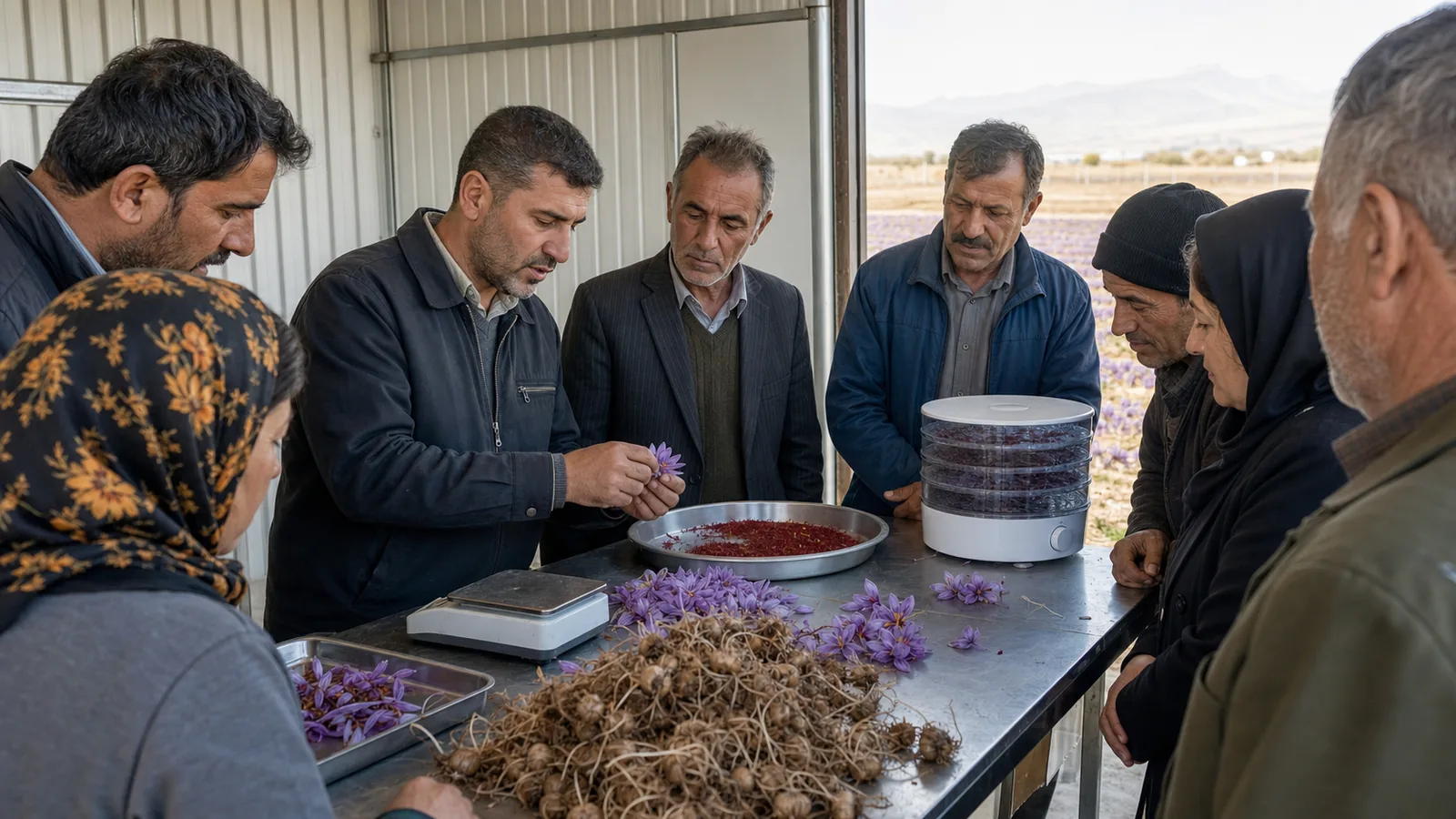
A useful saffron workshop should take a grower through the whole production cycle: field assessment, corm selection, planting, crop care, flower picking, stigma separation, drying, storage, costing, and market planning. The classroom part explains the decisions; the practical part lets participants handle the crop and see how those decisions affect quality.
This page began as a report on a cultivation workshop held in Hamedan Province, Iran. It now preserves that event while setting out what farmers should expect from serious saffron training—and what no one-day class can promise.
The Hamedan saffron workshop
Soraya Shabani, identified in the original report as executive secretary of Hamedan Province’s agricultural guild system, announced the workshop in 2017. It was organised with the provincial agriculture administration and was described as both theoretical and practical.
Forty farmers and guild members and non-members attended. The stated aims included:
- introducing saffron planting, flower harvest, and post-harvest work;
- examining income and employment opportunities;
- explaining the agricultural trade system and its services;
- providing training certificates; and
- helping eligible participants understand the support or lending routes discussed at the time.
The report placed particular emphasis on water pressure in Hamedan and interest in saffron as an alternative to more water-intensive crops. It also described the programme through the “resistance economy” policy language used by the organisers. Those were the goals of that dated workshop; this page does not claim that its certificates or finance arrangements remain available today.
What a saffron cultivation workshop should cover
1. Deciding whether the field is suitable
Saffron is often promoted as a relatively low-water crop, but that does not mean every dry field is suitable. Training should begin with climate, drainage, soil texture, salinity, field history, access to timely irrigation, and the risk of standing water. A poorly drained plot can lose corms even when its annual water use appears modest.
Participants should leave knowing which observations require a soil or water test and how to interpret results with local agricultural advice. A workshop that starts by selling corms before assessing the site is putting the transaction ahead of the crop.
2. Choosing and handling saffron corms
Healthy planting material is central to establishment. The class should show real examples of sound and damaged corms, explain why size influences flowering potential, and cover storage between lifting and planting. Corms need to be handled gently and kept in suitable dry, ventilated conditions; a sack of mixed, injured, or diseased material can turn a promising field into an expensive problem.
3. Planning planting depth and spacing
There is no single spacing plan for every farm. Mechanisation, soil, corm size, intended field life, weeding method, and labour all affect the layout. A practical saffron workshop should demonstrate how to measure depth and spacing consistently, calculate planting material for a known area, and maintain rows that can be worked later.
4. Irrigation and crop care
The timing of water matters as much as a simple seasonal total. Training should follow the local growth cycle: the first irrigation, flowering, leaf development, corm multiplication, and summer dormancy. Weed management, soil crusting, nutrition, rodents, and crop observation also belong in the programme.
Good teaching avoids universal calendars. Hamedan’s conditions are not identical to South Khorasan’s, and a schedule copied from another altitude or soil can be misleading. Dates should be tied to local temperature, rainfall, and plant stage.
5. Picking flowers without losing quality
Flowering can rise sharply over a few mornings. Growers need a labour plan before the first bloom, clean collection containers, and a quick route from field to separation area. Flowers should not remain crushed in deep, warm piles while the team waits for space indoors.
A hands-on session can compare an intact flower, a bruised flower, and material contaminated with soil. This makes the relationship between harvesting practice and finished quality easier to understand than a lecture alone.
6. Separating and drying the stigmas
Each flower has three red stigmas. Participants should practise separating them consistently and understand how the amount of attached yellow or orange style changes the appearance and commercial grade. They also need to see the difference between fresh and correctly dried threads.
Drying is not merely “removing water.” Temperature, time, airflow, loading depth, and cooling influence aroma, colour, stability, and weight. A responsible instructor demonstrates a controlled process and explains how it will be checked rather than recommending improvised high heat.
7. Clean storage and traceability
Finished saffron should be protected from moisture, strong light, heat, pests, and strong surrounding odours. Batch records can connect the dry product to its field, picking date, processing conditions, and weight. That record is valuable when comparing seasons, investigating a quality issue, or supplying a professional buyer.
8. Costs, yields, and routes to market
A training course should not promise a fixed profit per hectare. Corm cost, labour, establishment time, field yield, grade, packaging, testing, transport, and selling method all change the result. Participants should work through a budget using local prices and several yield scenarios, including a poor one.
Market training should also distinguish farm-gate sales, supply to a processor, cooperative marketing, wholesale packs, and direct retail. Each route brings different margins, responsibilities, food rules, and customer-service costs.
Questions to ask before joining a saffron workshop
- Who teaches the field, processing, and business sections, and what direct experience do they have?
- Does the course include practical work with corms, flowers, threads, and drying equipment?
- Are recommendations adapted to the local climate and soil?
- Will participants receive written methods rather than only promotional slides?
- Does the instructor explain risks and uncertain yields as clearly as the opportunity?
- Is any certificate recognised for a stated purpose, and by which organisation?
- Are loans, grants, buyers, or guaranteed returns being described accurately and in writing?
What a workshop cannot replace
One course cannot substitute for a soil analysis, local agronomic advice, a food-safety plan, or experience across several seasons. It also cannot guarantee flowering, yield, a buyer, or a price. Its job is to give the farmer a sound decision framework and enough practical understanding to ask better questions.
The Hamedan event recognised two important needs: farmers wanted alternatives under water pressure, and training had to extend from cultivation toward employment and market access. The strongest modern saffron workshop keeps that broad view while staying specific about local conditions, costs, quality, and risk.

![Exporting Saffron to Turkey + Price Guide [Complete 0 to 100]](https://img.rowhanisaffron.com/20260827003933/saffron-export-turkey-quality-inspection.webp)



