


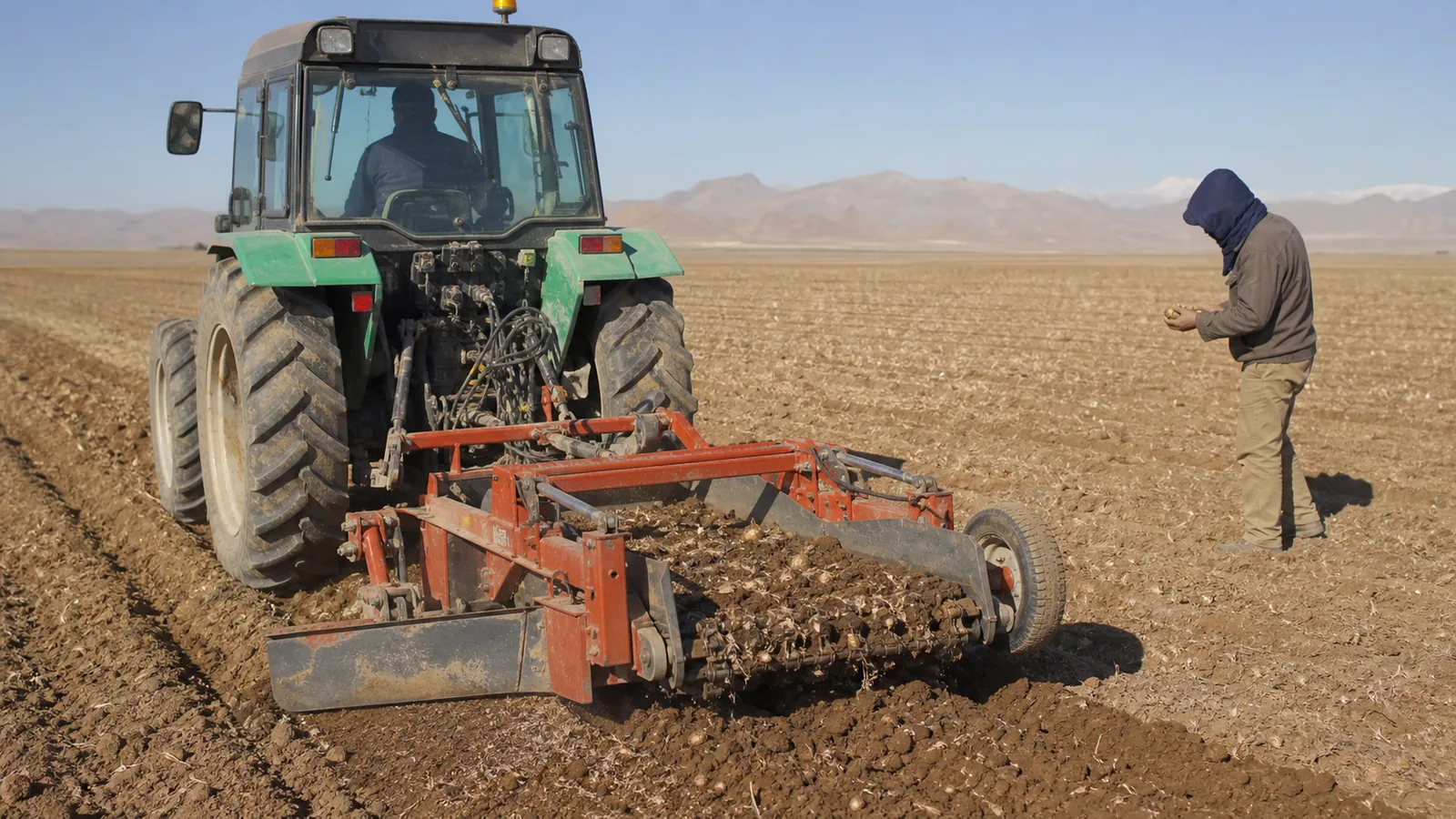
The Iranian machine introduced in Khomein in 2017 was a tractor-mounted saffron corm harvester, not a machine for picking the purple flowers. It was designed to work about 20 cm below the soil, lift saffron corms, and deliver them for collection. That distinction matters because “saffron harvesting machine” can refer to several very different jobs.
A complete saffron production cycle includes digging and grading corms, planting them, picking flowers, separating the red stigmas, and drying the spice. Each stage places different demands on machinery. A robust implement can move soil around dormant corms; a flower harvester has to handle a delicate bloom without damaging the stigmas or the leaves.
What the Iranian saffron picking machine actually did
The machine reported on this page was presented as the first achievement of the development centre at the Islamic Azad University, Khomein Branch. A mechanisation technology team designed and built the device after months of work in response to increased local interest in cultivating saffron under dry conditions.
The original report described a trailing implement connected to a tractor and using hydraulic and pneumatic mechanisms. It penetrated the soil to a depth of about 20 cm, lifted the saffron “onions,” and delivered them for collection. Saffron does not grow from a true onion bulb; the more accurate botanical term is corm.
The development team expected the machine to reduce lifting costs, complete the job in less time, make the operation more mechanised, and remain economical to build. The report said further development and mass production were intended, but it did not document later commercial availability or field-test results. Buyers should not treat the 2017 announcement as a current product listing.
Saffron harvesting machine can mean four things
1. A corm-lifting machine
Corms are normally lifted when a field is being renewed, propagated, or moved—not during every flower harvest. A lifter loosens the soil below the corm zone and separates or raises the crop so workers can collect it. Depth control, soil flow, stone tolerance, corm damage, missed corms, and the amount of soil carried onto the collection system are central design questions.
The Khomein prototype belongs to this group. Calling it a saffron picking machine is understandable in a broad translation of “harvest,” but it did not pick flowers from standing plants.
2. A saffron flower harvesting machine
A flower harvester removes open or nearly open blooms during the short autumn season. The machine must distinguish flowers from leaves and soil, work close to the ground, and avoid crushing or contaminating the crop. Field shape, uneven terrain, flower height, and the sudden daily flush of blooms make the task difficult.
Portable and experimental mechanical systems have been developed, but research repeatedly describes saffron flower picking as one of the least mechanised steps. A technical review of saffron production mechanisation covers flower harvesting as well as corm digging, sorting, planting, crop care, and post-harvest work.
3. A stigma-separation machine
After flowers arrive indoors, the three red stigmas must be separated from the purple tepals and yellow stamens. This is sometimes called stripping, peeling, or processing rather than harvesting. It requires more precision than moving whole flowers.
One published prototype used a camera to locate the correct cutting point and then positioned a mechanical cutter. The automated saffron cutting study reported a cycle of about four seconds per flower under its test conditions. That is evidence of a research system, not proof that every commercial separator achieves the same performance.
4. Drying, sorting, and processing equipment
The phrase “saffron processing machine” may also describe dryers, sieves, thread cleaners, corm graders, or packing equipment. These machines do not all solve the same labour problem. A buyer should define the input and output first: soil and corms, standing flowers, picked flowers, fresh stigmas, or finished dry threads.
Why saffron is difficult to mechanise
Saffron flowers close to the soil and blooms within a brief seasonal window. Each flower is soft, irregular, and valuable only for three slender stigmas. A field machine must work quickly enough to matter while protecting the plant, the crop, and the quality of the spice.
Several tensions shape the design:
- Speed versus damage: faster handling can bruise flowers, cut leaves, or break corms.
- Recovery versus cleanliness: collecting more material may also collect soil, leaves, and foreign matter.
- Precision versus cost: cameras, sensors, controls, and gentle mechanisms can improve selectivity but raise purchase and maintenance costs.
- Laboratory success versus field conditions: a prototype tested with uniform flowers may behave differently in stony soil, wind, mud, or an uneven crop.
What to evaluate before buying a corm harvester
A grower should ask for field evidence in soil and planting conditions similar to their own. Useful measures include corm recovery, visible damage, operating depth, work rate, fuel use, labour still required behind the machine, cleaning time, and the proportion of corms left in the ground.
Compatibility matters too. Tractor power, three-point or trailed connection, hydraulic capacity, row spacing, turning area, transport width, spare parts, and safe guarding should be confirmed before purchase. A low purchase price can become expensive if the machine forces the field into an unsuitable layout or damages valuable planting material.
The field should be checked before full-depth operation. Saffron corm depth varies with planting practice and soil movement, while rocks and buried irrigation components can create hazards. A short test strip allows the operator to adjust depth and travel speed, then inspect both the recovered corms and the soil profile.
What to evaluate in a flower harvester
For flower-picking equipment, the meaningful questions are different. Measure flowers recovered, flowers missed, visible bruising, leaf damage, soil contamination, work rate per person, and how quickly the harvested flowers reach the separation area. A machine that picks quickly but creates a dirty or crushed batch may simply move labour downstream.
Timing remains critical. Flowering can surge from one day to the next, so capacity should be judged against the busiest harvest morning rather than an average day. Cleaning between lots and food-contact materials also deserve attention because the flower becomes a food ingredient after processing.
Mechanisation should protect quality, not just reduce labour
A useful saffron machine removes a bottleneck without creating a new one. Corm equipment should preserve healthy planting material and soil structure. Flower equipment should deliver clean, intact blooms. Separation equipment should recover the red stigmas consistently without mixing in excessive style or foreign flower parts.
The Khomein corm harvester was a credible response to a real need for faster lifting and lower physical effort. Its historical importance is best understood accurately: it was an early locally developed mechanisation project, not evidence that an autonomous Iranian machine had solved flower picking. The broader search for reliable saffron harvesting machinery continues across corm handling, field harvest, stigma separation, drying, and grading.

![Exporting Saffron to Turkey + Price Guide [Complete 0 to 100]](https://img.rowhanisaffron.com/20260827003933/saffron-export-turkey-quality-inspection.webp)



