


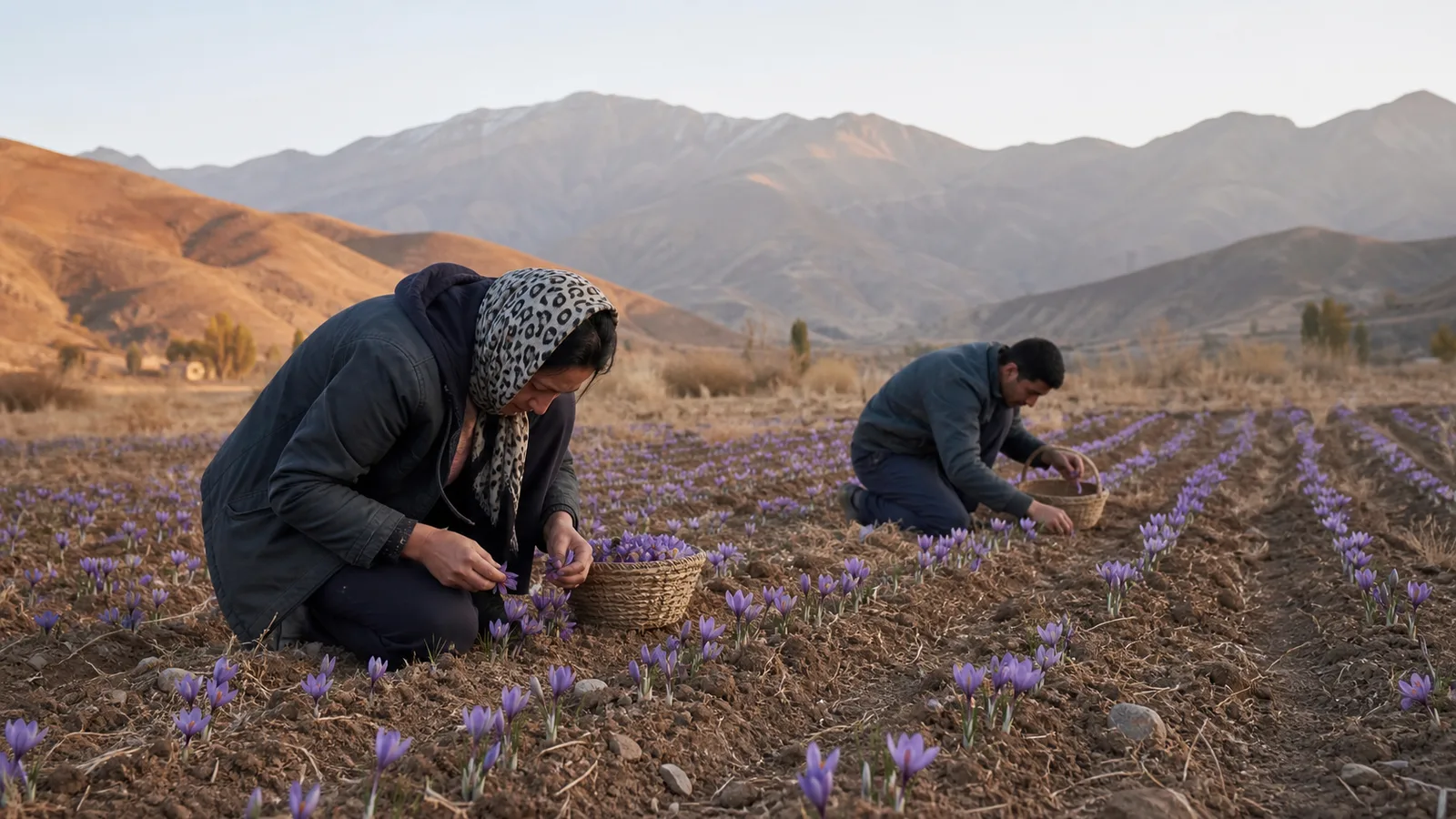
Production of saffron in the province of Alborz is smaller than in Iran’s established Khorasan centres, but it has become a genuine part of the province’s agricultural mix. A 2017 report described local growers testing saffron as a high-value crop with comparatively limited irrigation demand, including a two-hectare Savojbolagh farm that reported an exceptional harvest.
The opportunity is real, although the old article overstated Alborz as one of Iran’s most important saffron provinces. Success depends on the field, corm quality, water schedule, labour, drying and route to market. A strong result from one farm is evidence of local potential, not a yield promise for every hectare.
What Alborz officials said about saffron
Seyed Hamid Tahaei, then governor of Alborz, was quoted by Fars News through the provincial governorate’s public-relations office. His name appeared as “Seyed Hamid Tahabi” and the location as “Karzai” in the old machine translation; the intended references were Tahaei and Karaj.
Tahaei described Alborz as agriculturally capable and argued that the province could cultivate a wider range of crops needed by the country. He placed saffron among crops suited to a period of water constraint because it generally requires fewer irrigations than many conventional field crops.
That comparison needs care. Saffron is not a no-water crop. It needs moisture at the right points in its annual cycle, suitable drainage and enough water quality and quantity to support the field. “Low water demand” is an agronomic comparison, not permission to plant without a water budget.
Why saffron can fit parts of Alborz
Saffron grows from a corm and remains in the ground for several seasons. Flowering is encouraged by a seasonal cycle that includes a dry summer rest and cooler autumn conditions. Parts of Alborz can provide useful temperature patterns, but elevation, soil texture, frost pockets and irrigation access vary considerably across the province.
Before expanding a field, a grower should examine:
- soil drainage, salinity, texture and previous crop history;
- healthy, correctly identified corms from a traceable source;
- the timing and reliability of irrigation rather than annual water alone;
- labour available for the short flower-picking and stigma-separation period;
- clean drying, grading and protected storage capacity;
- a realistic buyer and price range for the grade produced.
A climate that supports flowering is only one part of the system. Poor drainage can damage corms, excessive nitrogen can favour leaves over flowers, and a delayed harvest can reduce quality. The economics also change as a field matures.
The Savojbolagh farm and its 11 kg claim
The report named Mohammad Moazami as a farmer and investor who had planted two hectares of saffron in Savojbolagh. It said that in the Iranian year 1392 he produced 11 kilograms of dried saffron per hectare and set a national record.
That is a notable claim, so its boundaries matter. The source did not publish a weigh sheet, moisture basis, plot sampling method or independent certification. It should be preserved as the farm result reported at the time, not converted into a normal Alborz yield or a guaranteed commercial forecast.
Yield per planted hectare can also be misleading when a field contains non-bearing sections or when production is measured from a selected plot. For planning, growers need multi-year records for the whole productive area, together with labour and processing losses.
Alborz in relation to Khorasan Razavi
Tahaei identified Khorasan Razavi as the country’s principal saffron cultivation centre. He said international demand encouraged farmers in other provinces to try the crop and presented Alborz as one of the places where cultivation had succeeded.
That does not make the provinces interchangeable. Khorasan’s production system includes deep grower knowledge, specialised labour, corm networks, traders and processing capacity developed over generations. A newer region must build its own local field evidence and post-harvest skills instead of copying a calendar without adapting it.
A later Rowhani Saffron report on saffron cultivation in Alborz named Nazarabad, Savojbolagh, Eshtehard, Fardis and Taleghan and described small, fragmented farms. That broader geographic picture supports the existence of a provincial sector while showing that it was not one vast production zone.
Markets mentioned in the original report
Moazami said there was significant buyer interest and referred to customers in Europe, Australia and Canada. The translation called Australia and Canada “European countries,” which is geographically wrong. They were separate overseas markets in his statement.
The old article supplied no invoices, destinations, volumes or period, so it cannot establish how much Alborz saffron those buyers purchased. Demand beyond Iran can be valuable, but exporters still need consistent grade, food-safety controls, traceable lots, compliant packaging and documentation for each destination.
Tahaei described saffron as a global industry whose expansion could support provincial economic development and trade. The strongest route to that outcome is not planted area by itself. It is saleable dried saffron with a known producer, reproducible quality and enough margin after picking, separation, drying, testing and packing.
Water efficiency should be measured, not assumed
Saffron’s irrigation calendar can avoid some of the peak summer demand associated with other crops. That is useful in a water-stressed region, but water efficiency is ultimately the economic or physical output achieved per unit of water. A low number of irrigations does not automatically mean low total use or sustainable extraction.
Expansion should therefore be matched to field-scale water accounting and local groundwater conditions. If cultivation replaces a thirstier crop on suitable land, the comparison may be favourable. If it brings new irrigation to previously uncultivated land, the basin effect can be different.
What makes Alborz saffron commercially credible
For a buyer, provincial origin is only the start. The delivered saffron should match its declared presentation, show normal stigma anatomy, meet agreed color, aroma and bitterness specifications, and remain protected from moisture, light and contamination.
The Codex standard for dried saffron provides an international reference for identity, quality, hygiene, contaminants and labelling. Grower records and appropriate laboratory testing turn a regional production story into evidence a packer or importer can use.
The practical conclusion
Alborz has demonstrated that saffron can flower and reach market from suitable farms, particularly in locations such as Savojbolagh. The 2017 account captured early confidence: provincial officials saw a comparatively low-irrigation, high-value crop, and one two-hectare farm reported 11 kg per hectare in 1392.
Those statements should guide questions, not promise results. A prospective grower still needs a site assessment, healthy corms, a multi-year budget, harvest labour, careful drying and a defined buyer. With those pieces in place, saffron can contribute to Alborz agriculture without pretending the province has the same scale or production history as Khorasan Razavi.
Historical source: Tabnak and a Fars News/governorate report, as cited in the original post.

![Exporting Saffron to Turkey + Price Guide [Complete 0 to 100]](https://img.rowhanisaffron.com/20260827003933/saffron-export-turkey-quality-inspection.webp)



