


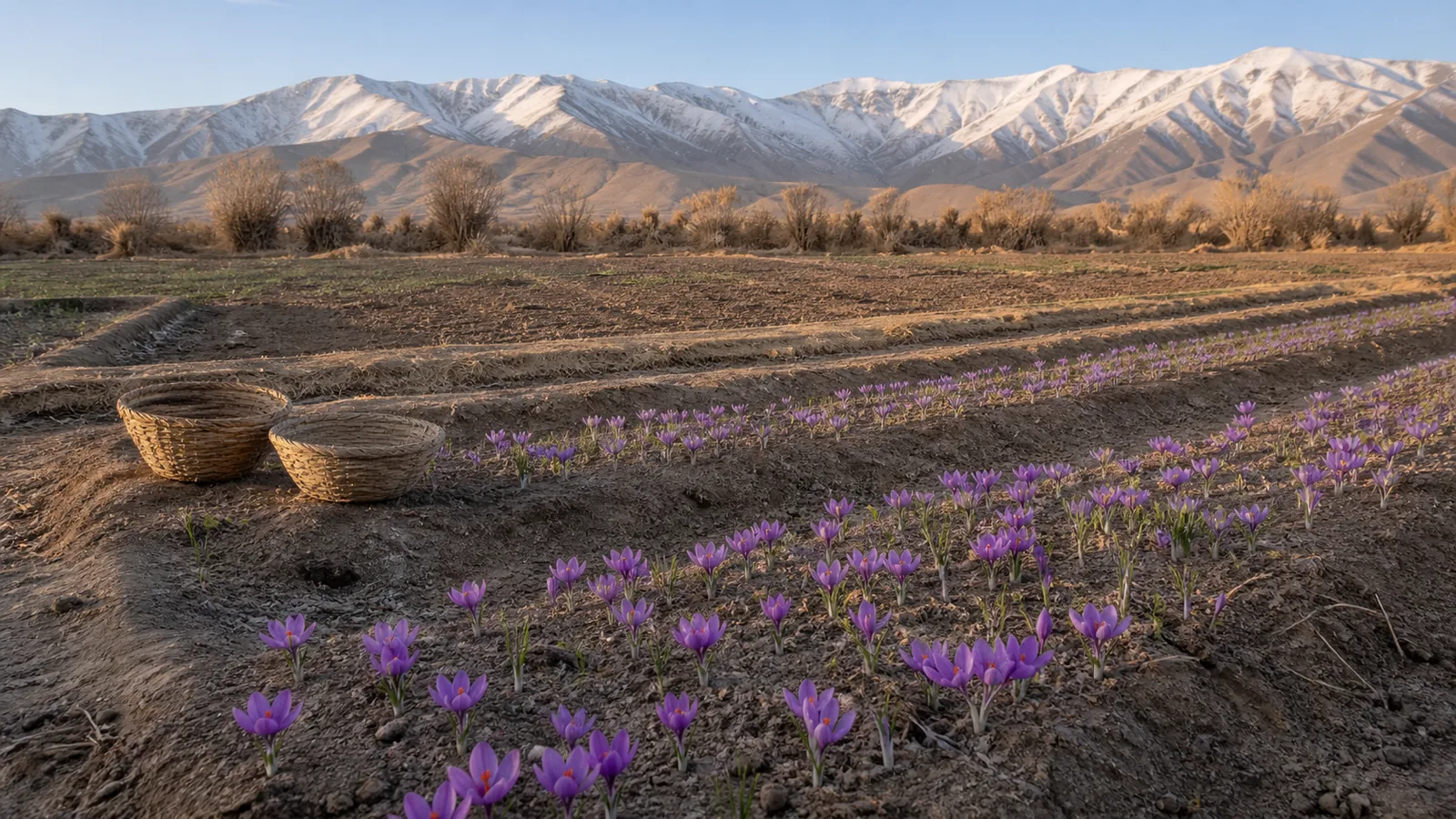
Alborz Province harvested about 160 kg of saffron in the reporting year covered by this 2020 article, according to Mohammad Taj Al-Dini of the provincial Agricultural Jihad Organization. The crop occupied 43 hectares, but the official described it as a small, fragmented activity rather than one of Alborz’s main agricultural industries.
The figures are historical, and one reported yield number does not reconcile with the stated area and harvest. They are preserved and checked below so that “saffron yield per hectare” is not presented with false precision.
How much saffron was grown in Alborz?
Taj Al-Dini, then deputy director for plant-production improvement, gave the following picture:
- 43 hectares of saffron farms across Alborz Province;
- 33 hectares described as fertile or bearing;
- 10 hectares not yet at productive age;
- about 160 kg of saffron harvested in the previous year;
- 153 saffron farmers in the province.
He stressed that saffron was not a principal Alborz crop. Wheat, barley and canola had greater strategic importance in the province, while saffron programmes focused largely on training farmers who chose to enter the sector.
The reported saffron yield per hectare needs caution
The stored interview says the average saffron yield was 2.1 kg per hectare. That number conflicts with the other figures in the same report.
- 160 kg divided by all 43 hectares equals about 3.72 kg per hectare.
- 160 kg divided by the 33 bearing hectares equals about 4.85 kg per hectare.
- A 2.1 kg yield across 33 bearing hectares would produce about 69.3 kg, not 160 kg.
Without the underlying agricultural record, it is impossible to know which figure was mistranslated, rounded or referred to a different area. Therefore, 2.1 kg per hectare should be treated as the interview’s reported average, not a verified calculation or a forecast for another farm.
Where Alborz saffron was cultivated
Nazarabad had the province’s largest saffron area, with more than 26 hectares. Saffron was also cultivated in Savojbolagh, Eshtehard, Fardis and Taleghan.
Ahmadabad in Nazarabad was described as an established cultivation area. Taj Al-Dini said people with suitable land and enough water could join specialised training programmes and receive cooperation from the ministry.
That invitation was not a promise of profitability. Suitability still depends on drainage, corm health, irrigation timing, frost, labour, drying capacity and access to a buyer.
Most farms were small and fragmented
Of the province’s 43 hectares, 34 hectares were spread across 170 plots, each less than one hectare. Small plots can help families test a crop without converting a large farm, but fragmentation complicates mechanisation, coordinated harvesting, drying and lot-level quality control.
The farmer count was also concentrated:
- 125 of the 153 farmers were in Nazarabad;
- 13 were in Savojbolagh;
- 11 were in Eshtehard;
- the remaining four were in Karaj, Fardis and Taleghan.
Those counts belong to the period of the interview. They should not be used as a current directory of Alborz growers.
Why production stayed focused on the domestic market
Taj Al-Dini said farmers sold their saffron in domestic markets using traditional or individual packaging. He did not consider the provincial volume large enough to support an independent export programme.
His reasoning used a simple average: 160 kg divided among 153 farmers is just over one kilogram per farmer. In practice, output would not have been distributed equally, but the average illustrates how small the operations were.
A small grower can still reach an export supply chain through a cooperative, processor or trader. That requires compatible grades, traceable lots, testing and enough pooled volume to handle packaging and logistics efficiently. The historical interview was saying that Alborz did not yet have that scale as a stand-alone origin.
Training and finance described in the report
The provincial organisation offered cultivation training and said it would cooperate with qualified farmers seeking domestic banking facilities. No rate, eligibility rule or guaranteed approval was stated, so the article should not be read as a current finance offer.
Taj Al-Dini also explained why more subsidised saffron support was directed to major producing regions such as South Khorasan, where production, processing and export infrastructure were already concentrated.
What the Alborz figures do—and do not—show
The 160 kg harvest showed that saffron could be produced commercially in parts of Alborz. It did not establish that every hectare would give the same yield, that every farmer earned the same amount or that saffron should replace the province’s main crops.
For anyone assessing saffron cultivation now, the useful records are field-specific:
- bearing area rather than total planted area;
- dry saffron weight after consistent processing;
- yield measured over several seasons;
- labour hours and actual wage cost;
- corm, irrigation, drying and testing costs;
- grade, sale price and payment terms;
- the buyer and final market for each lot.
The headline numbers remain part of Alborz’s saffron record: 43 hectares, 33 bearing hectares and a reported 160 kg harvest. The responsible conclusion is equally important. Historical averages can describe a season, but only consistent field records can tell a farmer what one hectare is likely to produce.

![Exporting Saffron to Turkey + Price Guide [Complete 0 to 100]](https://img.rowhanisaffron.com/20260827003933/saffron-export-turkey-quality-inspection.webp)



