


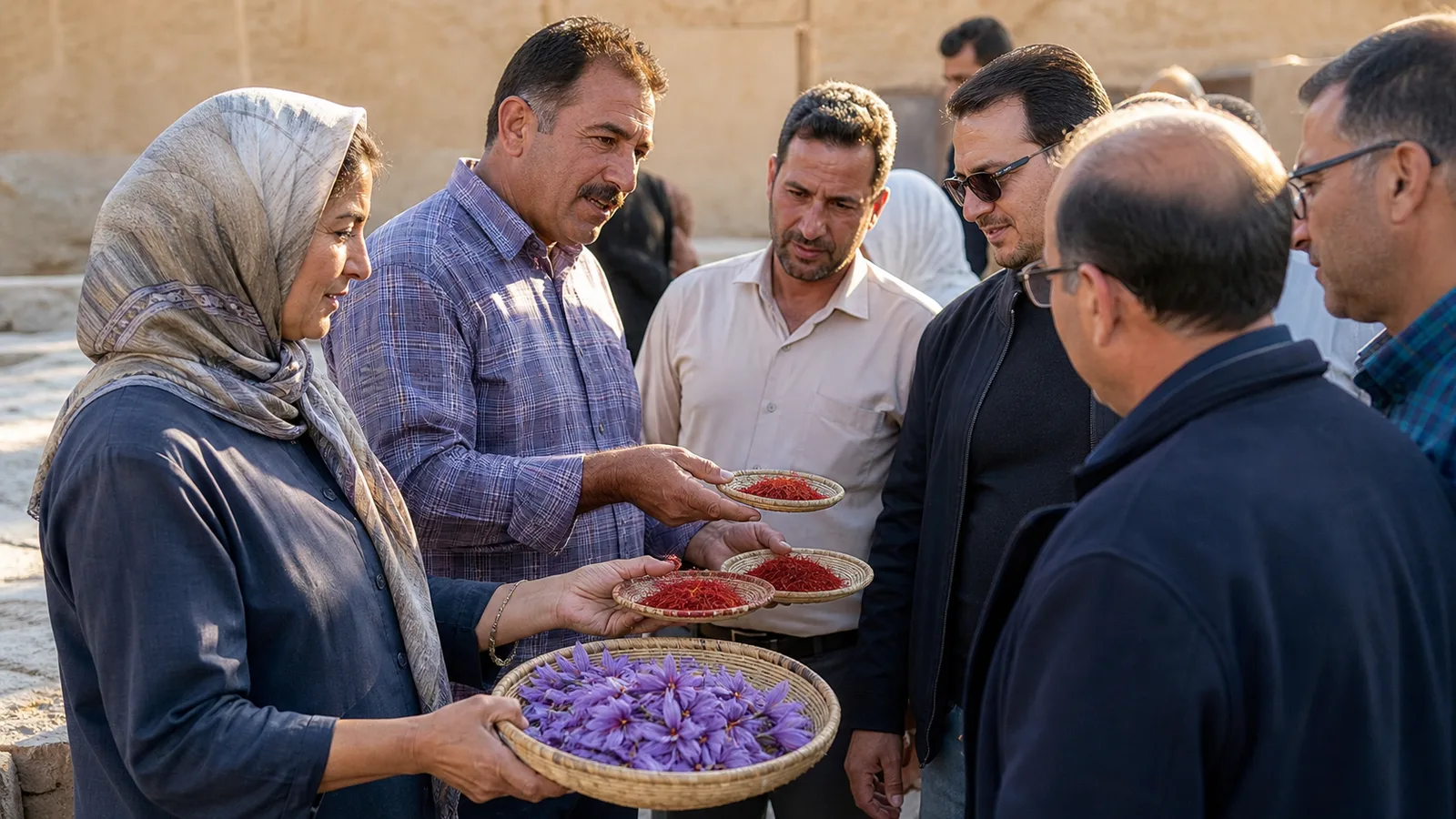
The event reported as the First Saffron Festival in Iran was a local “Red Gold” festival in Bahabad, Yazd Province. Farmers, county and provincial officials gathered to celebrate the crop, recognise leading growers and discuss a practical problem: Bahabad was producing saffron, but lacked the processing, packaging and regional identity needed to make that production visible in larger markets.
The headline came from a translated 2017 Fars News report. It should not be read as proof that this was the first saffron festival ever held anywhere in Iran; saffron-growing regions had hosted agricultural events before it. What the article documents well is Bahabad’s attempt to use a festival as a starting point for local branding and investment.
Why Bahabad held a Red Gold festival
Abbas Iqbal, identified in the report as governor of Bahabad, said saffron had become one of the county’s main agricultural products and that cultivation had expanded in recent years. He described saffron as strategic to the local economy because many households depended on growing it for part of their livelihood.
Iqbal also made a strong claim that Bahabad held a leading national position for saffron quality. The report offered no comparative laboratory results, grade distribution or national judging method, so that should be understood as local advocacy rather than an independently verified ranking.
His more concrete concern was the lack of local packaging and processing. When a crop leaves its producing area in bulk, later sellers may capture the value of grading, packaging and branding. The origin becomes less visible even though farmers did the difficult field and harvest work.
The plan for a Bahabad saffron identity
Iqbal said local officials were pursuing registration of a Bahabad saffron brand and that the Red Gold Festival had made the goal more serious. The translation later turned “Bahabad saffron” into “Bahabad bean beans” and “bean bean saffron.” Those phrases were machine-translation errors, not different products.
A festival alone cannot create a defensible origin identity. Producers need an agreed product specification, reliable spelling and geographic boundaries, batch traceability, consistent grading, quality control and packaging that tells buyers who prepared the saffron. If a collective name is used, its members also need rules for who may use it and what the mark promises.
That is why processing matters. Careful drying, cleaning, grading and storage can protect aroma, color and hygiene. Accurate net weight, tamper-evident food-grade packs and a lot code make the final product easier to trust. The value comes from verifiable practice, not decorative packaging by itself.
Saffron cultivation across Yazd Province
The head of Yazd Province’s Agricultural Jihad organisation told the festival that saffron had been promoted because it suited aspects of the province’s climate and required relatively limited irrigation compared with many crops. “Irrigable plant” in the old English text reversed the intended meaning: saffron was being described as a crop with comparatively low water demand, not as a crop that needs no water.
The report named Bahabad, Bafq, Yazd and other counties as cultivation areas. Bahabad was described as having the largest saffron area within the province. That geographic detail is important: the article was not saying all Iranian saffron came from Yazd, only that Bahabad was a significant centre inside Yazd Province.
The 65% and 270-hectare figures
Seyyed Jamal Sajjadipur, identified in the report as the provincial agricultural official, said Bahabad accounted for 65% of Yazd Province’s saffron cultivation area. He put the county’s saffron fields at more than 270 hectares at that time.
Those two numbers belong to the historical festival report. They should not be used as a current land survey without a newer agricultural source. Cultivated area can change with water availability, corm supply, prices, field age and farmers’ crop choices.
The same speaker said Iran produced 94% of the world’s saffron and placed Yazd seventh nationally, after Khorasan Razavi, North Khorasan, Isfahan, Kerman and Fars. The list names only five provinces ahead of Yazd, so it does not by itself reconcile a seventh-place ranking; a province may have been omitted from the translation or the original list. Both the 94% share and ranking are preserved here as claims made at the event, not current statistics.
Export markets named at the festival
The account said saffron from Bahabad reached China, Russia, Iraq and Germany. It did not provide customs data, shipment volumes or the share sold under Bahabad’s own name. Sajjadipur argued that better packaging could help expand the product’s foreign markets.
For that strategy to work, packaging has to do more than look attractive. An export-ready pack should accurately identify the food, net quantity, lot and responsible business, meet destination-market requirements, and protect the spice from moisture, light, contamination and tampering. Quality claims should be supported by representative testing and a documented method.
The Codex standard for dried saffron now provides an international reference for identity, quality, hygiene, contaminants and labelling. It cannot create a regional reputation on its own, but it gives buyers and packers a common technical vocabulary.
Bahabad’s wider agricultural setting
The festival report placed saffron within a mixed local economy. It said quince had long been an important Bahabad fruit; the old translation reduced this to the generic word “fruit.” It also named apricots, almonds, walnuts, grapes, pomegranates and dates as crops with a market in the region.
This diversity matters. Saffron can add high value to a small area, but harvest labour, water, frost, price and market access still create risk. A regional development plan should consider the whole farm and local processing economy rather than treating one spice as the only livelihood.
Sajjadipur said not all of Yazd and Bahabad’s cultivation potential had been used. He hoped local participation and investment in packing and processing could change the market. Expansion, however, should follow soil, water, climate, plant-health and demand assessments; the existence of unused land does not make every field suitable.
What happened at the festival
Fars News described provincial and county officials attending alongside Bahabad saffron farmers. Leading growers were honoured for their work in saffron production. Beyond ceremony, the gathering put farmers, agricultural managers and potential investors in the same conversation about brand identity and the missing processing link.
Bahabad itself was described as a county of about 28,000 people, around 140 kilometres from the centre of Yazd Province. The source said it had separated administratively from Bafq in the Iranian year 1388. These are historical profile details from the article and may not reflect today’s population or administrative description.
What a saffron festival can achieve
A well-run local festival can let buyers meet growers, show how stigmas are separated and dried, compare honest grades, recognise careful producers and make the origin memorable. It can also attract agritourism during the short flowering season.
Its limits are equally clear. A festival cannot verify every quality claim, solve processing capacity, register a collective brand or guarantee export access. Those results require year-round standards, investment and records.
That is the useful legacy of Bahabad’s Red Gold Festival. The celebration drew attention, but the speakers kept returning to the work behind a durable saffron name: preserve quality after harvest, package locally, document origin and give farmers a larger share of the value their crop creates.
Historical source: Fars News, as cited in the original 2017 post.

![Exporting Saffron to Turkey + Price Guide [Complete 0 to 100]](https://img.rowhanisaffron.com/20260827003933/saffron-export-turkey-quality-inspection.webp)



