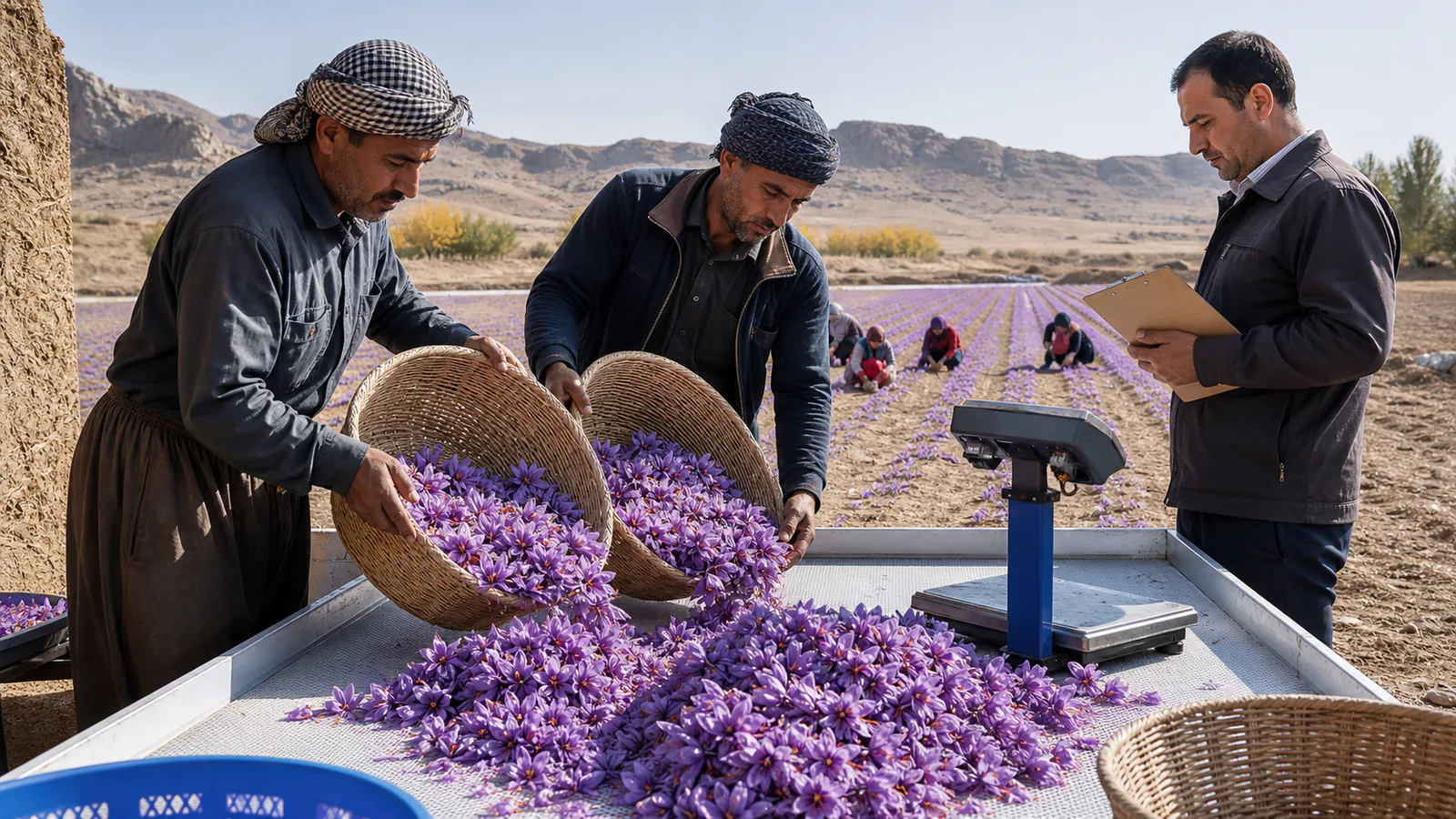
A historical Neyshabur agriculture report recorded 21 tonnes of dry saffron from 6,165 hectares and described guaranteed purchases of 3.8 tonnes. The same official later warned that cultivation was expanding faster than coordinated demand, exports, branding, and yield improvement. Together, the reports tell a more useful story than the harvest number alone: larger area can raise total output while value per hectare remains under pressure.
Mohammad Ali Farahmand Rad, identified in the articles as Neyshabur’s agricultural authority, supplied the production figures and the market warning. The numbers belong to the period covered by those reports; they should not be treated as current Neyshabur area, output, prices, or purchasing policy without newer official records.
What the 21-ton Neyshabur saffron harvest represented
The destination article said saffron area in Neyshabur increased by 60 hectares to 6,165 hectares. It put total dry-saffron production at 21 tonnes and reported yield at about 3.5 kilograms per hectare.
The arithmetic is close but not exact: 21,000 kilograms divided by 6,165 hectares is approximately 3.41 kilograms per hectare. The difference can result from rounded area or production totals. It does not justify silently changing the official’s 3.5-kilogram statement, but readers should understand how the published figures reconcile.
The old article does not identify how much of the area consisted of young, mature, or declining fields. That matters because a district average combines farms at different stages and under different management. It cannot predict what a particular field will yield.
The 924,000 figure referred to labor-days, not jobs
The machine-translated destination says the area created 924,000 jobs during harvest. Its next sentence provides the missing unit: roughly 150 workdays per hectare across planting, harvest, and processing.
Multiplying 6,165 hectares by 150 labor-days gives 924,750 person-days. That explains the rounded 924,000 figure. It should not be repeated as 924,000 individual jobs or permanent positions.
Person-days still reveal the crop’s labor intensity. Flower picking and stigma separation are concentrated into a short season, so a county can require many shifts of work without creating the same number of year-round livelihoods. A proper employment assessment needs the number of workers, days and hours worked, pay, contract conditions, and activities outside the flowering period.
Why reported yield was under pressure
Farahmand Rad linked the result to low autumn and winter precipitation, severe summer heat, and whether irrigation fully met crop needs. The surviving translation is awkward, so it is safest to retain the relationship without claiming a precise water deficit that the article does not quantify.
He recommended improved irrigation, appropriate nutrition, weed control, and technical advice. These are management categories, not field-specific prescriptions. Soil condition, drainage, salinity, corm health, density, field age, rainfall, and disease all affect the response.
Official FAO documentation of Iran’s qanat-based saffron system shows why the crop is valued under water scarcity while still depending on managed water. Peer-reviewed work on Iranian farms likewise finds that dense planting and field age can reduce technical efficiency over a multi-year cycle. Saffron is relatively adapted to dry conditions; it is not immune to heat, drought, or poor management.
Guaranteed purchase covered part of the crop
The destination reported that 3.8 tonnes were bought from Neyshabur farmers under a guaranteed-purchase arrangement and that all related farmer claims had been paid. Against the stated 21-tonne harvest, that equals about 18.1% of total production.
That percentage is only a comparison of two rounded figures. The article does not give the purchase price, grades accepted, delivery dates, number of participating farms, rejection rules, or whether “claims paid” meant every local farmer or every approved delivery. It should not be read as evidence that all 21 tonnes had a protected price.
The assigned sources add that the Rural Cooperative Organization announced readiness to buy saffron at what the report called a reasonable price in Torbat-e Jam and Mashhad. That was a period-specific intervention, not a standing offer to Neyshabur growers today.
Why uncontrolled expansion concerned the same official
Farahmand Rad described saffron as a relatively low-water autumn crop with higher added value than some alternatives. He also said authorities lacked a legal lever to stop its uncontrolled expansion across Iran.
His warning was economic: if planted area and output rise without enough export and domestic demand, value added per hectare can fall. More production is not automatically more farmer income when the additional supply reaches a market that cannot absorb it at the same price.
The two assigned sources are near-duplicate versions of this statement. Their shared meaning belongs here once; repeating both would make the article look stitched together. Their metaphor—that people expecting to harvest gold might instead harvest copper—expressed concern about weak returns, not a literal forecast.
Price volatility and low yield were linked problems
The official identified price fluctuation as farmers’ leading problem and low output per unit area as another. Those pressures interact. A farmer with weak yield has fewer saleable kilograms over which to spread land, corm, irrigation, labor, drying, finance, and testing costs. A farmer with strong yield can still lose if the market price falls far enough.
That is why hectares and tonnes alone are incomplete measures of regional success. Useful monitoring would combine area, age profile, saleable yield, quality distribution, production cost, realized farm-gate price, buyer concentration, inventory, and export demand.
A previous local case on a reported high-yield Khomein field shows why unusually strong yield claims also need measured area, dry weight, quality, and cost records. The same evidence discipline applies to a county average.
Export growth did not guarantee a higher price
The assigned sources said saffron exports in the first four months of the reported year were about 25% higher than in the comparable period, yet prices were lower. They attributed the weakness to bulk trading at low prices and insufficient attention to packaging, branding, and export planning.
No customs table, base-year volume, price series, grade mix, exchange-rate treatment, or package-size breakdown is provided. The 25% figure should remain an attributed historical comparison, not proof of a permanent relationship between exports and price.
Export volume can rise while unit value falls if supply grows faster, the product mix changes, buyers negotiate harder, currency conditions shift, or more low-grade or bulk lots are sold. A current analysis must compare like with like: the same period, grade, pack type, destination, and currency basis.
Bulk export, packaging, and branding require nuance
Farahmand Rad argued that branded or specified packaging could support value better than anonymous low-price bulk sales. That can be true when packaging connects a supplier to the final customer and the selling price covers design, compliance, materials, freight, inventory, and distribution.
Bulk export is not inherently a failure. It can be the appropriate format for food manufacturers, wholesalers, and foreign packers. The risk is selling an undifferentiated crop without documented origin, consistent grade, traceability, or a durable customer relationship.
Our article on why Iranian saffron historically moved through Spain and the UAE explains the difference between first destination, repacking, processing, final market, and origin. Current FAO work on Iran’s saffron value chain likewise emphasizes authenticity, transparent standards, branding, and market competitiveness rather than package size alone.
What coordinated expansion would require
The sources criticized the absence of centralized cultivation and market planning. Coordination should not mean copying one planting target everywhere. It means connecting field decisions to credible evidence about resources and demand.
Before encouraging more hectares, a current plan should establish:
- which fields are agronomically suitable and have a realistic water plan;
- the age, density, health, and expected replacement cycle of existing fields;
- saleable yield and quality by district, not only total production;
- harvest, separation, drying, testing, storage, and working-capital capacity;
- confirmed buyer specifications, volumes, payment terms, and destination rules; and
- how growers will retain value if market prices or export access weaken.
This evidence would allow expansion, rehabilitation, or consolidation decisions to be made separately rather than treating every additional hectare as progress.
What the combined Neyshabur reports establish
The historical record supports a 6,165-hectare area, a 60-hectare increase, about 21 tonnes of output, an official yield near 3.5 kilograms per hectare, approximately 924,750 labor-days by the article’s own formula, and 3.8 tonnes purchased under a support arrangement.
The two source versions add the other half of the story: cultivation was spreading, farmers faced price volatility and weak yields, cooperative purchasing was used as support, and an official feared supply would outrun export and value-building capacity.
None of those dated figures should be presented as today’s Neyshabur market. Their lasting lesson is that a harvest total must be judged beside yield, labor, water, quality, demand, and realized farmer value. Twenty-one tonnes can be a substantial crop and still leave the harder economic questions unanswered.

![Exporting Saffron to Turkey + Price Guide [Complete 0 to 100]](https://img.rowhanisaffron.com/20260827003933/saffron-export-turkey-quality-inspection.webp)