


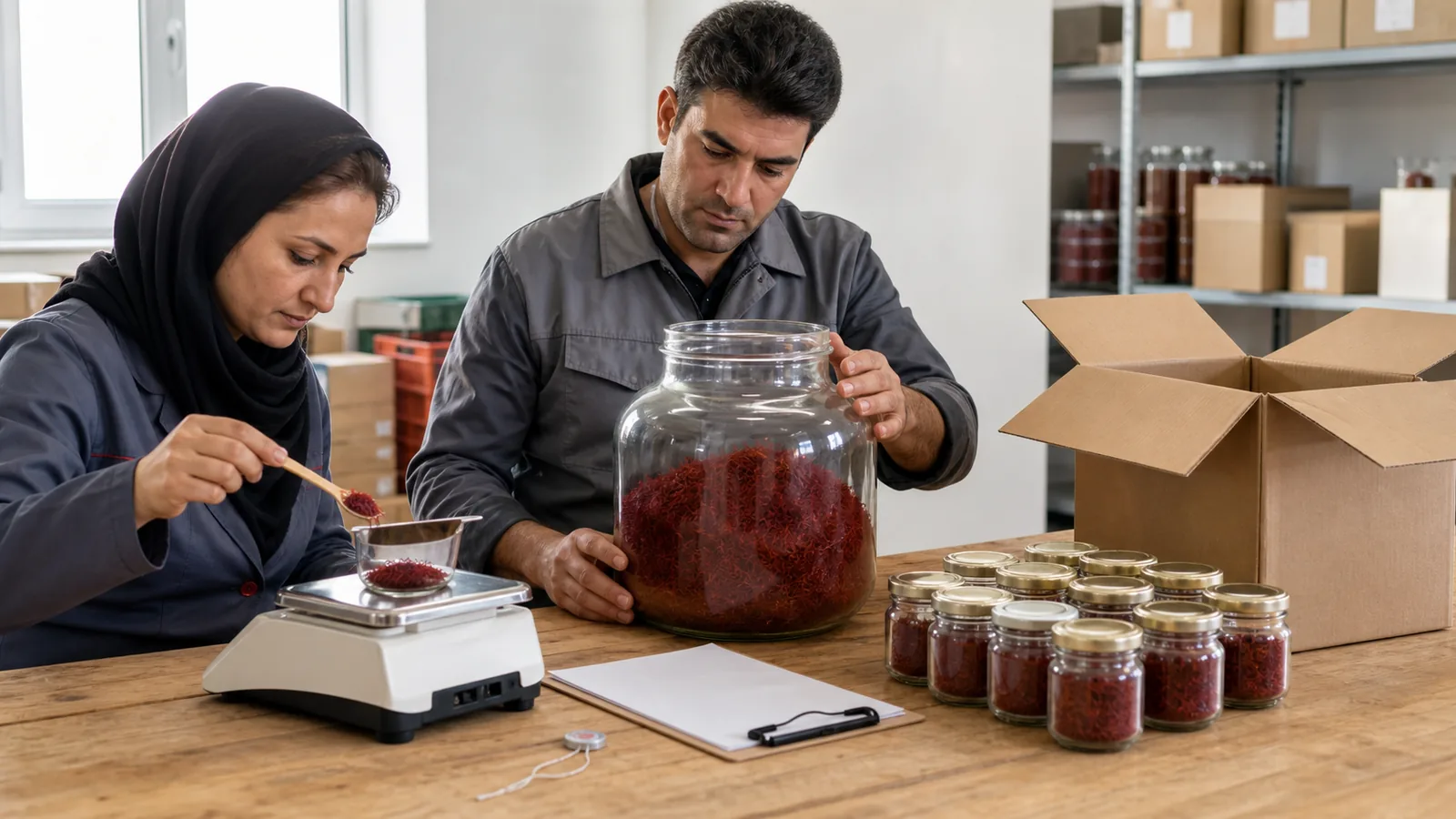
A historical Iranian trade report estimated that almost half of the saffron exported in its two-month snapshot went first to Spain or the United Arab Emirates, where it could be packed, processed, marketed, or re-exported. The report’s concern was that Iran supplied the crop while businesses closer to the final customer captured more of the branding and packaging value.
That estimate is not a current trade share, and an intermediate destination is not proof that every shipment was relabeled improperly. Export statistics record where a shipment goes first; they do not by themselves reveal its final buyer, retail brand, processing, or country-of-origin statement.
The historical Iranian saffron export figures
Ali Hosseini, identified as a member of Iran’s National Saffron Council, said 126 tonnes and 600 kilograms had been exported to 45 countries in the preceding year. He put exports in the first two months of the following year at about 20 tonnes.
Hosseini estimated that close to half of that two-month volume went to Spain and the UAE before onward sale. The article supplies no customs table, exact dates, destination weights, or final-market records, so “half” should remain his historical estimate rather than a permanent ratio.
For dated reports that can be compared without treating one snapshot as today’s market, see our broader Iranian saffron export statistics.
Package size showed how much left in bulk form
The same two-month report divided the approximately 20 tonnes by package size:
- about one tonne in packs under 10 grams;
- about 11 tonnes in packs from 10 to 30 grams;
- about eight tonnes in packs over 30 grams.
Those numbers total 20 tonnes. Hosseini treated the one tonne in sub-10-gram packs as closer to consumer-ready export and the remaining 19 tonnes as likely to be repacked or used by buyers. Package size is a useful clue, but it does not prove the next step for every lot: a larger pack may go to a restaurant, food manufacturer, wholesaler, or another packer.
What re-exporting saffron can involve
An importing business can buy bulk saffron, test and grade it, divide it into retail packs, develop customer-specific blends, use it as an ingredient, or distribute it to another country. The destination report said some markets—including Bahrain, Saudi Arabia, Kuwait, Qatar, Italy, and France—bought saffron for direct consumption, while some product entering China was processed before onward use or sale.
The assigned source named a wider historical market list: Spain, the UAE, Italy, China, France, the United Kingdom, Australia, Sweden, Saudi Arabia, Kuwait, and Bahrain. These are reported destinations from that period, not a current ranking by volume.
Spain’s role is especially relevant to the article’s original query. A separate historical shipment report records 13 tonnes of Iranian bulk saffron sent to Spain, illustrating why first-destination and final consumer market need to be distinguished.
Repacking does not erase where saffron was harvested
The old destination says saffron was reissued “in the name” of Spain or the UAE. It offers no labels or shipment-level evidence, so that wording cannot support a general accusation of origin fraud.
Current Codex work clarifies the principle. Its 2026 food-labeling report states that false or misleading origin declarations are prohibited and that packaging, sorting, and grading do not change the nature of a food. For dried saffron, the report treats country of harvest and country of origin as the same when no nature-changing process occurs.
A foreign brand may lawfully package or distribute Iranian saffron, subject to the rules of the markets involved. The label should still avoid misleading the buyer about harvest origin. If saffron becomes a genuinely different processed food, origin rules can become more complex and the applicable national law controls.
Why retail packs can be expensive to export
Hosseini argued that direct export in small consumer packs could multiply freight and handling costs. His example said 10 kilograms of saffron might produce a packaged shipment weighing more than 300 kilograms, depending on the package design.
The report does not describe the container material, number of units, cartons, pallets, or freight method, so the 300-kilogram figure cannot be treated as a universal packaging ratio. The underlying trade-off is real: glass, metal, presentation boxes, protective inserts, labels, and outer cartons add weight and volume to a light, valuable spice.
Small packs may still create more value when the brand has direct buyers and the price covers design, compliance, packing, breakage, inventory, fulfillment, and freight. The right comparison is contribution margin per shipment, not product weight alone.
The export-value ambition was not an outcome
The machine-translated destination refers to roughly US$200 million in export earnings, about US$500 million in existing exporter capacity, and an ambition to reach US$1 billion by Iranian year 1395. The relationship among those figures is unclear, and that target year is long past.
They are best read as a historical policy argument: a country responsible for most saffron production wanted a larger share of the final branded value. The article provides no later customs total showing that the billion-dollar goal was achieved.
Current FAO context puts Iran at about 85–90% of world saffron production and emphasizes authenticity, transparency, branding, and market competitiveness. A large production share creates opportunity, but it does not automatically create consumer recognition or pricing power.
Production was expanding beyond the Khorasans
The assigned source adds the production side that the export article lacked. In Chaharmahal and Bakhtiari, it said saffron area grew from eight to 105 hectares in three years. That is more than a thirteenfold increase, although the source loosely described it as tenfold.
A provincial agriculture official forecast 525 kilograms from the 105 hectares—exactly five kilograms per hectare—and valued the crop at 36.75 billion rials using a price of 70 million rials per kilogram. The arithmetic is internally consistent, but the numbers remain a dated forecast rather than a recorded final harvest.
The official also associated the crop with approximately 3,150 seasonal work opportunities. The report does not define whether that means individual workers, jobs, or person-days, so it should not be converted into full-time employment.
Climate claims need quality evidence
The source attributed Chaharmahal and Bakhtiari’s potential to altitude, climate, sunlight, and a rural workforce. It went further, claiming those conditions produced saffron with better color, aroma, and taste than other Iranian regions.
No comparative samples, grade distribution, laboratory results, harvest year, or blinded sensory panel are supplied. Climate and field management can affect quality, but regional superiority requires matched evidence. Buyers should compare actual batches by identity, purity, moisture, and relevant color, aroma, and flavor measurements; our guide to saffron grading explains the distinction.
The source also mentions a two-hectare Shahrekord university planting using selected corms sourced with support from a Mashhad research center. It reports “good results” without yield or methods. The useful lesson is to obtain healthy corms and qualified local advice, not to treat the pilot as proof of a particular return.
The water argument was seasonal, not absolute
Chaharmahal and Bakhtiari had faced drought and declining water resources. The source presented saffron as a possible alternative to crops such as sugar beet and maize because saffron grows mainly in autumn and winter, when rain and snow can supply part of its needs, and is dormant through much of summer.
That can reduce competition with summer irrigation, but “rain-fed” does not mean water-free or suitable everywhere. Field establishment, flowering, soil, drainage, salinity, rainfall timing, and corm health still matter. FAO’s official account of Iran’s qanat-based saffron system supports the crop’s value under water scarcity while also showing that reliable water management remains part of the system.
Local value depends on more than planted area
The source called for farmer training, finance, research support, processing, packaging, and other “conversion” industries. It also projected rural employment, investment, tourism around flowering fields, and less migration to cities.
Those are possible development effects, not outcomes demonstrated by the article. Expansion can create a short harvest-labor peak while leaving little year-round work. Tourism requires access, safety, visitor services, and protection of farms. Processing and packaging create local value only when they meet buyer, food-safety, traceability, and cost requirements.
Quality improvement, yield, and lower unit cost can help, but production should grow with confirmed demand. Otherwise, expanding hectares in new provinces can add supply without improving the share of value retained by growers.
How Iran can retain more saffron value
The combined lesson is not that bulk exports are inherently bad. Bulk shipment can be efficient and appropriate for industrial or wholesale buyers. The risk is depending on anonymous commodity sales while someone else owns the customer relationship.
More value can remain with Iranian producers and exporters when they can document origin and grade, maintain batch consistency, meet destination-market rules, use economical packaging, protect the product in transit, and build distribution around a recognizable supplier or regional identity.
Current decisions need current customs data, matched packaging and freight costs, and evidence about the final customer. The historical Spain/UAE estimate explains the branding problem that officials saw; it should not be repeated as today’s share without new shipment-level evidence.

![Exporting Saffron to Turkey + Price Guide [Complete 0 to 100]](https://img.rowhanisaffron.com/20260827003933/saffron-export-turkey-quality-inspection.webp)



