


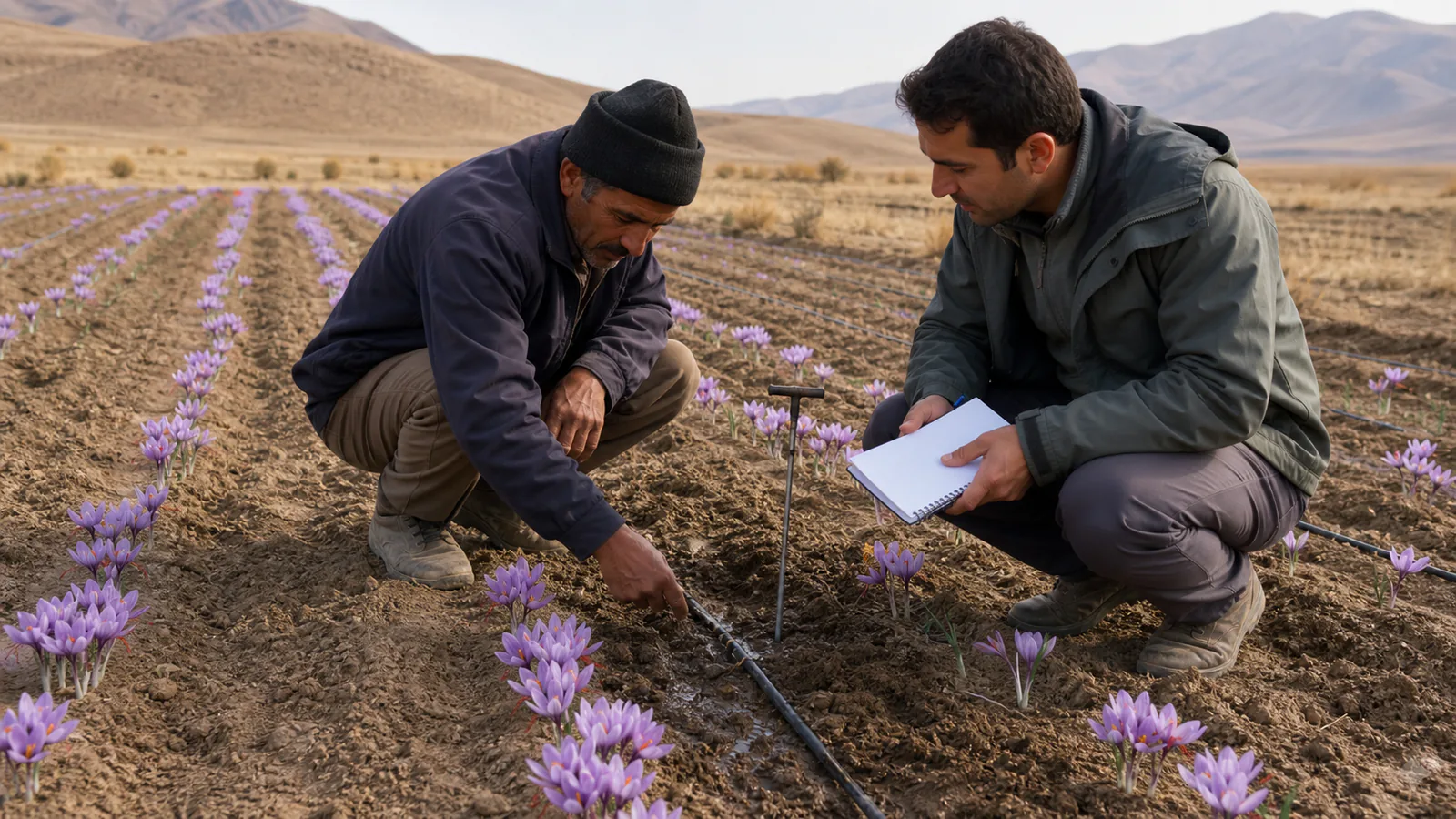
10% increase in saffron production in Azerbaijan refers to a 2016 forecast for East Azerbaijan province in north-western Iran, not the Republic of Azerbaijan. Agriculture officials expected production to rise as the province expanded saffron cultivation and refined its irrigation, purchasing and grower-support programmes.
The original title is retained because it is how this historical report has long been identified, but the geographic distinction is essential. The figures below describe East Azerbaijan at the time of the Iranian Students News Agency (ISNA) interviews. They are not current provincial totals or a national forecast for either country.
The production forecast in context
An East Azerbaijan Agriculture Organization official, whose translated name is rendered as Ayub Iranian in the source, said 138.5 hectares were intended for saffron cultivation across the province. The article expected the cultivated area to increase by roughly 10% and said officials considered growth of 10% to 20% possible.
The 10% in the headline is presented as an expected production increase, but the source largely discusses acreage. More land can raise total output without improving yield per hectare, while weather or establishment problems can prevent acreage growth from becoming an equal production gain. The two measures should not be treated as identical.
Marand was the main saffron area
Marand accounted for 96 hectares in the report, making it the largest saffron-growing city in East Azerbaijan. The other principal areas were listed as Shabestar, “Azar,” Ahar and Varzaghan. The translated place name “Azar” is incomplete and should not be silently replaced with a different municipality.
At 96 hectares, Marand represented about 69% of the stated 138.5-hectare provincial area. That concentration meant a change in Marand’s establishment, flowering or harvest could have a large effect on the provincial result.
How the reported yield figures fit together
Eskandari, identified as the Agriculture Organization’s director of horticulture, put annual saffron production at 529.8 kilograms. The report also gives an average yield of 3.8 kilograms of dried saffron per hectare.
Those figures are internally consistent: 529.8 kilograms divided by 138.5 hectares is about 3.83 kilograms per hectare. This arithmetic does not independently verify either input, but it shows that the translation probably preserved the intended scale and unit more reliably here than in some other historical reports.
Why saffron appealed in a water-conscious province
Officials described saffron as a crop with a relatively modest water requirement and presented that as an important reason for expanding it. The Food and Agriculture Organization’s account of Iran’s qanat-based saffron system similarly notes that saffron does not require large quantities of water and is suited to water-scarce farming systems.
“Low water” must not be read as “no water.” Saffron yield is sensitive to the amount, timing and quality of available water. A recent long-term field study indexed by PubMed found that irrigation depth, salinity and planting method all affected growth, yield and economic water productivity. Results from one climate, soil and planting system cannot be copied directly to another.
The source’s irrigation guidance
Asghar Naghshi, the Agriculture Organization’s saffron specialist, said corms were planted at a depth of 20 centimetres and irrigation should wet the soil to about 40 centimetres. In his explanation, water moving much deeper than the root zone would not be absorbed efficiently.
He recommended improving efficiency by adjusting irrigation frequency rather than simply applying a large amount at once. The report refers to a traditional schedule of four irrigations and gives a seasonal water figure of 2,500 cubic metres per hectare. It also contains a damaged sentence about water needs from May through October. These were local recommendations reported in 2016, not a universal prescription.
A farmer needs a schedule based on local rainfall, soil water-holding capacity, corm stage, temperature, salinity and the irrigation system. Even the depth reached by one application varies with soil texture and flow. The 2,500-cubic-metre figure therefore needs local agronomic validation before use.
October rain could help or limit flowering
Eskandari said saffron flower emergence in East Azerbaijan ran from early to late October and coincided with provincial rainfall. He described precipitation at that stage as a possible limiting factor. The statement does not mean rain is inherently harmful to saffron; timing, intensity, drainage and field condition determine the effect.
Excess water around a poorly drained root zone can create a different problem from useful moisture before flowering. Rain during a short harvest window can also complicate field access, flower collection and prompt stigma separation. These are reasons to manage the site and harvest plan, not reasons to assume a dry October is always better.
Purchase agreements were proposed as farmer support
The report says saffron purchase agreements could help cover growers’ production costs, raise farm income and reduce dependence on intermediaries. A guaranteed or contract price may give a farmer more certainty, but its value depends on the grade specification, delivery conditions, timing, enforcement and whether the price reflects real costs.
Removing every intermediary is not automatically beneficial. A responsible collector, grader or packer can provide aggregation, testing, storage and market access. The problem is an opaque chain in which the grower carries production risk without understanding how quality or price is determined.
Training and inputs were part of the plan
Naghshi linked higher production with both general education and specialised grower training. That combination is sensible. General extension can cover field records, water management and safe input handling, while specialist training can address corm selection, planting density, flowering, separation, drying and storage.
He also argued that subsidised inputs, including fertiliser, could support production. Fertiliser should not be treated as a default route to higher saffron yield. The right product and rate depend on soil testing, crop history and local recommendations; unnecessary application adds cost and can damage soil or water quality.
Processing was expected to strengthen East Azerbaijan’s position
Provincial policy aimed not only to expand cultivation on suitable land but also to improve East Azerbaijan’s role in processing this valuable crop. Processing determines how much field effort survives into the saleable spice. Flowers need timely collection, careful stigma separation, controlled drying and clean storage.
A processing strategy also requires lot identification and realistic capacity. New acreage is valuable only if labour, drying space, packaging and buyers are ready when flowers arrive. Because saffron flowers over a short window, a bottleneck can erase part of the gain expected from added hectares.
What the 10% headline means today
The 2016 report gives a coherent snapshot: 138.5 hectares, 96 of them in Marand; stated annual production of 529.8 kilograms; and an average yield close to 3.8 kilograms per hectare. Officials expected further acreage and production growth, supported by irrigation management, purchase agreements, training, inputs and processing.
It does not establish today’s production in East Azerbaijan, and it says nothing about saffron output in the independent Republic of Azerbaijan. Its value is historical and practical. It shows how a province outside Iran’s best-known saffron region was evaluating the crop: not simply as a low-water plant, but as a system that needed local agronomy, farm economics and post-harvest capacity to grow well.

![Exporting Saffron to Turkey + Price Guide [Complete 0 to 100]](https://img.rowhanisaffron.com/20260827003933/saffron-export-turkey-quality-inspection.webp)



