


“Spain Iranian saffron is exported to 140 countries” was a 2016 claim about re-export: Spain bought Iranian saffron, packed or marketed it through its own trade networks, and was said to reach far more destinations than Iran served directly. The archived customs figures show Spain was an important buyer. They do not, by themselves, prove a current 140-country count or that every Spanish saffron export was grown in Iran.
The wider story combines production growth, limited domestic consumption, indirect routes into tariff-protected markets, and Iran’s struggle to retain origin and value after the crop leaves the farm. Every number below keeps its historical context; none is a current price or trade recommendation.
What the Spain shipment figures actually showed
The underlying first-quarter report recorded 6,163 kilograms of non-powder saffron sent from Iran to Spain in packs below 10 grams and from 10 to 30 grams. It gave a value of about 20.851 billion rials, with a stated dollar equivalent of approximately $8.164 million.
A further 61 kilograms of saffron powder in the same small pack bands was reported at about 261.7 million rials, or $102,610. The old English version mistakenly turns some rial values into dollars, producing impossible totals; the stated dollar equivalents are the coherent figures.
Spain represented roughly one-quarter of the value in that period, according to the article. Iranian saffron also went directly to a long list of destinations including Germany, Austria, Jordan, Australia, the United Arab Emirates, the United Kingdom, China, France, Canada, the Netherlands, Hong Kong, Italy, India and Japan.
Ali Hosseini of the National Saffron Council contrasted Iran’s direct reach of about 45 countries with Spain’s claimed reach of 140. That comparison was intended to show unserved markets. It was not accompanied by Spain’s country-by-country re-export data, so 140 should remain an attributed historical assertion rather than a verified current total.
Where Iranian saffron was reported to go
Later interviews with Hosseini described an export-oriented crop. Domestic consumption was estimated at only 10–20% of production, leaving 80–90% for export. Roughly 50 countries were named as buyers, led at the time by Hong Kong, the United Arab Emirates and Spain, with Germany, France, Italy and Vietnam also important.
These percentages are estimates from a specific period, not a permanent split. Domestic use can change with price and purchasing power, while export share depends on harvest size, inventories and customs methodology.
Hosseini described two broad channels:
- Intermediary markets such as the UAE, Spain and India bought product that could be packed again and sent onward.
- Final consumer markets such as China, the Netherlands, Australia, Canada and Germany used smaller packs in dispersed retail networks and larger packs for food, industrial or pharmaceutical processing.
The distinction is commercial, not absolute. A country can contain consumers, processors and re-exporters at the same time, and a 10–30 gram pack is not necessarily the final consumer size.
Production grew faster than domestic demand
Hosseini placed Iran’s saffron area above 110,000 hectares and expected a crop above 400 tonnes. The previous season had been forecast above 450 tonnes, but the Ministry of Agriculture figure was said to be about 430 tonnes after November rain damaged flowers in some places.
He contrasted those totals with roughly 30 tonnes in the Iranian 1360s. The long-term growth from tens of tonnes to more than 400 created a structural need for export markets, but the old article does not supply a consistent statistical series, so the figures should be treated as reported milestones rather than recalculated growth rates.
Khorasan Razavi and South Khorasan remained the main producing provinces, with saffron also grown in around 20 others. FAO’s current 2025 overview places Iran at approximately 85–90% of world production. That confirms Iran’s leading role while replacing older fixed claims above 90% with a current range.
Tariffs and the alleged indirect routes to China and India
Hosseini said high Chinese import tariffs encouraged Iranian saffron to move first through Hong Kong and then enter mainland China indirectly. One poor translation calls Hong Kong the “Ganges Regiment,” but the same source names Hong Kong repeatedly and makes the intended route clear.
He estimated 60–70 tonnes a year followed that China route and said saffron reached India through Afghanistan and the UAE for similar tariff reasons. He further claimed that more than half of exports ultimately served China and India and that Chinese brokers bought directly in Iranian villages.
Those are attributed industry estimates. The articles provide no customs reconciliation for indirect shipments, so the tonnage and “more than half” share cannot be independently verified from them. Nor should all trade through Hong Kong, Afghanistan or the UAE be labelled smuggling without evidence about the individual consignment and applicable law.
The concern is nevertheless concrete: an opaque route can separate the farmer from the final buyer, obscure origin and make official trade statistics understate the true destination.
Why slow exports were expected to lower prices
The archived wholesale range was 6–10 million tomans per kilogram. Hosseini expected further declines if export flow remained slow because product would accumulate in the domestic market.
That is a supply-and-demand warning, not a current quotation. Different grades and transaction sizes can occupy very different points in the range. Stored inventory, exchange rates, payment channels, crop damage and buyer demand can also change the outcome.
Growers are especially exposed when a large share of the crop is offered during harvest and only a small group of intermediaries has finance or market access. Better storage, transparent grades, producer organisations and forward contracts can widen growers’ choices, but none can guarantee a price.
The $4 billion global-turnover claim
Two near-duplicate source articles said world saffron turnover was about $4 billion, that Iran captured only $500 million, and that better infrastructure could lift the Iranian share to $1 billion per year. They recommended removing export duties, using targeted incentives and designing packaging for destination markets.
The sources give no dataset or methodology for those figures. “Turnover” may count retail, repeated resale or products containing saffron, while an export value measures a different stage. The $4 billion, $500 million and $1 billion values should therefore remain Hosseini’s historical estimates, not established market size or a forecast.
His strategic point is sound without the unsupported totals: a producer country retains more value when it can test, pack, brand and sell to final buyers rather than relying only on bulk shipments.
Packaging for a real destination market
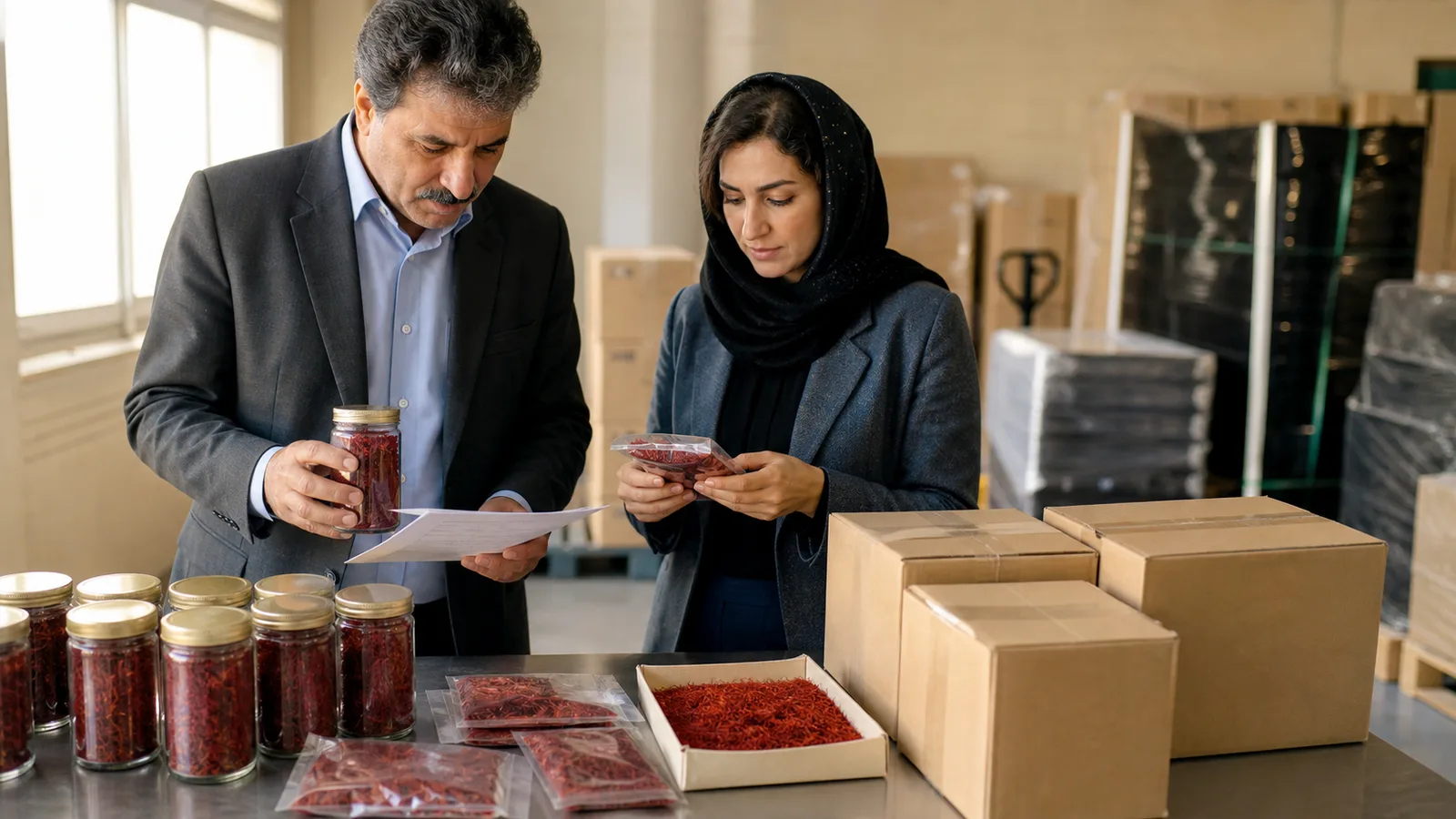
Small packs do not automatically create value. They need a documented lot, verified saffron, protective food-grade material, accurate weight, a responsible business and lawful destination-market information. The Codex standard CXS 351-2022 provides an international baseline for saffron styles, quality, contaminants, hygiene, packaging and labelling.
Origin also has to be stated truthfully. European Commission guidance says origin or provenance is mandatory where omitting it could mislead the consumer. A pack may lawfully identify a Spanish packer and Iranian origin; the problem is not that two countries appear, but that the label should not imply the saffron was grown where it was only packed.
FAO’s recent work with Mashhad University on saffron authenticity and post-harvest integrity addresses the part branding cannot solve alone: proving the product and preserving its colour, taste and aroma before it reaches the box.
Izeh as a newer production and export prospect
The export story is not limited to Khorasan. Iraj Almasi, then head of the Agricultural Jihad office in Izeh, Khuzestan, described one hectare of saffron in the city’s colder mountainous area and said local cultivation had begun in 1991.
He outlined flat planting and furrow-and-ridge planting, the latter using two rows on ridges with about 20 centimetres spacing. Planting took place around late September, harvest in November, and a key irrigation was applied roughly three weeks before harvest. The old translation’s phrase “a period of irrigation for three weeks” is better read as irrigation timed about three weeks before picking, not continuous watering.
Almasi called the crop commercially promising and expected future exports to Arab markets around the Persian Gulf. That was an export-capacity claim, not proof that shipments later occurred. Izeh’s one-hectare example belongs in the national article because it shows why consistent testing and origin records matter as more regions enter the trade.
What the 140-country claim teaches
Iran did not lack saffron or producing regions. It lacked direct reach into some final markets, and the archived interviews believed Spain and other hubs were better at distribution, packaging and customer access.
The remedy is not to treat every re-exporter as an enemy. It is to know the true destination, sell under contracts that preserve origin and grade, meet the buyer’s rules, and measure how much value reaches growers and Iranian processors.
Spain may have helped Iranian saffron reach many countries, but the exact 140 remains an old assertion. The durable objective is clearer: every route should make the product, origin, handling and payment chain easier—not harder—to verify.

![Exporting Saffron to Turkey + Price Guide [Complete 0 to 100]](https://img.rowhanisaffron.com/20260827003933/saffron-export-turkey-quality-inspection.webp)



