


Began to buy saffron flower in 20 Khorasan Razavi cooperatives describes a historical harvest-season programme, not a current offer or price notice. Mojtaba Mazrouei, then head of the province’s Agriculture-Jahad organization, said 20 cooperative-affiliated centres had started agreed purchases of fresh flowers from growers. The aim was to organize the brief, crowded harvest market and give farmers another route to sell a highly perishable crop.
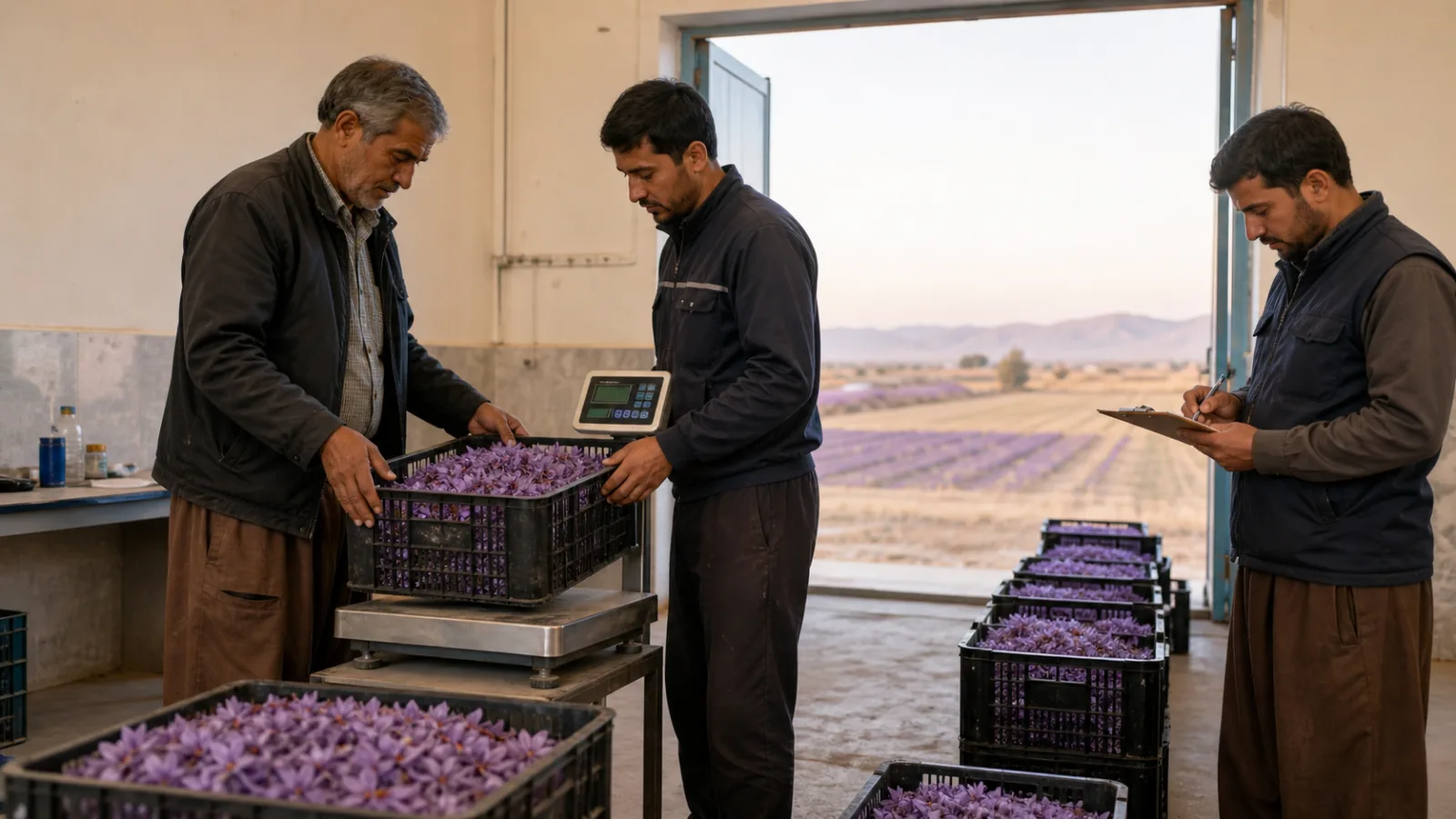
The distinction between saffron flowers and dried saffron is essential. The quoted 100,000 toman price was for one kilogram of freshly picked purple flowers. It was not the price of one kilogram of cleaned, dried Khorasan saffron threads.
What Mojtaba Mazrouei reported
The original English post calls the official “Mazrooei” and “Mazrouie”; Mojtaba Mazrouei is the clearer transliteration used here. He described 20 buying centres connected to the provincial union of production cooperatives and said that roughly 100 centres would handle flower cleaning.
The damaged translation ends by saying that 300 tonnes of flower had been bought. A contemporaneous Persian report of the same statement gives about 200 tonnes. It also adds details omitted from this page: roughly 100 kilograms of flowers yielded about one kilogram of dried Negin saffron, and the reported dried-saffron market price at that time was 11–12 million tomans per kilogram.
All of those prices and quantities belong to that harvest report. They are preserved to explain the event, not offered as today’s rate. Currency conditions, crop size, flower quality, labour demand and the market for dried threads all change from one season to another.
Why saffron flowers need a fast local market
A saffron flower is a short-lived agricultural input. Growers pick the blossoms early, then the three red stigmas must be separated and dried with care. Delays allow the flowers to warm, compress and deteriorate. A farmer who cannot process the day’s harvest therefore needs a buyer close enough to receive it quickly.
That urgency makes the flower market different from the trade in dried threads. Dried saffron can be graded, packed and stored under controlled conditions. Flowers contain far more plant material and moisture, require immediate labour and produce only a small proportion of finished spice. Comparing the two by kilogram without a conversion explanation creates a price difference of orders of magnitude.
The one-to-100 relationship reported at the time is a useful illustration, not a universal yield guarantee. The amount of dried stigma recovered depends on flower size, harvest condition, separation practice, retained style and final moisture. A buying centre should measure the flowers it actually receives rather than promise one fixed output from every load.
What the 20 Khorasan Razavi cooperatives were meant to do
The programme was described as an agreed purchase, not a permanent guaranteed-price scheme. A cooperative collection point can coordinate several tasks that are difficult for one small grower to arrange alone:
- receive and weigh flowers close to the farms;
- record the grower, time, quantity and agreed price;
- move flowers promptly to trained separation workers;
- keep unlike or damaged lots from being mixed without a record;
- dry the stigmas under a repeatable process;
- aggregate a traceable quantity for direct sale or exchange trading.
Those services can reduce frantic roadside selling and give growers clearer records. They do not make every transaction fair by themselves. The centre still needs transparent weighing, a stated quality basis, prompt payment and a receipt the farmer can understand.
The historical Khorasan saffron crop figures
Mazrouei said Khorasan Razavi had about 84,000 hectares under saffron in the previous season and produced 289 tonnes. He put the new season’s area near 86,000 hectares and forecast 290–300 tonnes. The expectation took account of expanded acreage as well as drought, lower yields and the risk of cold or rain during flowering.
These are attributed figures from a historical provincial announcement. They should not be used as a current acreage or production estimate. Their value is in showing why collection capacity mattered: a concentrated harvest from tens of thousands of hectares created several weeks of intense demand for picking, transport and stigma separation.
Current FAO reporting continues to identify Khorasan Razavi and South Khorasan as the heart of Iranian production. FAO also emphasizes that saffron quality is shaped after the flower leaves the field, through post-harvest handling, safety controls, traceability and processing.
Can cooperative buying stabilize the saffron price?
The stated objective included stronger cooperatives and greater price stability. More organized purchasing can prevent one local bottleneck from forcing every grower to accept the first offer. It may also produce better information about how many flowers were delivered and what volume of dried saffron resulted.
No group of centres can hold a price steady regardless of supply and demand. The flower price must still cover separation losses and labour, while the dried saffron must meet a grade and find a buyer. If a support price ignores the finished market, stock can accumulate or the programme can run out of working capital.
A useful assessment therefore looks beyond the announced rate. It asks how quickly farmers were paid, what quantities were accepted, how lots were graded, who carried processing losses, where the dried saffron was sold and whether growers received a better net return after all deductions.
What growers and buyers should confirm
A farmer delivering flowers should confirm whether the centre buys by gross or net weight, how foreign matter and damaged flowers are handled, when payment is due and whether there is a written receipt. If a cooperative also separates and dries the crop, the agreement should say who owns the finished saffron and how processing charges or yield are calculated.
A buyer of the dried product needs a different set of records: batch identity, place and date of harvest, drying and storage conditions, thread style, net weight and test results connected to the same lot. The number of collection centres says nothing about one package’s quality unless that chain remains intact.
For an explanation of how approved stored saffron can be represented and traded after processing, read our guide to saffron warehouse receipts and commodity-exchange trading.
The 20-centre announcement captured a real pressure point in Khorasan saffron: flowers arrive all at once and cannot wait. A cooperative earns trust when it turns that urgency into accurate weights, prompt work, clear payment and a traceable dried lot—not merely when it announces a purchase price.
Sources
- The historical statement by Mojtaba Mazrouei reproduced in the original version of this post.
- Contemporaneous Persian repost preserving the 20-centre, 200-tonne, flower-price and conversion details (secondary source; the item attributes the report to Quds Online and Young Journalists Club).
- FAO: saffron harvesting and processing practices in Khorasan Razavi.
- FAO: quality integrity and value-chain development for Iranian saffron.
- FAO GIAHS: Khorasan’s qanat-based saffron farming system.

![Exporting Saffron to Turkey + Price Guide [Complete 0 to 100]](https://img.rowhanisaffron.com/20260827003933/saffron-export-turkey-quality-inspection.webp)



