


Establishment of an International Consortium of Saffron in Iran was announced as a 2018 plan to help Iranian companies present saffron more coherently in world markets. Peyman Yousefi Azar, then responsible for Iran’s national medicinal-plants programme, said three or four established private-sector brands would begin the consortium and that other qualified brands could later join.
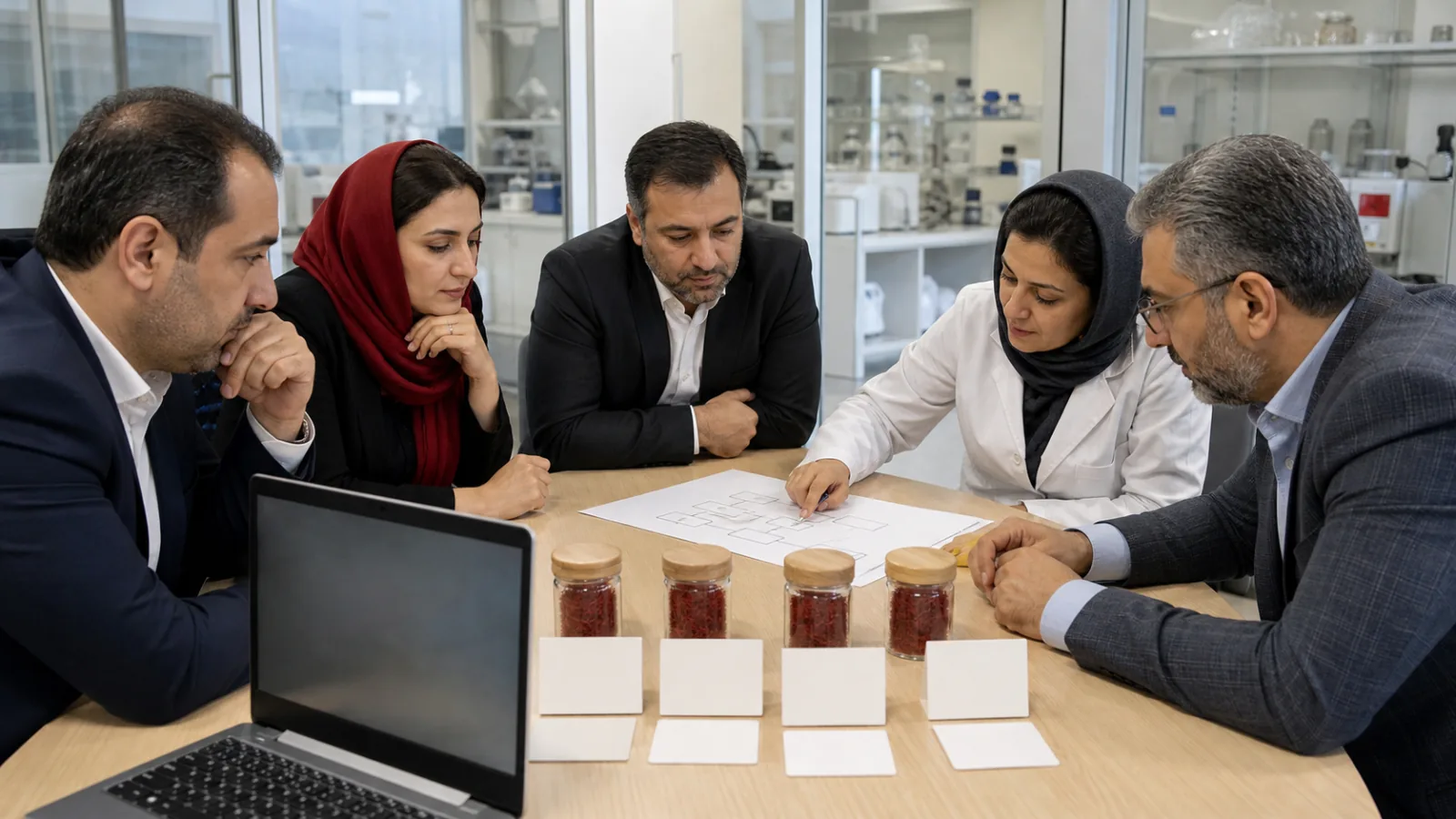
The announcement described an ambition, not a completed institution. It did not name the founding companies, publish membership rules or report results. No current operator or application route has been verified for this article, so businesses should not treat the historical statement as an active consortium invitation.
What the international saffron consortium was meant to do
Yousefi Azar presented the consortium as a way to take Iranian saffron to the world market under a recognizable identity and at a carefully assessed price. The plan belonged to Iranian year 1397, whose public theme promoted Iranian goods. Its basic concern was familiar: Iran supplied most of the raw material, while much of the final branding and customer relationship could be built elsewhere.
A consortium can help smaller or specialist companies share work that would be expensive to duplicate. Useful joint services might include destination research, trade-fair representation, translation, traceability rules, common testing protocols, logistics support and protection of a collective mark. Members can still retain their own products and customer relationships.
The original phrase “a specified price,” however, needs care. A shared method for describing grade and calculating costs is different from competing sellers agreeing what price they will charge. Competition rules vary by jurisdiction, but official U.S., U.K. and EU guidance all identify agreements among competitors to fix or stabilize prices as a serious concern. Any consortium handling sales, territories or pricing needs specialist competition-law advice before it operates.
A shared brand needs rules buyers can verify
Putting several suppliers behind one name can reduce confusion only if the name means something consistent. A consortium mark should answer practical questions: where was the saffron harvested, which thread styles qualify, how is a lot sampled, which tests are required, who audits members and what happens when a batch fails?
Without enforceable rules, one weak shipment can damage every member. With rules that are too vague or too costly, the consortium becomes a logo available only to the largest firms. The balance is a specification that protects the buyer while remaining possible for reliable growers and processors to meet.
A credible framework would normally include:
- a documented chain from grower or collection point to sealed export lot;
- agreed definitions for origin, thread style, net weight and crop year;
- sampling and laboratory methods tied to the same lot being sold;
- hygiene, packaging and storage requirements appropriate to the destination;
- independent complaint, audit and suspension procedures;
- clear rules for using the collective identity alongside each member’s brand.
Price should then reflect the member’s own grade, service, costs and contract terms. Uniform quality language makes offers easier to compare; it should not erase lawful price competition.
Why saffron international marketing needs more than promotion
A campaign can introduce Iranian saffron to new buyers, but promotion cannot repair an inconsistent shipment. International buyers usually need repeatable specifications, compliant documentation, dependable delivery and someone who will answer a problem after the sale.
FAO’s recent work with Iran places authenticity and traceability at the centre of the value chain. Its 2025 programme also covers post-harvest handling, safety, modern marketing and digital branding. That order matters. A strong market identity begins with a product whose origin and quality can be demonstrated, then communicates that evidence in language the customer understands.
A consortium could also collect useful, non-sensitive market intelligence: package sizes requested by food-service buyers, recurring documentation failures, seasonal freight constraints or demand for pre-measured formats. Members should obtain legal guidance before sharing current or future prices, bids, customers, production quotas or other competitively sensitive information.
How exchange trading fitted the historical plan
Yousefi Azar also referred to spot saffron trading on the agricultural commodity exchange. Exchange trading and an export consortium solve different problems. A warehouse receipt or exchange contract can make a standardized stored lot easier to trade and can improve price visibility. A consortium can develop the market identity, service and distribution around products sold to overseas customers.
Neither guarantees a “world price.” Saffron is sold in different thread styles, test categories, package sizes and contract conditions. A visible exchange price may provide a reference for one specified commodity, while an export quote still needs to account for processing, packaging, documentation, finance, freight and the seller’s service.
The separate plan for 14 medicinal plants
The original report then moves from saffron to a wider rural-employment programme. It says 14 nationally selected medicinal plants had been mapped across their value chains and that projects would seek about 450 billion tomans in government employment finance. Proposed work covered cultivation, harvesting, processing, market support, exports and processing plants.
Those figures belong to the same 2018 policy period. They are not a current funding notice, and the article does not identify the 14 plants or show how the 450-billion-toman requirement was calculated. The useful principle is that finance should follow an entire value chain rather than pay only for more planting.
A crop project can create sustainable rural work only when processing capacity and buyers are ready for the harvest. Otherwise, additional acreage may leave growers competing to sell the same perishable material. Each proposal needs its own demand evidence, operating budget, skills plan and route to market.
How to assess a consortium before joining
A company considering any saffron consortium should ask for the legal entity, current directors, member list, audited rules, fees, services, trademark ownership and evidence of completed sales. It should understand whether participation is exclusive, who owns customer data, how contracts are allocated and whether the company remains free to price and sell independently.
The same scrutiny applies to a proposed investment project. Our guide to evaluating foreign investment in Iranian saffron projects explains how a defined customer, pilot evidence, regulatory pathway and ownership terms turn a broad idea into a testable proposition.
The historical consortium proposal identified a real need: Iranian saffron benefits when origin, quality and service remain visible beyond the bulk sale. The durable answer is not one slogan or one coordinated price. It is a trustworthy shared standard, independently run businesses and a market promise that every member can consistently keep.
Sources
- The historical statement by Peyman Yousefi Azar reproduced in the original version of this post.
- Iranian Agriculture News Agency: Yousefi Azar on saffron marketing and medicinal-plant value chains.
- FAO: quality integrity, traceability and marketing in Iran’s saffron value chain.
- U.S. Federal Trade Commission: price-fixing guidance (jurisdiction-specific example; not Iranian legal advice).
- U.K. Competition and Markets Authority: collaborating with other businesses (jurisdiction-specific example).

![Exporting Saffron to Turkey + Price Guide [Complete 0 to 100]](https://img.rowhanisaffron.com/20260827003933/saffron-export-turkey-quality-inspection.webp)



